American Football has been described as ‘a game of inches’ such is the fine margin between victory and defeat. This years Vuelta may yet be decided on the seconds that have ebbed and flowed from Alberto Contador’s lead during the second week of the race. Contador took over the leaders jersey from the somewhat battered Nairo Quintana following the stage 10 individual time trial. Quintana, who lost enough time to fall out of the top ten altogether, crashed heavily enough to wreck his bike and reinforced the theory that 2014 is not a good year to be a race favourite in a grand tour. The Movistar rider was gone the following day (with echoes of Chris Froome’s depatrure from the Tour) following a in peloton accident early in the stage that added broken bones to the broken bike Quintana had suffered the day before. For a rider who only seems to have one facial expression to call on, Quintana showed emotion as it became clear he would need to abandon, although it was incongruous that he appeared to be grinning maniacally at the time.
Right rider, wrong jersey – Can Contador keep Red?
So Contador took the lead and the questions now surrounded his form and fitness following his ill fated Tour. The suggestion that he had been sandbagging about his chances in the Vuelta, perhaps even returning earlier that reported to riding are superfluous as long as he is able to hold on to the race lead. The difficulty for the Tinkoff Saxo team leader is more so that he has not been able to make the most of the opportunities to put time into his key (remaining) rivals; Alejandro Valverde, Joaquim Rodriguez and the aforementioned Froome. On more than one occasion during the last week Contador has attacked but he hasn’t been able to sustain long enough to break anyone. Is this a question of his fitness? Perhaps, but you can’t help feeling that Contador is lacking in the team stakes here. In particular, VCSE thinks that Contador would not be quite so isolated at the death of each stage if Mick Rogers or Nico Roche were around. Rogers, of course, has already got two grand tours under his belt this year and the Sky bound Roche is at the Tour of Britain. Compare and contrast the Tinkoff squad with Movistar, Sky or Katusha and it’s clear that Contador’s rivals have at least one or two trusted lieutenants (if not genuine contenders) in their line ups.
Writing this ahead of today’s stage (16) it feels like a disaster would have to befall Contador for him to lose the lead ahead of the final rest day, but the fact remains that his lead is a narrow one with three riders all capable of winning within two minutes of his jersey. Chris Froome has struggled at times, most obviously in the TT where he is one of the few GC riders who can genuinely put pressure on Tony Martin. The typically dizzying ramps of the Vuelta have upset him as he is not able to maintain the steady cadence that forms that basis of how Sky (still) ride most of the time. Froome has shown real determination though and every time he has looked dead and buried he’s managed to get back to and sometimes even in front of Contador. If he can remain within striking distance of Contador, Valverde and Rodriguez after today’s stage he’s got to be good for the podium, if not challenging for the win that Sky need so desperately to salvage their season. Rodriguez has been a bit of surprise package in week two and shares the same time as Froome on GC. He hasn’t looked like the best of the four at any time though and it’s hard to see him standing on the top step next weekend. Valverde has to be the main threat to Contador, in second place currently and less than a minute behind. There’s been much talk of Valverde needing to take a pay cut next season due to budget restrictions at Movistar. If he could take the Vuelta it would strengthen his hand considerably and in Quintana’s absence he has (and more importantly his teammates) the motivation to go for the win. The risk for the Spanish triumvirate is that game playing of the sort they indulged in yesterdays stage to Lagos de Covadonga will allow Froome to sneak through and take the prize from them. Sky looked at the formidable best when the delivered Froome to the foot of the climb on stage 14 and they need to be able to do this again in the final week if he’s really going to be in with a chance of victory.
What we haven’t seen much of yet is the GC guys going outright for stage wins (unlike Quintana at the Giro and Vincenzo Nibali at the Tour). Nibali’s Astana teammate and 2014 Giro revelation Fabio Aru has already claimed one stage win, That along with a likely top ten (if not top five) placing is probably already job done for the Italian. Lampre have some consolation that they have been unable to defend Chris Horner’s title from last year with a second stage win. It’s an indication that Horner would at least have had strong support, even if the idea of repeating his 2013 success seemed as unlikely as last years win was at the same stage a year ago.
Dan Martin survived an off road excursion yesterday to maintain his solid top ten performance. After his Giro debacle and missing the Tour, the Vuelta is the Garmin riders opportunity to salvage his season and potentially restablish himself as a GC contender in the eyes of team boss Jonathan Vaughters. Martin has gone for the win on a couple of stages and while these attacks haven’t delivered the result consistent high stage placings translate to (currently) 7th on GC, that could have been higher save for yesterdays crash. Garmin do have a stage win to their name though, thanks to a determined ride from Ryder Hesjedal on stage 14. Hesjedal crawled over ramps that the he had no business doing so and as the road finally began to level off overhauled his final breakaway companion to take the win.
With Nacer Bouhanni’s exit, John Degenkolb should be a shoe in for the points jersey. He’s still two short of his tally of five race wins in the 2012 Vuelta but Michael Matthews may yet spring a surprise. Both riders are better equipped than most sprinters to get over the climbs and it may come down to who is less fatigued next Sunday.
Brilliant timing from your correspondent means that this Vuelta preview is nothing if not topical. Today it was announced by his Lampre Merida team that 2013 Vuelta champion Chris Horner would not be starting this years edition. Withdrawn due to rules surrounding his cortisol values (he has been suffering from bronchitis), Horner’s non-start caps what has been a pretty awful year for the rider following a serious accident while on a training ride earlier this year. Of course this begs the question; could Horner have defended his title in 2014. The answer is probably no, but it’s terrible news for rider and team as neither have made much of mark this season.
Vuelta a Espana 2013 – who’s going to win this year?
A huge factor effecting a possible Horner title defence in this years race stems from the appearance of a number of riders who under different circumstances would not even have considered riding in Spain. First we have the ‘re-match’ between two protagonists who were meant to duke it out in this years Tour de France. Chris Froome and Alberto Contador both crashed out of the Tour (Froome on the ‘Roubaix’ stage, Contador in the Vosges) fairly early on and while it was clear early on that Froome would attempt to salvage his season at the Vuelta, Contador has had to battle back to fitness from his own accident that occurred later in the same race. It will be interesting to see how Froome goes at the Vuelta. He has good form at the race, finishing second in 2011 where many people thought he could have won if given his head earlier in the race where he had to ride for Bradley Wiggins (the source of some of the enmity between the two riders). After riding for Wiggins at the Tour in 2012, Froome was given outright team leadership duties for the first time in that year’s Vuelta, but struggled with fatigue and against a resurgent Contador who was returning from his clenbuturol ban. Can Froome go one better than 2011? It’s certainly possible. Sky need something from the final grand tour of the year after abject performances at the Giro and Tour and Froome hasn’t added much to his palmares in 2014 other than early season wins in Oman and the Tour de Romandie. If 2014 isn’t going to turn into Sky’s ‘worst ever’ season then Froome will have to do nothing short of winning this years Vuelta. Under different circumstances it’s hard to imagine the team placing that much importance on the race (Sergio Henao as team leader in 2013 ring a bell?). Certainly since their maiden Tour victory with Wiggins it’s been clear that Sky’s focus is Tour centered and even if Froome goes well in Spain this year it’s unlikely that his team will put as much into next years race. There’s potentially more pressure on Froome to deliver as a result and his form and fitness will surely be a deciding factor as much as the route and the competition from other riders in the peloton. Nevertheless, VCSE still picks Froome as one of the favourites for the GC in 2014.
For the other rider crashing out of this years Tour Alberto Contador the pressure is lower. The fact that he will manage to make the start line is an achievement in itself and expectations will be lower for the Tinkoff Saxo team leader. Contador’s team had an outstanding Tour considering the loss of their principal rider with stage wins and the emergence of Rafal Majka as a big star (and KOM). This doesn’t mean that Contador will line up just to make up the numbers at the Vuelta, but if he isn’t in contention for the GC, there is a lot less riding on the race for Tinkoff than for Sky. As with Froome, the key thing will be Contador’s fitness; has the rider recovered sufficiently from the knee injury he sustained in July? If he has and can rediscover the form he showed earlier this year Contador will be locked on for at least a podium, if not the outright win.
There’s another factor in this years GC line up that may reduce Froome and Contador to be fighting over the left overs. 2014 Giro d’Italia champion Nairo Quintana will race this years Vuelta and could be the rider best placed to take victory. Last years Giro winner Vincenzo Nibali was unable to do the ‘double’ fading on the penultimate stage and it will be interesting to see how Quintana manages this year (form and fitness again a question mark?). The Colombian has been almost invisible since his maiden grand tour success so it’s not easy to assess his condition for the Vuelta but a Quintana in the same form as the one who rode the Giro ought to be a favourite for victory here, but for one fly in the ointment in the shape of Alejandro Valverde. Valverde never really threatened the lead at the Tour and faded badly in the final week. It’s hard to imagine Movistar denying him a place in their Vuelta team, but of the riders mentioned so far Valverde would have to be the least likely GC winner and it seems perverse to include Quintana and Valverde in the same squad as this inevitably divides finite resources. This leads to speculation around who leads the team. VCSE’s view is that Valverde is the wrong horse to back for the GC, the teams future is Quintana and the older rider can do more damage to Movistar’s GC rivals by attacking on key stages to tire out the likes of Froome and Contador. Whether or not this comes to pass remains to be seen but Quintana (with the caveats already mentioned) would be the VCSE tip for the win this year.
Among the other contenders is another rider looking to salvage their season. Purito Rodriguez like Chris Horner is suffering from an early season crash and hasn’t really got back into shape since the spring. It’s unlikely that his fortunes will change here. He looked out of sorts at the Tour and it’s really too soon afterwards to imagine him having much more than an outside chance of a podium. There’s further Colombian interest in Rigoberto Uran and Carlos Betancur for Omega Pharma Quick Step and AG2R respectively. Uran will top ten for sure, but there’s the normal composite feel to the OPQS squad and the relative lack of support will most likely deny him a podium. Betancur is altogether harder to predict. After his breakthrough win in this years Paris Nice he’s proved to be something of an enigma, missing the Tour and even ‘disappearing’ at one point. Betancur was poor in last years Vuelta after a decent showing at the Giro. It’s difficult to say how he will run this year, but suspicion has to be that he won’t trouble the top five. Belkin bring a strong team to the Vuelta and should be looking for at least a top ten finish from Wilco Kelderman. With Robert Gesink and Laurens Ten Dam in the squad it’s possible that the team prize will head Belkin’s way with all three riders capable of finishing high on the GC. Astana bring another Giro surprise package in the form of Fabio Aru. Aru has plenty of potential, but it would take a special performance to break into the top five here. Trek could be looking to pinch the leaders jersey on the opening stage team time trial with a strong outfit that includes Fabian Cancellara. MTN Qhubeka have finally secured a grand tour wild card and it will be good to see the African outfit at this year’s Vuelta. Recently announcing a tie up with Cervelo for next year it’s more likely that we’ll see their jersey in the break, but Gerald Ciolek could feature if he can get away towards the end of some of the rolling stages.
Outside the GC the sprinters and points battle should be interesting. Peter Sagan, finally confirmed as a Tinkoff Saxo rider next year, will have his swansong with Cannondale. Sagan faces off against 2014 Giro points winner Nacer Bouhanni, another rider switching teams next year (from FDJ to Cofidis). Giant can pick from any number of strong sprinters in their roster and John Degenkolb should be their go to guy for the flat stages. However, Giant have also selected a bit of a composite team with double stage winner from last years race Warren Barguil in the team also. Barguil has a bit more support this year, but now he’s something of a known quantity it will be interesting to see how he goes. The likelihood is that this years target is a high GC placing rather than outright stage wins, which responsibility will probably fall to Degenkolb who went three better than Barguil in 2012.
The 20th Commonwealth Games was bookended by its track and road cycling events. With a different mix of events included in comparison to the Olympics there wasn’t quite the same slew of medals seen at London 2012, but that also had a lot to do with the current state of GB track cycling. London was the last hurrah for the riders who had carried the success of the track programme on the shoulders since the beginning of the last decade. Sir Chris Hoy who would see the track events take place in his eponymously named velodrome had originally planned to retire at the games. Victoria Pendleton retired immediately after the London games and was a media presence at the games this time while her sometime nemesis Anna Meares continues to dominate the women’s sprint.
Venue for 2014 Commonwealth Games – The Sir Chris Hoy Velodrome
Part of the decline in British track cycling’s fortunes since London are put down to the four year Olympic cycle that sees the principal riders of the track team peak in line with that event. In other words; forget about the results now and look forward to Rio. So far the fall off in results doesn’t appear to be having an impact on the popularity of the event. Track meets featuring the medal winners from London like Jason Kenny, Laura Trott and Joanna Rowsell are assured to be a sell out, even if the crowd don’t always get the result they want. The cheers for the household names are always the loudest, irrespective of the outcome in their particular event.
The decline has been most keenly felt in the men’s sprint. Hoy had been replaced by the younger Kenny in London, but since he took the Olympic gold his results have been patchy. Physically smaller than Hoy, Kenny wins his races with bike handling and guile more so than outright power, but he’s often struggled to make the final in meets in the last year. He took Silver in Glasgow, losing here to the New Zealand rider Sam Webster. One half of track cycling’s ‘golden couple’ Kenny’s girlfriend Laura Trott took her own Commonwealth gold in the points race, narrowly beating Elinor Barker. In contrast to the emotions shown by some of the home nations medal winners across the Glasgow games Trott had been embroiled in a bit of a social media spat ahead of the games by appearing to downplay the status of the event in comparison to the Olympics. Trott failed to say she had been outright misquoted in the Daily Mail interview, but she didn’t have quite the same profile at these games and seemed happy enough when she thought she had missed out on the winners medal in the immediate aftermath of the points race.
The women’s team pursuit where Trott had won the first of her Olympic golds with teammates Roswell and Dani King was missing in Glasgow. The dominant rider of the trio, Rowsell took the individual gold in a display that cements why she’s the current world champion in the event also.
One of the successful elements of the track programme (the whole games in fact) was the integration of the paralympic events within the schedule. Scotland’s Craig MacLean took two golds with Neil Fachie in the tandem events after returning to the track. MacLean had been one the very early successes of the GB track programme and his return makes you wonder of Hoy could do something similar in Rio. The likelihood is not, but there’s surely some merit in the MacLean model allowing further integration of paralympic sport as well as the prospect of raisin para sports profile yet further. It’s hard to mention MacLean as a rider returning in search of former glories without mentioning Bradley Wiggins having another tilt on the track. Wiggins returned to anchor the men’s team pursuit squad. Working with the team for barely a week before the games Wiggins seemed happy with a silver medal. As with the sprint the benchmark for success is gold in Rio in two years time. Wiggins is also extremely realistic about what can be achieved, he was similarly sanguine about his silver medal in last years world championship time trial defeat to Tony Martin.
Wiggins missed the individual time trial and road race in Glasgow and offered some thinly veiled thoughts on his road racing future in a wide ranging interview the day after the team pursuit. Describing the road scene as “..very political” he confirmed that he no longer expected to lead a team in a grand tour. Out of contract with Sky at the end of this season this admission would appear to limit where Wiggins could go next year, if indeed he does continue to race on the road. He’s been announced as a late call up to Sunday’s Ride London event, an indicator of the fact the Wiggins is box office as far as race organisers (if not Sky) are concerned. With Mark Cavendish choosing to pull out of the race as he continues to recover from his injury sustained at this years Tour it’s possible that Cavendish’s appearance money has been redirected in Wiggins direction.
Back to Wiggins plans for next year, the choice seems to be remaining with Sky on the basis that they will be more likely to accommodate his track plans or to do a (likely) very lucrative one year programme with another team who will bank on his marketability. This could open up any number of teams. With Jens Voigt retiring Trek might see the benefit of providing Wiggins with a birth to defend his Tour of California title and he could be a useful counterpoint to Fabian Cancellara in the classics. VCSE has mentioned BMC in the past, but that seems as unlikely as a move to Orica Greenedge who definitely wouldn’t be supportive of Wiggins building up to the track in Rio where Australia will also be targeting medals. Garmin, or whoever Garmin become next season when they hook up with Cannondale as a bike supplier might still be an option but as things stand it’s entirely possible that Wiggins will stay with Sky or even walk away from road cycling altogether. Wiggins retains the capacity to surprise us and whatever he ends up doing it may well be something that no one predicted!
As the 2014 Tour de France entered its final week and the second of three days in the Pyrenees the GC looked increasingly nailed on for Vincenzo Nibali. By the time the next two stages had been completed his victory was all but assured and most people’s attention shifted to the competition for the podium places being contested by three French riders for the first time in 30 years. But first to the Shark of Messina, Nibali who dealt with the man who was arguably his last remaining rival by appearing to not focus on him at all. Movistar tried any number of combinations to provide Alejandro Valverde with the platform to take time back from Nibali, if not take an unlikely lead. Nibali, supposedly hamstrung by a weaker team in many pre-race assessments actually rode similarly to Chris Froome last year, able to look after himself when the stage entered the final act.
Vincenzo Nibali TDF 2014 winner
There is a clear stylistic difference between the two riders, but the way Nibali disposes of his rivals by putting on short, powerful bursts of acceleration is no different to Froome. The Sky riders exaggerated pedal stroke is more obvious than Nibali’s digs but the end result is the same. On stage 17, won by KOM winner Rafal Majka Nibali did what was necessary to maintain his advantage but on the following day he destroyed any lingering chances of the yellow jersey going elsewhere this year.
Nibali won the stage to the top of the Hautacam by more than a minute from Thibaut Pinot. Inextricably linked with doping the margin of victory on the climb led to a louder chorus of questions for the Maillot Jaune. Whatever anyone thinks of Nibali’s performance it’s worth noting that his time up the Hautacam was only good enough to make the top 30 of all time climbs of the peak. Some have argued that his time may well have been slower as the stage also had to cross the Tourmalet, but from the VCSE viewpoint the significance of the time gap owed more to the absence of the aforementioned Froome and (of course) Alberto Contador.
Nibali’s winning margin when the race entered Paris was nearly 8 minutes, but he gained much of his lead on the cobbles of stage 5 where one of the pre-race favourites crashed out and the other lost time. It was also lost on many that Nibali gained yet more time on the penultimate stage time trial when most cameras were focusing on the battle for second and third between Pinot and Jean Christophe Peraud. The attack, if it can be described as such (surely just better race craft) on stage 5 is the most obvious example, but throughout the race Nibali took maximum advantage from the chances that were presented to him. When these chances happened towards the end of a stage, as with the end of stage 2 in Sheffield, Nibali grabbed the win while others seemed to wedded to their own game plan to capitalise.
The doping questions have been less strident this year, although the presence of Alexander Vinokourov managing Nibali’s Astana squad meant that some saw no smoke without fire. Nibali seemed to deal with the questions in a dignified way, although it’s also true that doping questions in general tend to emerge from English speaking journalists so it’s always possible some things got lost in translation. If the assumption is that Froome’s 2013 win was clean, then there’s no reason why Nibali’s victory should be viewed any differently. Of the riders starting this years Tour Nibali, Contador and Froome are a class above and in the absence of the latter two surely it’s not that surprising that Nibali emerged as the winner?
Nibali’s victory, for all of the peaks of his stage wins was understated and classy and that’s typical of the rider. The fact that Nibali is already talking about returning to the Giro next year demonstrates his appreciation for the history of the sport. Of course, a cynic might say that in doing the Giro in 2015 Nibali will avoid a match up with 2014 Giro winner Nairo Quintana, not forgetting the likely return of Froome and / or Contador. The likelihood of Quintana and Nibali meeting for a GC contest next season is unlikely if the Scilian doesn’t defend his Tour title. The question of who is currently the greatest grand tour rider will have to wait a while longer.
30 years of hurt.. Over?
You wait 30 years for one French rider to get a Tour de France podium and then two come along. In our last post we had speculated whether AG2R could get a rider on the podium after Roman Bardet had lost his young riders jersey and third place to Thibaut Pinot on stage 16. With a time trial to follow the final mountain stages it seemed likely that Bardet would be the rider to lose out with the AG2R team, but as Alejandro Valverde’s hopes of a podium went a stage too far in the Pyrenees the French teams found themselves scrapping for second and third with two podium places on offer.
Peraud was often Nibali’s shadow in the mountains and that alone should dispel some of the speculation about whether or not Nibali is clean. Peraud the ex mountain biker is 37 and it’s hard to see his second place as anything other than a career high watermark. This isn’t to diminish his performance; Peraud finished ahead of stage race winners like BMC’s Tejay Van Gardaren as well as Valverde, Pinot and Bardet. Peraud leapfrogged Pinot as expected during the TT, but the FDJ rider was consoled by his own place on the podium as well as the young riders jersey.
The absence of Froome and Contador looms over this French renaissance however. It’s hard to see how the dual podium for Pinot and Peraud could have been acheived if Froome and Contador had been present. It’s more likely that a top ten result would have been possible, indeed this is where Pinot saw himself within the 2014 Tour contenders: “..no better than 5th to 8th”. The payoff for French cycling is a likely increase in interest and participation with the sport itself able to reflect that this is what a clean(er) race looks like.
The biggest story of the week had to be Chris Froome’s abandon on the ‘Paris Roubaix’ stage on Wednesday. Froome had crashed heavily the previous day as the Tour returned to home shores. Running at the front on what should have been a comparatively easy day for the GC contenders, Froome touched a wheel and was down. The crash seemed fairly innocuous at the time; hardly anyone else was effected and Froome sprang up pretty quickly to get back on his bike. He spent a lot of time with the on course doctor however and there was speculation that he might have fractured his wrist. Although this was dispelled by the team following x-rays it was subsequently revealed on Friday long after his exit that he had in fact sustained two fractures (revealed by an MRI scan).
Can I win the Tour? – Vincenzo Nibali
The chances are that Froome would have wanted to start the next day whether he was in acute pain or not. As much as he (and to be fair Sky) has lost support in some sections as a result of Bradley Wiggins non selection for this years race, Froome was undoubtably extremely motivated to defend his title. He had already shown his appetite by his performances during the opening two stages and the look on his face when he shook his head in response to the mechanic who asked if he could continue after his second crash on stage 5 spoke volumes. Sky pretty much admitted that they had their concerns about Froome when they committed some of the squad to protect Richie Porte, their ‘Plan B’, during the stage and the teams efforts looked divided from the moment that the erstwhile leader had his first crash of the day.
While a number of riders, both in and out of this years race, team managers and other interested observers opined that cobbles had no place on the Tour, the facts are that only one rider abandoned on stage 5; Froome. Sections of the Paris Roubaix course have been included in previous Tours but this stage had the misfortune to be run in pretty awful weather, unlike the last few years of the actual race that has enjoyed dry and sunny conditions in April. With the unexpectedly huge crowds that lined the route in the UK causing a few spills combined with the slippery nature of the weather effected stages since the race has returned to France this years Tour has had its fair share of abandons and retains quite a few walking (or should that be riding?) wounded.
While Chris Froome faltered Vincenzo Nibali has prospered. The Astana rider enjoyed almost the polar opposite of fortunes on stage 5 finishing 3rd on the stage and pulling out over a minutes lead on his nearest GC rival. The easy assumption when the route of this years Tour was announced was that the GC contenders would view stage 5 as one to be endured and hopefully completed without too many mishaps. There wasn’t a slew of articles trumpeting Nibali (or anyone else) as the GC rider most likely to do something on the stage. The cliche that Nibali is a ‘great descender’ is almost a bit of a joke these days, but like a number of riders in the peloton, he is an ex mountain biker and on that basis is less fazed by sketchy conditions. After springing a surprise to take stage 2 in Sheffield (what were the odds for that one?) it almost feels as if Nibali has taken advantage of the fact that no one really tapped him as a serious contender for this years race. His first win this year had been just a week before the Tour at the Italian nationals, but in seven stages of the Tour he has taken the Maillot Jaune, a stage win and a podium.
Contador’s confusion
The question of whether of not Nibali can hold onto the lead is not quite as clear writing this ahead of the first stage (8) that involves some serious climbing. Wrapping up the opening stages we suggested that Nibali could hold on to the jersey if he didn’t suffer any mishaps on stage 5 (done!). However, we further speculated whether Nibali’s stage 2 win was just a bit of opportunism, scraps from the table of the forthcoming Froome / Contador match up. The next three days in the Vosges should provide some if not all of the answers as to if this is a serious tilt at the GC by Nibali. He has looked good so far, but to win the race from stage 2, to hold the lead for that length of time, is something that hasn’t been done since 1961 with Jacques Anquetil.
Alberto Contador appears to be a man in confusion at the moment. He started the Tour with the strategy he had employed during the Dauphine; marking Froome. Now that Froome is absent, Contador seems bereft of ideas, thrown by the prospect of combating a rider with a completely different riding style. Contador had a torrid time of the cobbles too, losing nearly 3 minutes to Nibali. Although Contador has lost a key domestique (to concussion on stage 6) riders like Nico Roche and Mick Rogers are in great form and it’s going to be really interesting to see how the two teams Astana and Tinkoff Saxo and their respective team leaders trade punches over the next few days. When you examine the facts, Contador has enjoyed a fantastic year so far and Tinkoff look like a very well drilled outfit. Nibali and Astana in comparison have had a tough time and the team have been rife with bitching between the Italian and Kazakh components. The sense is that Contador needs to get his head right as Nibali may just have rediscovered his will to win.
Sagan consistent but winless
Quote of the day was from the rider missing from this years race who speculated if Peter Sagan was “..receiving instructions over his team radio or just Metallica at full blast”. Sagan has been there or there abouts on every stage so far and it’s pretty hard to see anyone else claiming the points jersey from him. A third win in this competition in as many years is obviously some achievement, but the stage win tally is falling. Missing out on the victory by inches yesterday hurt much more than the placings gained while sprinting against Marcel Kittel. Sagan will continue to have a go, but he’s another rider who looks a little short on confidence at the moment despite the jersey he’s wearing.
Marcel Kittel enters every sprint stage knowing that they are his to lose. Mark Cavendish’s accident and subsequent abandonment of this years Tour has denied the Giant Shimano rider of his most potent competitor. VCSE’s view is the in the bare knuckle environment of the last kilometre of a bunch sprint Kittel currently is just about impossible to beat and for all the work Cavendish has done this year to counter the Kittel threat, he has been undone himself by riders that a year or two ago would have been in his wheel tracks.
Kittel can be beaten. Andre Greipel won his obligatory stage win the day before yesterday after Kittel and his teammates had been exhausted by the cross winds that effected stage 6. Similarly Kittel wasn’t always a feature in last years race for the same reasons. For him though, he has already achieved the first part of the important Tour double; yellow after stage one. It’s pretty difficult to imagine that he will fail in his quest for the second; a consecutive victory on the Champs Elysee.
After spoiling ourselves last year with two weeks in France and four stages the assumption was that this years live and direct interaction with the Grand Boucle would feel like something of an anti-climax. This year has also been a bit of let down in terms of miles on the bike for various reasons, but a recent window of opportunity meant that VCSE would be joining some regular riding buddies and heading out to catch a glimpse of Monday’s stage from Cambridge to London.
Who knew a flat straight road could be this interesting? – Tour de France 2014
Your correspondent had been minded to pour a fair amount of cold water on the expectations when plans were being laid to go and see the peloton as it rode through Essex. The parcour was (relatively speaking) pan flat, the riders would flash past in a blur and it might feel like something of a let down for those that were used to 360 degree television coverage. Then we bemoaned the health and safety culture of the UK that would mean that roads would be closed at 6.00am, far earlier than in France.
Even after seeing the huge turnout in Yorkshire for the Grand Depart VCSE was sceptical that there would be that many stood at the side of the road save for the very local population and die-hard cyclsts and fans. Of course we didn’t need to leave before 9.00 to get a good spot. VCSE’s biggest fear was would there be any food served at the pub near where we were due to watch the race.
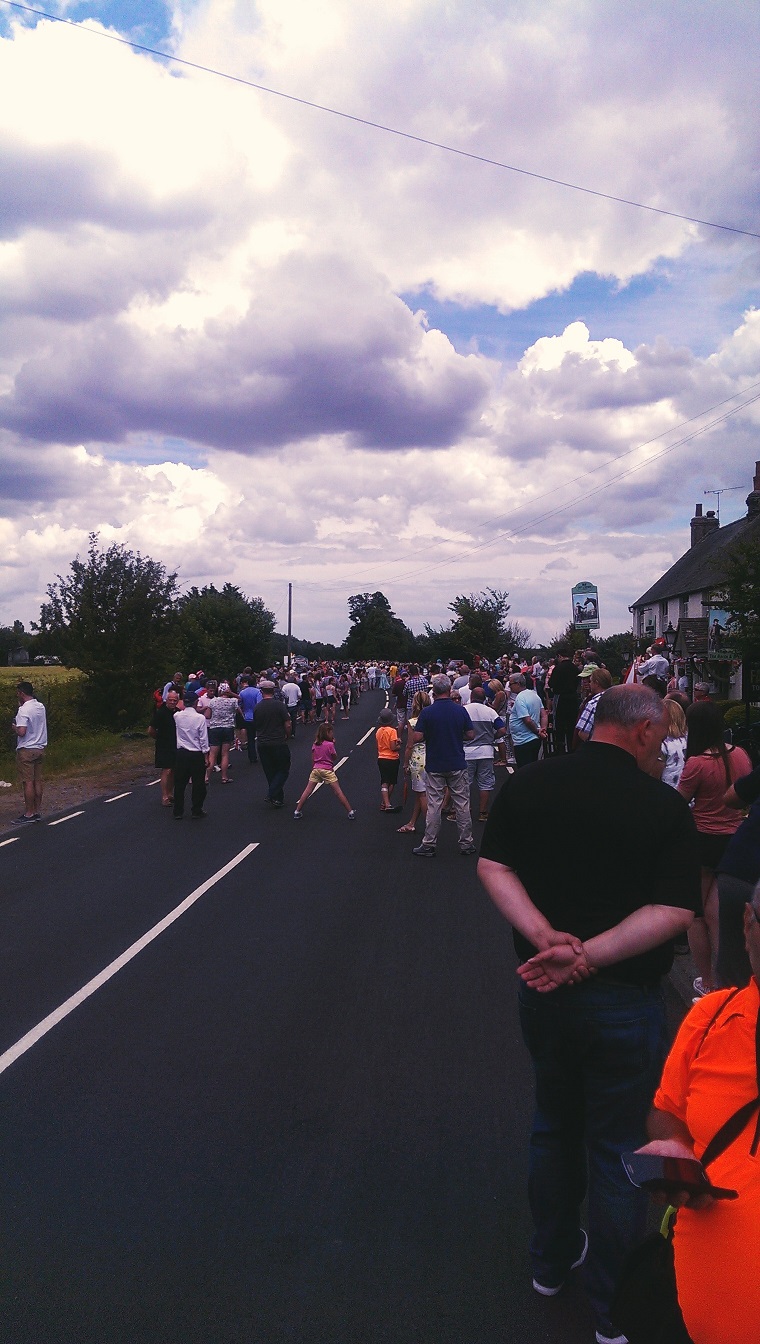
Threading our way through the back lanes from Southend to the outskirts of Chelmsford we encountered other riders, sometimes singularly or in pairs or bigger groups. The only indication that something was happening as we reached the road the stage would pass over was a few cars parked on the raised verge and then (suddenly) there was the Road Closed sign and the inevitable flourescent tabard wearing stewards. Just as suddenly it was clear that the Tour was capturing the imagination in Essex as much as it had in Yorkshire at the weekend. In either direction both sides of the road was sown with spectators. In the time-honoured tradition of stoically waiting for something to happen (otherwise known as queuing) were small groups of fans with picnics and fold up chairs. The occupants of one house had brought the furniture from the conservatory to the roadside to watch proceedings in comfort.
Ahead of the race VCSE had spoken to people who were booked up for some homespun hospitality experience in pubs that enjoyed a position alongside the route. The pub near our chosen vantage point had a mixture of corporate guests whose VIP experience may have been slightly marred by the fact that they were on the direct route to the gents toilet and had to endure a steady precession of MAMIL’s walking in and out. There was a three deep crush at the bar and a roaring trade in bacon rolls for those of us who were managing with more prosaic catering. By the time we were fed, watered and were done with interrupting the corporate guests the pavements had filled further with more and more walk and ride ups. Overheard conversations revealed that this wasn’t an exclusively Essex crowd, just as last years stage finish in Montpellier had been leavened with a fair few Brits who had made their way inland from the beaches of the south of France. There were a couple of Danish fans and a surprising number from Australia. On the opposite side of the road was a group entirely decked out on orange polo shirts who had obviously been there for a while based on the car that was yielding a steady supply of food and drink. Belkin fans? Apparently no, according to the disappointed Dutchman who had wandered down to engage them in conversation.
Conversation turned to where the race had reached so far, before we realised that it hadn’t even left Cambridge yet. There had been a reasonably steady flow of official cars coming through and in an increase in volume signified the arrival of the promo caravan. After our experience last year VCSE anticipated the possibility of adding to our collection of hats and key rings, although this was leavened with the likelihood that the caravan would be moving a bit quicker on Essex A roads than the 300 metre mark on a stage finish. This was confirmed as the caravan started to come past; the four point safety harnesses that the ‘Tat Chuckers’ wear looked absolutely essential as the cars weaved around at 50 mph. For all the marketing advantages of a float shaped like an oversized Fruit Shoot bottle these things are not designed to corner. As the drivers kept their palms permanently on the horn we were ‘treated’ to the odd trinket thrown to us. French betting chain PMU (sponsors of the points competition) clearly felt that there was zero benefit from promoting their brand in England and the caravan felt a bit threadbare and Anglicised as a result. Oven chip purveyors McCain’s got a big cheer (this was the case in Yorkshire too apparently) as they climbed towards us. What looked like a matchbook turned out to be herb seeds and VCSE supposes there wasn’t much point in tossing us potato seeds if you want us to buy more frozen chips. The scarcity of freebies had everyone that cared scrabbling for the few crumbs that were thrown, but anyone who had expected a typical Tour de France tat fest would have felt a little disappointed.
And so we waited for the main event. Tour Tracker gave up just past Saffron Walden so we were reduced to speculation on the arrival of the peloton that ranged from the well-informed (“..about 2.13pm”) to the ‘haven’t a clue’ (“Wiggins is in the lead and just outside Chelmsford”). The VCSE predictions of stage 3 being the least supported stage had been thoroughly rubbished as fans began to spill off the kerbs and into the road. As the Tour outriders began to come through pint clutching spectators casually leaned back a bit to allow them to pass. Everything was good natured though, the British Police motorcyclists were too busy high fiving anyone that stuck a hand out to have one. The Gendarmes took a somewhat different view, perhaps with a sense that it wasn’t a case of if an accident with a spectator would happen but when.
The arrival overhead of the helicopters heralded the approach of the break. The two riders who had been away from pretty much kilometre one (and weren’t all that far from the end of the stage when the ‘catch’ took place) must have felt a bit nonplussed to be riding through crowds on a stage that (if held in some boggo department in France) would attract the occasional glance from a farmer in his field. Not so much your ’15 minutes of fame’, but your 150km’s perhaps?
That the peloton came through our vantage point in a little more than two minutes if you include the team cars probably isn’t the point. We had got a taste of what it feels like to be part of something that happens rarely, if not once in a lifetime with the Olympics in 2012. There was a sense that all of us would be able to remember when the 2014 Tour de France came through Essex on its way to London and say “I was there”. Some of us will no doubt get our next taste of fan participation somewhere in France next time, but that was planned. Maybe a few more, now that they have had a taste, will be inspired to join us over there. The unscientific vox pop that took place in the immediate aftermath hinted that those who had experienced a bike race up close and personal for the first time wanted to do it again and it does look like the success of this years Grand Depart will lead to a swifter return to these shores than the eight years that preceded this UK visit. This could also see more towns and regions seeking involvement in the Tour of Britain and while we bathe in the afterglow of the Yorkshire Grand Depart it’s possible to imagine the ToB extending to ten days or maybe even two weeks. Those of us that follow the sport week in week out were disappointed that there were less Brit riders starting this Tour than in 1968 and casual fans alike rue the non-appearance of Bradley Wiggins and the early exit of Mark Cavendish. And yet the spectacle hasn’t suffered, because in so many ways the spectacle has been the crowds. Whatever the outcome in the race itself it felt good to be a (very small) part of it yesterday.
While putting the Tour preview to bed this morning VCSE was missing the developing story on social media that two more British riders were being omitted from their respective Tour teams. David Millar, apparently inked in last week was binned after what his team determined to be a sub par performance at the British road nationals. Alex Dowsett was withdrawn due to what was described as ‘breathing problems’. At the time of writing there doesn’t appear to be any more to the Movistar riders withdrawal (Alex hasn’t commented) and it must be gutting for him after missing out on the Olympics in 2012 due to a broken leg.
Down and out of the Tour – David Millar (pic copyright James Start)
Movistar had obviously seen the benefits of including the Essex based rider when they announced their line up, especially as stage 3 would cover some of the roads that Dowsett trains on week in week out. As popular as riders like Mark Cavendish are (ironically another Essex roads rider) Dowsett would be have been guaranteed lots of support on his home roads.
The Millar scenario is different and has a whiff of Wiggins about it, although for entirely different reasons. Millar was the marquee rider on the Garmin team when they first joined the (now) world tour and won a stage at the Tour as recently as 2012. Long since cast in the role of domestique / sage Millar announced at the end of last season that 2014 would be his final year and he has made a number of valedictory appearances in races this year.
It was always unlikely that Millar would trouble the GC if he raced the Tour but the sheer bloody mindedness of the rider suggested that he would identify one or two stages to ‘go hard or go home’ in search of a breakaway stage win. He didn’t feature in yesterdays GB national road race and withdrew from his arguably stronger event, the TT, last week in an effort to be fit for the Tour. Millar had outed himself as part of the Tour team by accident a couple of weeks earlier when he tweeted that he was ‘packed’ for the Tour and was painfully prescient when he suggested that a lack of contact from his Garmin colleagues last night could signify that he had lost his Tour place. Whether or not his deselection has “killed” his relationship with his team remains to be seen, but it evidences that Garmin want to make a serious tilt at the Tour rather than allow Millar a sentimental journey.
Garmin had a disastrous start to the Giro earlier this year losing team leader Dan Martin before the first stage was even over. It’s entirely possible that there’s a commercial imperative for the team to put in a stronger showing at the Tour. The emphasis is on the team here. Ryder Hesjedal was able to put in a decent showing pretty much unsupported at the Giro. Millar could have delivered views of the Garmin jersey on television similarly, if by a slighty different route to Hesjedal but maybe the team and the sponsor want more. Maybe the 2014 Tour is all about the team delivering a result, even if ultimately it will be an individual (in this case Andrew Talansky) who takes the plaudits.
If that was the case though why wait until five days before the Tour starts to decide. Would Millar really have been such a deadweight to the team, particularly as the toughest stages are back ended on this years route? Burying bad news about another British crowd favourite not taking part in the Yorkshire Grand Depart is pretty difficult at a time when even the mainstream media start to take a proper interest in the sport.
With the emergence of a British team that has been incredibly successful on the world stage, two Tour wins and two huge hauls of Olympic gold medals since the last time the Tour visited the UK it seems perverse that there will only be three British riders at the start this weekend (and one of those flies under a flag of convenience). It’s likely that the organisers, ASO and the team in Yorkshire, didn’t think anything else could go wrong after Bradley Wiggins omission by Sky, but the absence of Millar in particular is the nasty tasting icing on that rather inedible cake.
This time a year ago the talk was not so much of who would win the Tour but the margin of victory. With the exception of Tirreno Adriatico Chris Froome had been victorious in everything he had entered and he was the firm favourite ahead of the opening stages in Corsica. This year the pre-race chatter has been dominated by the will they, won’t they (non) selection of Bradley Wiggins for Sky’s Tour team.
In yellow again this year? – Alberto Contador
In some ways this has been a welcome distraction for Froome as his season to date has been punctuated by injury, illness and being found wanting by some of his chief rivals for the GC this year, most recently Alberto Contador in the Criterium du Dauphine. As defending champion and undisputed leader of the Sky team Froome is of course among the favourites for the 101st edition of the Tour. The key here is that he is merely among the favourites, rather than being the outstanding candidate to take the general classification. Sky’s domination of the race in recent years does allow this rivals to remain somewhere below the radar however. Contador, who gave the impression of a rider clinging on by his fingernails in last years race has looked back to his best this year, showing his best form when he has wanted to demonstrate his superiority of a rival like he did to Alejandro Valverde at this years Pais Vasco.
Contador looks most likely to break the Sky hold over the GC, but there are other riders waiting in the wings who may yet cause an upset on the way. The aforementioned Valverde has looked other worldly at times, particularly in the early season. It’s hard to imagine that the Spaniard will be any more than a podium contender though. If Movistar had wanted to win this year they should have picked Nairo Quintana, last years runner up and this years Giro victor. Last years Giro winner Vicenzo Nibali should arguably have been the man cast in Contador’s role this year. Utterly dominant in the 2013 Giro and Tirreno Adriatico (where he crucially had the beating of Froome) Nibali began to fray around the edges at the Vuelta and he hasn’t looked anywhere near his 2013 best this season. Nibali was often a thorn in Sky’s side at the 2012 Tour though and he has the ability to hurt the GC riders in the mountain stages. A podium is a possibility, but VCSE suspects that a stage win or two may prove to be the goal for the Astana leader.
In Quintana’s absence the young guns should be well represented by US pairing Tejay van Garderen and Andrew Talansky. BMC struggled last year trying to accomodate two leaders in Cadel Evans and van Garderen. Evans’ absence this year should help Tejay but he would have to be an outside bet for a podium place. A top ten is more likely. Talansky’s Garmin team have demonstrated their mastery of in race tactics, particularly when targeting a stage win as with Dan Martin in the Pyrenees last year. Talansky was in the right place at the right time in the Dauphine when he stole the race lead from Contador on the last stage to win the overall. He’s a stronger candidate for the podium than van Garderen but once again a top 10 feels more likely. This is Talansky’s opportunity to improve on his result from last years Tour and to become the rider around who future Garmin Tour efforts are built now that Martin’s year has been disrupted by injury.
Aside of the main contenders Joaquim Rodriguez was a fairly late addition for the Tour after his plans for the Giro were upset by injury in the Ardennes. Rodriguez took a stealthy podium last year but it’s harder to see him repeating that result 12 months later. Belkin, in the form of Bauke Mollema and Laurens Ten Dam were a bit of surprise package last year. The Dutch outfit have the motivation (if not pressure) of the announcement that their team sponsor are withdrawing at the end of this season and Mollema has looked in good form in recent weeks. Again it’s an unlikely podium, but with the teams sponsor difficulties a headline grabbing stage win could be the target for the either rider.
World champion Rui Costa was successful with stage wins last year but his goal this year will be a stronger showing on GC. He’s managed a win in the rainbow stripes this season which deals with any superstitious fears that may have existed for the rider about the supposed ‘curse’ but it’s unlikely he will be looking to repeat wins in 2014. France demands at least one stage win in the race it gave to the world. Last year we had a long wait for Christophe Riblon to come good for AG2R. VCSE offers the following names to look out for at this years Tour for GC contention and / or a stage win; Roman Bardet (AG2R) and Kevin Reza (Europcar).
With the loss of Vacansoleil and the elevation of Europcar to the world tour it’s meant that we have a bit more variety in the wildcard invitations this year. Anglo-German Net App Endura have a decent shout of a top 10 with Leopold Konig after the teams ‘dry run’ at last years Vuelta. IAM cycling were in contention for the overall at the Tour de Suisse and will bring a strong squad to the Tour with previous stage winners in Chavanel and Haussler. Stage wins may well be the target for the team, but they have riders that could prove to be contenders on GC also.
So who will actually win? Putting aside the fact the Froome is hard to like because of the Wiggins non-selection he remains the rider most likely to win this years Tour, albeit with more caveats than last year. Contador looks super strong and if Valverde and Nibali both bring their A game the Sky rider will face more assaults than he did a year ago. Also Froome’s most trusted helper Richie Porte is struggling for form and it remains to be seen if Mikel Nieve can establish a similar bond with his leader. Sky have assembled a very experienced unit with a good mix of riders who can shepherd Froome through the tricky stages like Arenberg as well as the type of stage that saw him cut adrift by cross winds last year. This is Contador’s best chance of a repeat Tour victory, but he has lost a key helper in Roman Kreuziger due to bio passport irregularities just days ahead of the grand depart. Will this upset the Tinkoff Saxo applecart? Unlikely, but anything that chips away at Contador’s confidence will be to Froome’s benefit. Every GC rider faces the difficult stages in Yorkshire and on the Roubaix cobbles and this could lead to some riders going out of contention before the peloton reaches the Vosges for the start of the climbing proper.
Mark Cavendish will have another go at claiming the maillot jaune for the first time in his career. Cavendish could place some of the blame for missing out on yellow on last years first stage on the Orica team bus getting stuck at the finish line, but as the race went on it became clear that he’s no longer the man to beat in sprint stages. Marcel Kittel may have ‘stolen’ Cav’s jersey on that first stage in Corsica but by beating the Omega Pharma Quick Step rider in Paris it looked as if the crown and sceptre for the king of the fast men was going to the younger man. Even if Cavendish wasn’t targeting the win into his Mum’s home town of Harrogate on Saturday he can rely on a partisan UK crowd and the media to make it ‘his’ goal. In some ways there’s more pressure on Cavendish to win this stage than their will be to beat Kittel on the Champs Elysee in three weeks time. Both riders have reconnoitered the opening stages and while Kittel may respect his rival he won’t be sentimental about handing the win to Cavendish. Much as VCSE would like to see Cavendish take yellow it seems more likely that Kittel will take the lions share of the stage wins and will lead the GC into the second stage.
Can he wear yellow? – Mark Cavendish
Peter Sagan only managed a single stage victory at last years Tour but should see a third straight win in the points competition. Sagan could target a victory as early as stage 2 which has been described as a Yorkshire version of Liege Bastogne Liege. He will also be among the favourites for the stage that takes in part of the Paris Roubaix cobbled route on stage 5. Sagan could have a rival this year in Orica’s Simon Gerrans, a rider in good form who while unable to match Sagan in a sprint is as least as good if not better over the climbs.
Andre Greipel is reduced to playing second, if not third fiddle to Cavendish and Kittel these days and will need some kind of mishap to befall the leading riders to be in with a chance of stage win at this years Tour. FDJ’s Arnaud Demare has won the internal battle to become lead rider and could be another outside bet for a win, but is more likely to contest stage podiums.
KOM is harder to predict this year. It’s possible that we might see a repeat of 2012 where the rider in the break secures the points and the jersey and this seems more likely than a repeat of last year where Quintana took a sweep of the KOM and young riders jerseys on his way to second place.
Key stages of the 2014 Tour de France
Armchair fans can watch the race live on ITV4 and British Eurosport again this year. Who you choose may depend on your choice of television provider but it’s a shame that Eurosport won’t repeat their pairing of Rob Hatch and Sean Kelly like they did at the Giro. Hatch seemed to get the best out of Kelly and their commentary is preferable to the prospect of Carlton Kirby in the lead chair. Kirby is as eccentric as Phil Liggett is predictable but ITV4 will probably win out thanks to a stronger presentation team in Gary Imlach and Chris Boardman outweighing Liggetts spoonerisms.
With a UK grand depart it’s also a lot easier to go and see the race in person although the peloton will disappear in a bit of flash on the flat stage 3 into London. The fan parks in Yorkshire and London may be better places to watch the action before heading to the finish line to see the final sprints.
Stages 1 thru’ 3 – Leeds to Harrogate, York to Sheffield, Cambridge to London Sat, Sun, Mon 5,6,7th July
The UK based stages will be worth a watch to see if Mark Cavendish can claim his first ever yellow jersey on stage 1 and to see if there are any early GC casualties on the challenging stage 2 that has 9 catergorised climbs.
Stage 5 – Ypres to Arenberg Porte du Hainaut Weds 9th July
The stage that takes in 15 kilometres of the Paris Roubaix cobbles is otherwise a flat, transitional stage. GC riders will be looking to stay out of trouble and it’s likely to be a chance for the rouleurs from each team to grab some glory with a stage win.
Stage 10 – Mulhouse to La Planche des Belles Filles Mon 14th July
The summit finish where Froome won the stage in 2012 and Wiggins took the maillot jaune revisits in 2014 after a testing stage the previous day where the Tour takes in the first cat 1 climb of the race and the highest peak in the Vosges the Grand Ballon. Stage 10 has three other cat 1 climbs besides the Belle Filles along with a pair of cat 2 and a single cat 3 climb over its 162kms.
Stage 14 – Grenoble to Risoul Sat 19th July
The toughest day the peloton will face in the Alps this year. The stage includes the Col d’Izoard one of the most iconic climbs that the Tour uses and home to some of its most dramatic scenery. The stage has a cat 1 summit finish at Risoul
Stage 17 – St Gaudens to St Lary Pla D’Adet Weds 23rd July
Three cat 1 climbs including the Peyresourde before finishing with a HC summit finish of just over 10km at slightly more than 8%. It’s the shortest stage outside of the TT stages but should be a tough one.
Stage 18 – Pau to Hautacam Thurs 24th July
The final day of climbing in this years Tour takes in the famed climbs of the Tourmalet and finishing atop the Hautacam. Both climbs are HC and account for roughly 20% of the stages entire distance. If the GC isn’t decided by now it’s still possible that the TT on Saturday could provide a final shake up.
Stage 19 – Bergerac to Perigueux Sat 26th July
The penultimate stage has the potential to be a TT that’s actually worth watching live or merely be the icing on the GC cake for the holder of the maillot jaune. If there are still small time gaps between the leading contenders then riders will be looking over the shoulders as the strong testers take back time on them. If Froome is leading at this point, this stage is likely to increase the gap. If it’s Contador he will have to hope that he has built up enough of a cushion in the Pyrenees.
Just as night follows day the winning the Dauphine has become part of the landscape for Sky on their way to winning the Tour a few weeks later. In 2012 it was Bradley Wiggins and a year later Chris Froome. For Froome victory would have been a strong indication of his form ahead of his July target, his race programme for 2014 had been extremely low key so far, although both times he had raced he had won the GC (Oman and Romandie). Backed by a team of domestiques deluxe who would make anyone’s Tour team Froome would be facing off against some of his key rivals for the yellow jersey when the Tour gets underway in Yorkshire and a few pretenders who would be troubling the top ten. Alberto Contador was looking back to his best form of 18 months ago when he captured the Vuelta and Vicenzo Nibali, who while not enjoying the same kind of results would be seen as threat to the Sky rider.
“Your name’s not down, you’re not coming in” Wiggins and Froome
Froome has a teflon like ability to rise above the ‘noise’ that follows the Tour de France champion although he could not avoid the fact that he was a big part of the story ahead of the race. Following the serialisation of his book in the Sunday Times (ghost written by ST journalist David Walsh) which had cherry picked the chapters that focused on the Froome / Wiggins ‘relationship’ (and lack there of), Wiggins had popped up on radio and TV to announce that he wouldn’t be riding the Tour. In itself this was a juicy narrative for the rotters of the press and social media to get stuck into (VCSE pleads guilty; see the previous post). The will he, won’t he selection of Wiggins for the Sky Tour roster was merely an apertif though. First, we had Froome looking vulnerable and falling out of the GC lead he had establish in the stage 1 prologue and then we had a rather messy spat between sections of the (French) press and Sky over a TUE.
For the casual follower of the sport a TUE can be explained as a ‘sick note’ that excuses the rider for using a banned substance if it is necessary to treat a particular condition. So far, so reasonable but TUE’s have a very murky past. It was a false and post dated TUE that Lance Armstrong used to explain the prescence of cortisoids in the ’99 Tour. Ironically and certainly unfortunately for Froome it was the same variety of banned substance that got him into hot water at the Dauphine.
After crossing the line ahead of Contador on stage 2 Froome was given an inhaler. No attempt was made to conceal its use and this is an important point. Sky handled the following furore with the typical cack handedness they display when the aren’t in control of the story (or indeed a race) and this certainly didn’t help the situation. Over the course of the week it emerged that Froome had previously stated he didn’t suffer from asthma, the reason given for the use of the inhaler and some commentators took things off on a tangent suggesting that Sky and their rider were somehow being ‘protected’ by the UCI. Perhaps the most damming criticism came from Walsh who had spent the previous year embedded with the team as well as writing the Froome tome. Walsh felt that Sky were backtracking significantly from the standards they had set for themselves at the team’s inception, that they wouldn’t race a rider that needed a TUE.
Things are so toxic because of Armstrong and the TUE use cannot help but remind people of cycling’s dark recent past. Sky’s whole reason for existence stems from a desire to race and win clean and the story of Froome’s inhaler shouldn’t be seen as history repeating. Much of the reason for this is what subsequently happened at the Dauphine. Over the final two stages of the race Froome lost his place and the leaders yellow jersey to Contador on Saturday and on the final day fell out of the top ten altogether.
Contador, point proven perhaps, lost the lead himself on stage 8 to Garmin’s Andrew Talansky an emotional victor hinting that Garmin may seek to do more than just go for stage wins at the Tour. Besides the collapse of their team leader Sky have a further headache in the loss of form that Richie Porte is going through. Porte has suffered a string of bad luck and non finishes since switching from Paris Nice to Tirreno Adriatico early on in the season. He will go to the Tour but it seems more likely that Froome will be reliant on Euskatel Mikel Nieve as his last man standing. Whether or not Froome will click with Nieve the way he does with Porte remains to be seen and Sky’s jangling nerves won’t have been soothed by Contador’s results with what was pretty much a Tinkoff Saxo B team supporting him.
Another rider dusting himself off after a poor week was Nibali who didn’t look like troubling the podium from the prologue onwards. There are a lot of noises off around Astana at the moment with Nibali and the Italian contingent seemingly at odds with the Kazakh management. It maybe too early for a parting of the ways, but it will take some of the bloody mindedness that Nibali displayed at the 2012 Tour in the face of Sky dominance for him to deliver another podium place in July.
Another young rider emerging with credit was Belkin’s Wilco Kelderman. With Belkin announcing that they are leaving the sport less than a year after coming Kelderman’s fourth place could prove timely. The team may yet survive as bike supplier Bianchi are keen to remain, but this will dependent on finding a title sponsor and results so far this year have been patchy at best. Orica’s Adam Yates delivered another strong finish in sixth, but will probably find himself squeezed into the top 20 or so, assuming the Aussies select him for the Tour. It’s possible they might be teeing up Simon Gerrans for a tilt at the points jersey if he can get over the climbs better than Peter Sagan this year and the Cannondale rider is squeezed out of the sprints by the three way battle between Cavendish, Kittel and Griepel.
Tour de Suisse 2014
The question for fans of Britain’s cycling knight ahead of the Tour de Suisse was would Bradley Wiggins use the race as an opportunity to stick a metaphorical finger up at Team Sky’s management in general and Chris Froome and Dave Brailsford in particular. Having announced that as far as he was concerned that he wouldn’t be part of Froome’s back up at the Tour a win in Switzerland seemed like the perfect risposte to the apparent snub delivered to the 2012 Tour de France winner. That Wiggins chose not to get on the pace, finishing more than 30 seconds down on the opening stage prologue, before losing more time on the subsequent stage and withdrawing from the race early is typical, although not for the reasons some would think.
Wiggins is goal driven and after riding Paris Roubaix and winning the Tour of California his stated aim was ride (in support of Froome) at the Tour. Having summised that he would be surplus to requirements in July Wiggins would not have felt the motivation to demonstrate his form in Switzerland while Froome rode in the Dauphine. The difference between the driven, target in mind Wiggins and the rider whose heart just isn’t in it is palpable and Wiggins was probably grateful in some strange way that the accident he was caught up in while loitering at the back of the peloton provided a platform for him to bow out early.
Some might say that Wiggins was doing the equivlent of taking his ball and going home and there is perhaps something in this. Now it’s clear that Wiggins never wanted to race the Giro last year it does go some way to explain his poor results and showing in the run up to that race. Wiggins may have felt that he deserved inclusion in the Tour team based on (delete as applicable) being a previous Tour winner and with the race starting in Yorkshire, but this ignores the fact that he merits inclusion based on form alone if you look at how he dominated the Tour of California.
The leader for much of the week was Omega Pharma’s Tony Martin who managed to hold on to the leaders jersey right up until the closing kilometres of the final stage. Martin had clung on through two mountain stages without much in the way of riders to support him; OPQS using the race to drill the Cavendish lead out train further ahead of the Tour. Martin took the lead after winning the prologue and cemented things further later in the week with victory in the TT also. He was eventually undone by world champion Rui Costa who is enjoying a better year than his predecessor in the rainbow stripes Philippe Gilbert.
Martin, lacking support, was powerless to stop a large break going away on the final stage that included Costa and he was able to distance his remaining companions in the break to claim victory over Belkin’s Bauke Mollema and IAM’s Mathias Frank who made out the overall podium as well.
With the Tour starting a week on Monday there’s a bit of a hiatus as the teams announce their shortlists and in some cases actual Tour line ups. We’re still waiting for the final Sky group but it seems likely that Wiggins won’t be a part of it with the rider announced as part of the England team for the Commenwealth Games. The party line remains that Wiggins will only be confirmed in terms of actual events if and when he isn’t selected for the Tour by Sky, but with the resurfacing of the fissure between him and Froome and the TUE controversy it seems more likely that Dave Brailsford will not wish to unsettle Froome further by including Wiggins in the squad.
Lets get this out of the way now; if Chris Froome doesn’t win the 2014 Tour de France VCSE will not be too bothered. This doesn’t mean that Froome won’t win in July. His performance during the coming week at the Criterium du Dauphine will be a good indictator of his form against two of his chief rivals Alberto Contador and Vincenzo Nibali.
No, what’s got the VCSE Froome voodoo doll out of its box is the omission of ‘teammate’ Bradley Wiggins from Sky’s Tour team and all the signs suggest that Froome is the architect of Wiggins non selection.
Thinking how much he hates Wiggins – Chris Froome
So why is this a problem? The relationship between the two has been well documented here and elsewhere and it’s hardly a secret that the two aren’t best of friends. But surely the selection of the Tour team should be based on form and on this basis alone it’s staggering that Wiggins hasn’t been picked. There hasn’t been much comment from Sky officially since Wiggins appeared to breakfast TV last week and announced he was “gutted” that he wasn’t doing the Tour despite being (in his view) “..in the form I was two years ago” when he won the 2012 Tour and the Olympic TT gold medal.
There was much speculation ahead of Wiggins announcement that he wouldn’t be at the Grand Depart in Yorkshire and VCSE predicted as much in the aftermath of his overall victory at the Tour of California. Much of the justification given for a potential Wiggins omission ahead of the riders confirmation that he wouldn’t be riding was based on Froome’s need for riders around him that would work for him. So far, so reasonable, but since the start of the year Wiggins has been clear that if selected he would ride for a Froome victory. Wiggins has been incredibly consistent about this and if we take his statements at face value he’s showed an incredible amount of humility for someone who dominated the race as recently as two years ago. In any other team, in current form, he would be an undisputed leader.
However this is not any other team and Dave Brailsford has painted himself into a corner with Froome. It’s fair to say that of the two riders Froome is perhaps by a small margin the better rider. The way he rode on the second Pyrenean stage in last years Tour demonstrated just what a talented rider he is, holding onto to the race lead in the face of concerted attacks from other teams and with no teammates left in support. But this is less about who is the stronger rider or the most likely to deliver a third Tour victory in a row for Sky, than what would be the best team. The way Wiggins destroyed the peloton by riding on the front alone and at pace on the Mount Diablo climb in the Tour of California would have made most people say (you would think) he should be in the Tour squad. After the debacle of the first half of 2013 Wiggins has won two week long stage races, been in contention for Paris Roubaix and dominated TT’s. Within weeks of finishing in the top ten and Paris Roubaix he had shed kilos to get into the kind of physical condition he was in at his best in 2012.
None of this seems to matter to Froome and Brailsford though. The suggestion is that Froome doesn’t want Wiggins in the Tour squad whatever his condition and despite the potential advantage that the 2012 winner could provide. It appears that Froome’s ‘issues’ with Wiggins goes back further from his short lived ‘rebellion’ at the 2012 Tour where he rode away from Wiggins in a demonstration of superiority on the climbs. The dislike apparently stems from a supposed lack of support from Wiggins to Froome when he was in danger of losing his place on Sky during the 2011 Vuelta. Ironically this proved to be Froome’s breakthrough race and some argue that he could have taken the overall if he had been allowed to ride, rather than support Wiggins who eventually finished third to Froome’s second place finish.
Froome then doesn’t forget a slight, perceived or real and it would seem from this point on Wiggins was in his sights and has been ever since. Whether or not this was (or is) reasonable behaviour requires better knowledge of what went on in that Spanish hotel room during that race. Wiggins is acknowledged as not the easiest person to get along with but as the undisputed figurehead of the Sky team (at the time) it might be suggested that those around him needed to adapt to his behaviour and not the other way around. It would be interesting to imagine history taking a divergent course at the end of 2012 where Wiggins was prepared to maintain the training regime that had brought such success and go for a follow up Tour win in 2013. Instead Wiggins was shunted to an ill fated attempt on the Giro after privately making clear to Sky that he couldn’t make the same sacrifices required to deliver a Tour win.
This was Wiggins downfall and where Froome fills the mould that Dave Brailsford looks for in a grand tour rider to back. For all of the jokes about ‘Chris Froome looking at stems’ it’s his metronomic approach that makes Froome the better fit for Brailsford in the Sky set up. No doubt Sky still recognise that Wiggins has the kind of reach (particularly in Britain) that Froome can currently only dream of. As personable as Froome can be on camera, it’s unlikely that people will be hanging on his every word. He will parrot the party line where Wiggins can go off message in way that would frustrate Brailsford but delight fans. There’s unlikely to be that much of a backlash against Sky when the Tour gets underway in Yorkshire. The team are pretty much ‘Team GB’ by proxy in the UK, but in a World Cup year and with Commonwealth Games competing for the back pages in addition to the rest of the summer sport Wiggins absence will not help the profile of the Tour. It speaks volumes for the arch pragmatism of Brailsford that he will put the (potential) result ahead of any marketing consideration.
This a relatively uninformed viewpoint on the whole Wiggins / Froome saga and VCSE is firmly in Team Wiggo. Reliant on the public statements of each rider the reality of the situation can be judged as much on what Wiggins has said and the absence of anything from Froome on the matter. Probably wisely he’s keeping schtum on a argument he won’t easily win. He’s also hamstrung by the fact that it’s very hard to find a classy way of saying he just doesn’t like Wiggins. If you’re inclined to take Wiggins statements at face value it does seem odd that Froome could argue that Wiggins shouldn’t be included on form or that he wouldn’t honestly fulfil a designated support role.
Wiggins will now, barring any accidents for Froome in the Dauphine (oh the irony if that happens!), concentrate on the Commonwealth Games and may ride the track as well as the road. It will be interesting to watch Wiggins in the Tour de Suisse and see if he uses it as an opportunity to stick the metaphorical finger to Froome and Brailsford.
So what now for Sky’s cycling knight. There’s already speculation about Wiggins going to Orica Green Edge and he has admitted he hasn’t got an offer from Sky for 2015. Orica’s free wheeling and relaxed (in comparison to Sky) atmosphere would probably suit. There are other possible destinations; a return to Garmin would tie in with Wiggins apparent desire to build his profile in the US but VCSE wouldn’t rule out a possible move to BMC if Cadel Evans hangs up his cleats at the end of this year.




 Velo Club Sud Eglise