No Sky.. No comment – VCSE’s Racing Digest #24

Paris Nice wrap up

If you’re one of the occasional readers of this blog you might be forgiven for thinking VCSE is a bit of a Team Sky fanboy. Certainly the team behind the Death Star crop up pretty often in these pages but that’s as much to do with the teams poor showing in one day races rather than the way they impose (or attempt to) themselves on stage races. Since the teams ‘difficult’ birth in 2010 where results didn’t match the hype and expectations Sky have proved to be a flagship example of the thoroughness that has made British Cycling and British cycling so successful. Winners of the last two Tour de France the team have also treated some of ASO’s other headline races as a Sky benefit in the last three years. Sky have delivered the last three winners of Paris Nice, previously seen as a warm up for the classics, but from Sky’s point of view an opportunity to drill their high tempo superdomestiques for the grand tours.

Big win for Colombia  & French cycling - Carlos Betancur
Big win for Colombia & French cycling – Carlos Betancur

The last week has seen a reversal of fortune for Sky. Not yet of terminal proportions, but a reminder of the unpredictable nature of road racing and the teams inability to go to a ‘plan B’ when their strategy unravels. Richie Porte, last years Paris Nice winner, was moved into Sky’s Tirreno Adriatico line up at short notice after Chris Froome was injured. This went down like a lead balloon with the ASO and things weren’t helped by Sky’s tacit disapproval of the parcours for this years edition that did away with the final day’s TT up the Col d’Eze and featured no summit finishes. ASO shouldn’t be criticised for changing the format; most people who have seen the race this week have said they have found it more exciting. The normally monosyllabic Sean Kelly, a seven time winner of the race and known as ‘Monsieur Paris Nice’ was probably at his most animated during commentary alongside Rob Hatch. We were treated to a weeks racing where the final outcome for GC could have been decided in the last few kilometres of the race. So, ultimately the race was won by a climber, but this was a racer’s race with the contenders at the sharp end at the death each day.

Sky elevated Geraint Thomas to team leader in Porte’s absence and the Welshman did take the overall at one point during the race, only to fall out of contention after a nasty crash on the penultimate stage. By then AG2R’s Carlos Betancur had taken the yellow jersey following back to back stage wins during the week. Betancur was well looked after by a team that aren’t that familiar with trying to control a race, but it was good to see a race being controlled using old school methods like covering attacks, rather than relentless drilling on the front that seems to have become the norm with Sky. A bit of an aside here; Movistar have taken to riding on the front this year too and AG2R should be grateful for that as the Spanish team kept the breakaway riders very honest today for the final stage.

Just as it’s too early to write Sky off, it’s far too soon to talk about the curse of the rainbow jersey. World champion Rui Costa had a couple of close finishes at Paris Nice, but the disappointment of missing out on those wins was probably less painful than the crash he got caught up in on today’s final stage. He looks like a great signing for Lampre and bike sponsor Merida are making the most of him too in their new TV advert.

Assuming Thomas is still being viewed as a classics specialist then his performance in Paris Nice, at least until his crash, was pretty decent. He still doesn’t look like someone who’s about to win a big one day race, let alone a stage race but taking the lead in Paris Nice is another step forward from holding the lead for a few days in the 2013 Tour Down Under.

Betancur ends the week as the leading rider on the world tour. The ‘big’ names; Froome, Nibali etc. are nowhere to be seen at the moment, but Froome rides in the Volta a Catalunya in a weeks time and it’s hard to imagine that the table will look like this by the end of July. Despite this, Betancur’s result is a big one for him and Colombian cycling, perhaps elevating him in front of Rigoberto Uran if not Nairo Quintana for now.

It’s also a massive result for French cycling; today’s win for AG2R was the first for a French team in Paris Nice since the 1980’s. If it’s also a sign that cycling is becoming ‘cleaner’ if a French team can win Paris Nice it’s no bad thing, but for now the real winners are ASO for showing how interest can be maintained in a race if you dispense with endless summit finishes.

Tirreno Adriatico – the story so far

If the parcours for Tirreno Adriatico suited Richie Porte more than that on offer at Paris Nice we will never know as he pulled out of the event after Saturday’s stage. Porte never really looked like he was in contention this week and if he really was suffering from a virus it might explain his feeble digs on the climbs this week.

The early part of the race belonged to Omega Pharma. With Tony Martin and Mark Cavendish in the line up, the world TTT champions took the leaders jersey after stage one with Cavendish eventually surrendering it to teammate Michael Kwiatowski. The Pole is in great form after a win at Strade Bianche and considering the mix in the OPQS squad between GC specialists like Kwiatowski and Uran and Cavendish’s lead out train the team did well to keep the lead for so long. Uran seems out of sorts at the moment, perhaps unsettled by the more established Kwiatowski’s performances so far this year.

Kwiatowski finally faltered on Sunday’s stage losing the lead to Tinkoff Saxo’s Alberto Contador who has looked stronger as the week has gone on. Contador looked like he was back to his best, teeing up his stage win and stealing the lead from Kwiatowski with an economical ride in Saturday’s stage. Ably supported by Roman Kreuziger, who also looked super strong yesterday the two teammates saw off rivals and got within a minute of Kwiatowski ahead of today’s (Sunday) stage. It’s hard to see Contador giving up the GC now with a flat stage tomorrow ahead of the final TT.

An in form Contador is good news for those of us that don’t want the grand tours to be just about when Chris Froome will take the lead this year. Let’s just say this once more; it is far too soon to write Sky off, but for those that want some drama at the head of a stage race a resurgent Alberto Contador and the continued emergence of good Colombian riders is a very good thing indeed.

Revolution series round 5 – London Velodrome

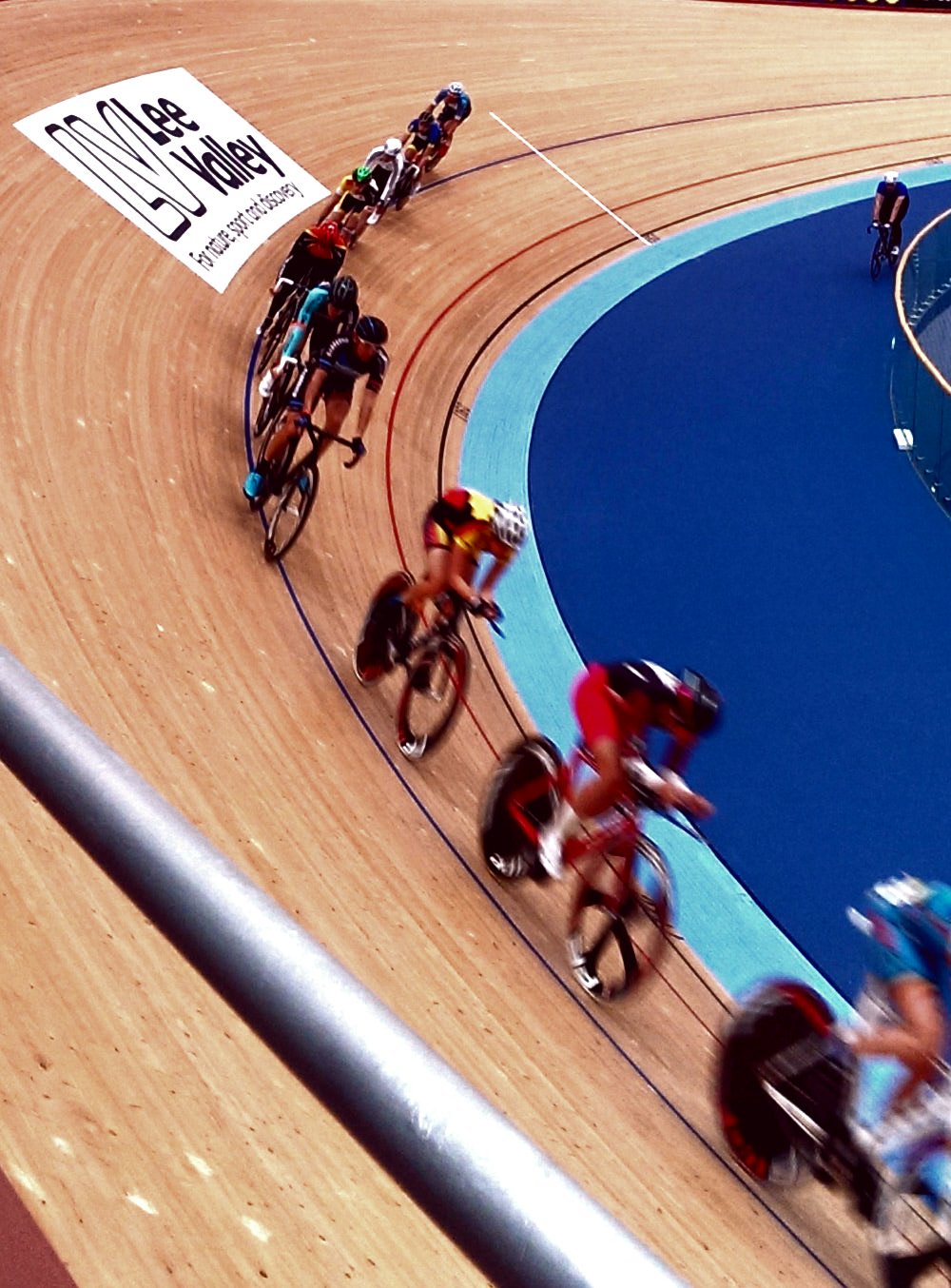
VCSE was lucky enough to attend one of the sessions at the Revolution series final round this weekend. This was the first competition to be held in the Velodrome since the Olympics and there’s was a pretty much a full house, even at the afternoon session we joined.
Revolution
Revolution

First, a bit of a confession. Track cycling doesn’t really do it for your correspondent. That’s not to say all of it, but some of the events and not necessarily the obvious ones, are a bit of a yawn. For example, where’s the excitement in watching a three lap track stand contest? That said, even up in the gods it was as interesting to watch the riders prepare and then wind down between events. Seeing Laura Trott calmly walk over and pick up a flip top bin before vomiting into it after her pursuit round is a visceral insight into what it takes to win. A semi-serious debate between track commentator Hugh Porter and the crowd (via Twitter) about why velodrome tracks always turn left mentioned the connection with the Roman chariot races. There is something gladiatorial about the track and some riders know how to involve the crowd and then exploit that to their advantage. World champion Francois Pervis was able to get the kind of reaction that belied the fact that here was a Frenchman beating a British Olympic champion in his own backyard.

Pervis was putting the hurt on Trott’s other half, Jason Kenny. You imagine that Trott is properly supportive of her boyfriend no matter how he performs, but it maybe another psychological hurdle to overcome if you’re partner is winning for fun and you’re struggling to make the final. Trott it seems is not fazed by anything, even being physically sick in front of thousands of fans and the going to sign autographs for an hour. Before the incident with the bin, Trott was able to remove her aero helmet and do a victory lap that gave no indication of what was to come.

The Olympic legacy seems alive and well with the turnout for the Revolution. The biggest cheers were always going to go for the riders that the crowd had heard of; there was surprise and a little dismay when Dani King was beaten by Katie Archibald in the pursuit. Hugh Porter whipped things up as much as a man in his seventies could do when the crowd went a little flat and eventually the men’s points race had the crowd hooked when each sprint came around.

Trott ended the event with a fantastic score of six points in the omnium, the lowest possible score being six points for six victories. There’s obviously strength in depth in British track cycling but Trott looks like someone who can become truly dominant. We’re left with a hankering to stand in the centre of the track at the Ghent six day; as exciting as the racing was from the stands with a diet coke, watching amongst the crowd with a beer sounds like the way to go!

Revolution @ London Velodrome

It’s on… racing to the sun via the two seas – VCSE’s Racing Digest #23

Sky find form in the classics.. or do they?

Ian Stannard’s victory in the Omloop Het Nieuwsblad was Sky’s first victory in a one day race for more than 12 months but does his win mean that Sky can begin to dominate in the classics? Not necessarily. For starters Sky have ‘form’ where OHN is concerned, Juan Antonio Flecha winning the race in 2010 and standing on the podium in the next two editions.

Classics breakthrough for Sky? - Ian Stannard
Classics breakthrough for Sky? – Ian Stannard

Het Nieuwsblad is one of the one day races euphemistically described as a ‘semi-classic’ and along with Kuurne Brussel Kuurne run the following day it’s the curtain raiser for the cobbled classic season in Belguim. Last year’s race was held in freezing conditions that saw the following days race (KBK) cancelled due to snow. Katusha’s Luca Paolini was the opportunistic winner who after breaking from the peloton sheltered behind the only rider who you could fit two of Paolini into: Omega Pharma’s Stijn Vandenbergh. Vandenbergh would probably accept that he’s something of a diesel as a rider and it might have been the cold that fogged his mind last February as he dragged Paolini almost to the line. The Italian who held the Maglia Rosa early on in last years Giro is a sprinter of the old school (in other words, he’s not that fast) but he wouldn’t have needed much pace to overhaul Vandenburgh.

While this years edition didn’t suffer the same climatic conditions as 2013 a similar race was developing with two riders breaking away towards the finish with marked similarities to last years protagonists. Stannard definitely falls into the diesel category. He’s the kind of rider that the average recreational rider can identify with physically and is blessed with the kind of ‘never say die’ attitude that makes you want him to hang on for the win. He was up against BMC’s Greg Van Avermaet, a five time winner in 2013 and a second line sprinter in the Paolini mode. With British fans willing Stannard on, elsewhere and in the commentary boxes the discussion centered on the likely strengths of each rider if the race was decided in a last kilometre sprint.

Whether or not Stannard remembered the fate of Vandenbergh or just recognised that he would be at a disadvantage against van Avermaet in a sprint, he didn’t wait to find out. Winding up his speed over the final kilometre Stannard just managed to hold off Van Avermaet at the line and immediately sparked a debate about whether or not Stannard’s win represented a turnaround in Sky’s fortunes in the classics.

So does it? The VCSE view remains in the ‘no’ camp (we didn’t tip a Sky win ahead of the weekend) although perhaps we’re a bit more optimistic. Sky’s infamous choice of preparing for races in the wind, rain and snow of northern Europe in the sunshine of Gran Canaria was seen by many as the prime reason for Sky’s poor showing in the classics last year but it’s more accurate that they just don’t have a marquee one day rider (or riders) in the mould of a Cancellera or a Boonen. If Stannard winning OHN proves to be the high water mark for Sky in the classics this year then he will have been the teams best one day rider for the second year after his strong showing at Milan San Remo last year. He could yet trump what is being seen by many as his breakthrough win if and when he competes in Paris Roubaix later next month. Stannard seems to rise to the occasion when the weather is at its most biblical but Paris Roubaix has the kind of parcours that he could thrive on rain or shine. It’s still hard to be convinced that Edvald Boasson Hagen that can win any kind of race anymore and Stannard and maybe Geraint Thomas apart VCSE thinks that Sky have some way to go before they can be considered in the first rank of one day teams.

Boonen’s back

Tom Boonen had a disappointing OHN but he and his Omega Pharma team were in dominant form the following day at Kuurne Brussel Kuurne. While the race features some of the fabled Flandrian bergs it’s one of the sprinters classics with Mark Cavendish winning the last race in 2012 as last years edition was lost to the weather.

We’ve become used to seeing teams dominate stages during the grand tours but the unpredictable nature of one day races tends to preclude this from happening. Yet, KBK saw Omega Pharma managing to get five riders into the break, including Boonen and this allowed them to control the race to an extent that a Boonen victory was all but assured with over 50 kilometres to go.

Boonen is running out of time to become the outright ‘greatest of all time’ if he wins at Paris Roubaix or the Tour of Flanders this year, but he achieved a less heralded milestone by winning KBK. If becoming the rider with the most victories in KBK is an omen then Boonen may yet to go on to be the star of this years classics the way that Fabian Cancellara was last season. Neither Boonen nor Cancellara is getting any younger, but the sense is that Boonen is the man running out of time. Another year on may see riders like Peter Sagan and Sep Vanmarcke take over the crown, but in 2014 the momentum seems to be with Omega Pharma and Tom Boonen.

His teams early season dominance was reinforced with a win in Strade Bianche for Michael Kwiatowski the Polish road race champion. Kwiatowski is seen as a potential grand tour winner, although this isn’t always the best thing to be in a team that already struggles to balance the competing priorities of Mark Cavendish and the classics outfit. Kwiatowski beat no less a rider than Sagan who had ridden away from the leading bunch, including Cancellara, with ease. When it came to final climb, Kwiatowski rode past Sagan like he was going backwards. It remains to be seen if his team wonder why the invested heavily in Rigoberto Uran if there was already a climber like Kwiatowski under their noses.

Sky upset the ASO applecart

With the two one day races in Italy last weekend and the start of Paris Nice and Tirreno Adriatico this week it really feels that the road race season has started. For the armchair fan there’s some juggling to be done to try and see both of the week long stage races as the events overlap from the middle of the week. Both events had compelling stories last year with Richie Porte achieving his biggest victory to date in Paris Nice and Sky’s third win in a row while Vincenzo Nibali beat Chris Froome in their only match up of the year in Italy.

The story this year at least so far is Sky’s decision to move Porte from the Paris Nice squad where he would have defended his title to replace the injured Froome at Tirreno. Froome has injured his back and while his withdrawl is being justified for greater things to come later this year it’s tempting to wonder what might happen if Sky’s main rider becomes sidelined by a persistent injury this season. Porte is earmarked for the Giro but would Sky shift him to the Tour in Froome’s absence?

In the short term Sky have upset Paris Nice (and Tour de France) organisers ASO by appearing to prioritise Tirreno over their race. Both races feature markedly different parcours to last years and Sky’s view is that Tirreno is better suited to Porte’s talents. If that is the reason, then why didn’t Sky race him there from the outset? Traditionally seen as preparation for Milan San Remo, there’s no reason why the race should be seen as essential to Froome’s Tour presentation. If anything Froome might have scored some useful psychological points over Nibali if he had raced Paris Nice like the Sicilian.

With Froome’s injury all of this is academic but it will be interesting to see just how personally ASO have taken Sky’s decision to withdraw Porte as the year goes on. Might they take a different view if there’s a repeat of Froome’s gel incident from last years Tour this year?

Valverde – pas normale?

After his dominant performance at the Ruta del Sol Alejandro Valverde continued to raise eyebrows with his performances at Strade Bianche and Roma Maxima last weekend. The Movistar rider featured in both races. Commentators referred to Valverde’s form many times over the weekend, but whether it’s credible is something else again. The fact that he was the only rider to feature as strongly in both races is undeniable. Lance Armstrong used to refer to the performances of riders he believed were using PED’s as “not normal”. Should the absence of any repentance from Valverde over previous drug bans mean that his performances will be subject to scrutiny? Well, yes and comparing and contrasting Valverde’s performance over two consecutive days and races with Boonen provides more food for thought in the ongoing debate about cycling’s credibility.

What do you do with a rider like Valverde?* – VCSE’s Racing Digest #22

Ruta del Sol 2014

The Ruta del Sol or Tour of Andalucia or Vuelta a Andalucia (depending on your preference) finished last weekend. The only ‘live’ cycling on offer to the armchair fan last week was shown perhaps less because of the race’s sixtieth anniversary than the fact that coverage was available for Eurosport. Most of the ‘smaller’ races shown on the digital channel are commentated on from a studio in London, probably not in homage to the days of Murray Walker and James Hunt sharing a microphone during the BBC’s grand prix coverage in the 70’s and 80’s, but for obvious cost reasons. Eurosport had people on the ground in on the Costa del Sol in the shape of the delightful and multilingual Laura Meseguer and it may not have been entirely unconnected that we enjoyed rather a lot of pre-stage interviews mixed in as the race unfolded.

Not everyone's favourite - Alejandro Valverde
Not everyone’s favourite – Alejandro Valverde

Any confusion over what to call the race arises in VCSE’s view from the fact that the Ruta del Sol is less a tour of Andulicia than one of those coach bound day trips marketed to pensioners in the back of local newspapers. The Ruta lasted four days with an opening prologue followed by three stages. This years Vuelta a Espana kicks off in the south so there was some interest in seeing what passes for a cat 1 climb in southern Spain. Sum up; they seem a bit easier than the ones in Galicia.

In the opening prologue it looked for a long time that Sky super domestique and automaton Vasil Kiryenka would take the win and leaders jersey. Sky had Richie Porte and Bradley Wiggins at the race and whatever their respective roles were likely to be for the rest of the week Wiggins would normally start out favourite against the clock. So it goes, and Wiggins did indeed beat Porte but he finished down on Kiryenka and Geraint Thomas. A top ten finish suggested that Wiggins was trying at least at this point. By the closing km’s of stage one it appeared that some of the demons of 2013 hadn’t been completely exorcised as he was one of the first of Sky’s train to pull out of the line on the final climb. This could (of course) be unfair; the plan for Britain’s first winner of the Tour de France has already been heavily trailed with Wiggins headed for Paris Roubaix and, perhaps, team leadership at the Vuelta. Nevertheless, knowing what we do now about how Wiggins had been reluctant to ride the Giro last year is it possible that Sky are pushing him towards races simply to earn something (anything) from their investment? In fairness to Wiggins he repaid his employers and more in winning the Tour ahead of Dave Brailsford’s five-year target and a small stage race early in the season is the wrong place to make sweeping conclusions. Wiggins remains a more compelling and complex character than the man who has usurped him as leader Chris Froome and the racing scene seems more enjoyable when Wiggins is enjoying his racing as with last years Tour of Britain.

But enough for now of the trials of one fallen hero and on to another. Alejandro Valverde was victorious in the prologue and in the next two stages. A three-time winner of the Ruta del Sol, there was still some surprise that he won the prologue. Valverde is a pretty divisive rider for reasons that can be counted off on each finger should you have enough hands and the inclination to do so. His unrepentant approach to doping historically and to quote a more recent example his apparent surrender during the worlds last year denying countryman Joaquim Rodriguez the win. With the lovely Laura on hand to interview and Rob Hatch providing a fluent translation we were treated to Valverde thanking his team and family if not his doctor at the end of each stage.

Anti doping has caught up, if not exactly caught on in Spain in recent years, although there is a sense that the relative decline of the countries sporting greats (not only in cycling) have paralleled these developments. It doesn’t feel right to be too cynical this early in the season, but it will be interesting to see if Valverde can repeat this kind of form outside Spain as the season progresses. VCSE suspects not.

Marcel Kittel was absent from the race, so Giant Shimano had to look elsewhere for a result. Tom Dumoulin came close in the prologue and in a break on the final stage. While the dutchman received no help from his compatriots on the rival (dutch) Belkin squad, he might have been better selecting one of Giant’s Propel aero frames for his breakaway. Last year Giant were bike sponsors for Belkin, although this team ran under the nom de plume Blanco until the Tour in a very similar team uniform to this years Giant Shimano outfit. Looking at Dumoulin pedalling squares as he attempted to stay clear of the peloton on stage four VCSE wondered if it was possible that Giant had saved themselves some money by recycling some of the old Blanco bikes into the Giant Shimano service course this year.

Tour of Oman 2014

It’s felt a bit like a television column as much as road racing comment so far this year. Not that this years racing has been short rationed. So far, VCSE has enjoyed the Dubai Tour as well as the Ruta del Sol live on Eurosport where last year it was highlights only from races like the Tour of Oman.

In many ways Oman is the poor relation to the other races held in the Arabian peninsula during February, although it often serves up the most interesting stages. Last year saw Chris Froome taking, what seemed inexplicable at the time, his first ever stage race victory. His performance was made more emphatic by the riders he saw off on the climb to the top of the Green Mountain; Joaquim Rodriguez and Alberto Contador. Froome was back this year to defend his title, although the field was a little less than stellar to challenge him. The viewing was a bit underdone too. Unable to get the funding to deliver live racing a half hour highlights package was served up the day after each stage accompanied by the sort of martial music that would top the charts in North Korea.

It’s disappointing that a race that offers far more than its counterparts in Dubai and Qatar cannot pull in the revenue to justify a live feed. No doubt it’s out there somewhere (Al Jazeera Sport anyone?) but this years version felt, like the Ruta del Sol above, something less than it promised.

Rain stops play

Tom Boonen
Tom Boonen

Rain might not, but snow certainly will. Last year VCSE returned from a weeks riding on the Isle of Wight ready to enjoy the first of the Belgian spring races, Kuurne Brussels Kuurne. You know how it is, avoid social media for the day and then hit the Sky Plus box with an appropriate beverage to enjoy the action. At the time the self induced social media blackout meant that the cancellation of the race due to the weather had passed us by. All that was left to do was to blame the Sky box.

Twelve months on and it’s 99.99% certain that the race will go ahead, the day after Het Nieuwsblad (which managed to run last year). The spotlight will be on Tom Boonen in his comeback year from injury in 2013 and he will turn out in both races this weekend. Last years winner Luca Paolini goes for Katusha although it’s hard to see last years cat and mouse style finish being repeated. BMC have Thor Hushovd and Greg van Avermaet and could provide tough opposition for Boonen. Also lining up in his first race since leaving Boonen’s Omega Pharma team is IAM cycling’s Sylvain Chavanel. Chavanel has a point to prove this year and another rider to look out for is Garmin’s Nick Nuyens.

Many of the same riders will turn out on Sunday with riders like Belkin’s Sep Vanmarcke elevated to team leader status. With last years hiatus the previous winner of the semi-classic was (at the time) a Sky rider, but Mark Cavendish is absent this year. Sky will be led by Edvald Boasson Hagen this year, but the Norwegian will be an outside bet if this race comes down to a sprint. The rider who showed last year that he could adapt to the shorter climbs of the cobbled classics was Andre Griepel and if it it’s in a bunch at the close on Sunday he is the VCSE favourite.

* with apologies to ‘The Sound of Music’

“That’s a bit of a turn up…” – The (inevitable) VCSE 2013 season review

Team of the Year 

When the BBC shows (what for it) is a minority sport like cycling on the annual Sports Review of the Year the coverage tends towards the lowest common denominator. The assumption is that most viewers will have a vague idea of a race around France each summer although that is possibly based on the arrogant view that if the BBC don’t cover it then people won’t find an alternative way to watch the event. In this environment there’s a certain amount of inevitability that Team Sky would be discussed (and nominated) as Team of the Year.

From a (slightly) more informed position it’s hard to imagine why Sky could be considered the team of this year, although last year’s was perhaps a reasonable choice. They retained their ability to set a tempo at the head of the peloton in stage races, up until the Giro seemingly able to impose this tactic on the supplicant opposition. Increasingly though those teams and riders who wanted to bring the fight to Sky began to find ways of overcoming the British team’s game plan. There were early hints that the Sky train could be derailed at Tirreno Adriatico when Astana and Vincenzo Nibali ganged up on Chris Froome to deny him victory for the only time in a major stage race this year. Sky didn’t have things their own way at the Tour either when it seemed like the entire peloton had decided it was payback time on Sunday’s stage in the Pyrenees. Forced to defend attacks from the outset, Sky had burnt their matches long before the days live TV coverage began.

In shorter stage races Sky had already demonstrated that if they didn’t have the strongest team they could easily fall prey to other teams (often) superior racecraft. They were even more exposed in the classics where their ‘protected’ riders couldn’t even deliver the squads best result. The criticism that followed the lack of results in one day races was fuelled by the fact that Sky had invested so much in a training program based at altitude in Tenerife rather than the ‘traditional’ preparation of early season stage races.

So if not Sky, then who? Certainly not fellow moneybags team BMC. Other than the quiet resurgence of Cadel Evans at the Giro BMC achieved little before the mid point of the season and their lacklustre performance was characterised by their attempt to back two riders at the same time in the Tour and have neither achieve. Perhaps the most significant event of BMC’s season was the shake up of their back up team with Allan Peiper taking over as race director after the Tour. The start of Peiper’s reign coincided with the team beginning to win again. A team to watch in 2014 maybe?

Vincenzo Nibali’s decision to move to Astana gave the Kazakh team the kind of marquee rider to deliver grand tours it had been lacking since Alberto Contador left. Dominant at the Giro, they were less involved at the Tour in Nibali’s absence. Reunited with ‘The Shark’ at the Vuelta the teams tactics on the penultimate stage were supposed to deliver Nibali victory on the day and the overall. Astana had riders in the break and in poor weather they had managed to stay away on the final climb to the top of the Angrilu. The strategy seemed telegraphed; as the peloton caught the break Nibali’s domestiques would be in the perfect position to support their leader as he went for the win. The script didn’t quite go as planned and the third grand tour went instead to Chris Horner riding for VCSE’s pick for the team of 2013, Radioshack.

RadioShack-Nissan - Eneco Tour 2012
Team of the Year – Radioshack (Photo credit: Wouter de Bruijn)

Horner’s squad began the year arguably as a lame duck team. The team’s association with Johan Bruyneel and Lance Armstrong hung over the 2013 outfit like a bad odour and then there was the announcement that title sponsor Radioshack would be pulling out at the end of the season. Would Fabian Cancellara have been as dominant in the classics if he had been up against a fit Tom Boonen? Academic now, but at the start of the year no one would have known that Boonen would have been struggling for form following his off season injury or that his year would have ended just as it was starting thanks to a crash in the early miles of the Ronde. The manner of Cancellara’s wins in E3 Harelbeke, the Ronde and Paris Roubaix might not have been quite so emphatic with an in form Boonen against him, but just as 2012 was the Belgian’s year so 2013 belonged to the Swiss.

Cancellara faced competition, in particular with the emergence of Peter Sagan as a real threat in the classics. At an individual level there were times when Sagan was maybe the stronger rider, but Cancellara was able to make an impact in races when it counted thanks to the tireless work of the Radioshack domestiques like Hayden Roulston who covered every attack and were never far from the front if in fact they weren’t heading the peloton.

Thanks to Cancellara then Radioshack were the team of the classics. Figuring at the grand tours was probably not part of the plan and this might have remained the case but for the intervention of the Orica Green Edge team bus on stage one of the Tour. Confusion surrounding where the stage would finish extinguished Mark Cavendish’s chances of taking the yellow jersey but left Radioshack’s Jan Bakelants in a position where he would inherit the jersey the following day in Corsica. Bakelants put Radioshack on the map at the Tour but it took the final grand tour to provide a triumphant end to the team’s season. Absent since Tirreno Adriatico where he had delivered a top five finish Chris Horner arrived at the Vuelta with a stage win on home soil as an indicator that he was coming back into form following injury.

A stage win early in week one was news enough for a rider about to celebrate his 42nd birthday but as the race progressed and Horner began to take more time out of the race leaders people began to realise he might actually win the whole thing. Once again the team leader was ably backed by his domestiques, including for part of the race Cancellara and Croatian champion Robert Kiserlovski. For many onlookers a Horner victory was not something to be celebrated and it’s fair to say doubt remains that a rider of 42 can win a three week grand tour ‘clean’. In the absence of a revelation that Horner’s victory actually was unbelievable, writing now it cements Radioshack as VCSE Team of the Year based on team and individual performances in the classics and grand tours.

Honourable mentions go to Movistar for delivering some memorable stage wins in the Giro and Tour and Orica for the irreverent custody of the maillot jaune during the first week of the Tour. Argos Shimano threaten to become the number one sprint team with Marcel Kittel and John Degenkolb. They have some of the leading young talent on their roster with double Vuelta stage winner Warren Barguil.

Rider of the Year

After dismissing Team Sky as a contender for Team of the Year it might seem contrary to pick Chris Froome as VCSE Rider of the Year. Froome deserves his place as the year’s top rider for the way he was able to surpass anything his team were able to do collectively, even when riding in support of him.

Christopher Froome at the prologue of the Tour...
Christ Froome (Photo credit: Wikipedia)

This couldn’t have been made any clearer than on stage nine of this year’s Tour. The previous day it seemed as if Sky’s rival teams and Froome’s GC opposition had run up metaphorical white flags as the British team delivered a crushing one two as the race entered the Pyrenees. With his closest rival over a minute behind Froome had taken over the Maillot Jaune and the discussion was not would he win the Tour, but how big would his winning margin be. The following day as the peloton continued to traverse the cols of the Pyrenees the script was ripped up as first Garmin and then Movistar attacked Sky from the outset. By the time live TV coverage began Froome was alone at the head of the race. In truth, the sting had probably gone out of the stage by this point. Nevertheless Froome had no option other than to cover any attempt made by Movistar to attack the race lead.

Sky recovered the composure after the rest day and Froome survived another collapse in his teams inability to deal with the unexpected in the winds on stage thirteen. It was no coincidence that he came under greater scrutiny on the stages that he won in the Alps and the Pyrenees but the trajectory Froome followed in 2013 was in many ways similar to that of Bradley Wiggins in 2012 with victories in the Tour de Romandie and Criterium du Dauphine. Froome was in dominant form from the outset and VCSE speculated as early as the Tour of Oman (his first ever overall stage race victory) that the pattern for the season could be emerging. The only rider who looked able to unsettle Froome on the road in 2013 was Vincenzo Nibabli but other than their early season encounter in Tirreno Adriatico they did not meet head to head until the world championships at the end of the racing year. It could be argued that Wiggins unsettled Froome also, particularly with his interview ahead of the Giro where he speculated that he wanted to defend his Tour title. With hindsight it’s clear that Wiggins was never going to be allowed to do this and the axis of power has definitely shifted within Sky now with Wiggins unlikely to renew his contract after 2014.

While VCSE suspects an on form Nibali would edge Froome (we will have to wait for next years Tour to find out) the Sicilian was the nearly man this year as his tilt at a second grand tour victory and the world championships ended in anticlimax. Fabian Cancellara dominated the northern classics, but maintained a lower profile after that. The most successful rider in terms of outright wins was Peter Sagan. Judged purely on his ability to put bums on seats Sagan had a successful year. He won the points competition at the Tour with weeks to spare, reminding everyone that the green jersey is awarded not to the best sprinter but the most consistent finisher. Sagan is probably the closest rider in the current pro peloton to an all rounder. He is a factor against all but the quickest sprinters, yet is able to mix it in the classics.

If someone had to finish runner up to Froome this year VCSE would go for Tony Martin. His heroic failure to win stage six of the Vuelta after a monster solo break was VCSE’s moment of the year. Martin was possibly forgotten about at the world TT championships as Cancellara and Wiggins seemed like the form riders, but it was the Omega Pharma rider who dominated.

Race of the Year 

The early season stage races Paris Nice and Tirreno Adriatico got things off to a great start. Richie Porte emerged as possible third GC contender for Sky at Paris Nice and it will be interesting to see how he goes at the Giro this year. Sky backed Sergio Henao at the Vuelta but his performance as a team leader was in inverse proportion to his effectiveness as a domestique. If Sky hadn’t been so abject in the classics, their GC performance in Spain could have been the teams low point, soothed only by a Kiryenka stage win. Of the two, it was the Italian race that captured the imagination with a taste of the Giro to follow with punishing climbs and equally punishing weather. As the team’s Giro build up continued the Tour of the Basque country highlighted the decline of Euskatel as riders like Amets Txurrucka offloaded for mercenary ‘talent’ showed what we will miss about the riders in orange next year. The race also heralded the arrival of the latest crop of Columbian riders with Movistar’s Nairo Qunitana (the eventual winner) and AG2R’s Carlos Betancur featuring alongside Sergio Henao. As the season wound down it was hard not to enjoy a return to form (and happiness?) for Bradley Wiggins in the Tour of Britain.

Biblical weather disrupted Milan San Remo forcing the neutralisation of part of the race and the withdrawal of many of the peloton. Sky’s Ian Stannard demonstrated why he is one of the teams best hopes for a classic win as the race entered the final few kilometres, but it was Gerald Ciolek’s win that had the greatest impact, catapulting MTN Quebeka onto the world stage with a massive win for the African squad. Paris Roubaix had it all with spectacular crashes (search FDJ’s Offredo on YouTube) and Sepp Vanmarcke’s tears as he was beaten by the wilier Fabian Cancellara. In the Ardennes classics Garmin showed their tactical ability again (how Sky must want some of this magic to rub off on them) with Ryder Hesjedal providing the platform for a Dan Martin win.

Each of the grand tours had a claim for the race of the year crown. Marcel Kittel ursurped Mark Cavendish in the Tour, but perhaps more impressive was Cav’s win in the points competition at the Giro meaning he had one this contest in all three grand tours. Seeing Bradley Wiggins undone by bad weather and sketchy descents at the Giro and Nibali looking head and shoulders above all comers provided the character stories a three week race needs, although some of the drama was lost as stages were truncated if not cancelled altogether due to snow. Add in another British rider to cheer in Alex Dowsett (winner of the TT) and the Giro probably edged the Vuelta as the VCSE grand tour of 2013.

VCSE’s races of 2013

One day classic – Paris Roubaix                                                                                                                                                                                                                                  

Stage Race – Tirreno Adriatico                                                                                                                                                                                                                                      

Grand Tour – Giro d’Italia                                                                                                                             

A victory for old men and baldies – VCSE’s Racing Digest #19

Vuelta a Espana final week

What a difference a week makes. In our last post we wondered whether or not Chris Horner would have be able to continue to bring the fight to (at that time) race leader Vincenzo Niblai in the final week of Spain’s grand tour. Horner was lying in second place, 50 seconds behind as the race entered its final week and its final day in the Pyrenees. 

Français : Christopher Horner au Tour de Calif...
Christopher Horner (Photo credit: Wikipedia)

The weekend stages from week 2 suffered the misfortune of poor weather in proportion to how much they had been built up by the organisers and in previews. Inclement weather had a similar impact on the high mountain stages in the Giro earlier this year also and there was a slight feeling of anticlimax as the Vuelta entered its final week. The second week of the race had lacked some of the drama of the first week too. With one stage to go before the second rest day Nibali looked comfortable and unlike the earlier stages when the leaders jersey had seemed like a burden he was unwilling to shoulder by the end of the second week the Sicilian and his Astana teammates were geared to defend the lead.

If the wheels didn’t completely fall off for Nibali on stage 16 they were severely loosened. Horner far from fading was showing signs of being the stronger of the two GC rivals as Nibali cracked for the first time.

But first we had more signs of potential renaissance for French Cycling as Warren Barguil won a second stage. In the break again as with his earlier stage victory Barguil was caught as the ramps of the final climb steepened. It’s perhaps crediting Barguil with the experience of, say, a Chris Horner to suggest that his second win was planned that way. Maybe Sky’s Rigoberto Uran burnt to many matches catching the Frenchman. Whatever the tactics, or sheer good fortune on display it was Barguil that outsprinted everyone to the line, if you can sprint up a 10% ramp.

As Barguil crossed the line to yet more ‘the new Hinault’ comparisons there was drama unfolding in the GC further down the climb. Joaquim Rodriguez attacked and only Horner could respond. Nibali found himself on the back of the small group of remaining GC riders. As Horner extended the gap the Astana rider was being overhauled by the lower reaches of the top 10 like Net App’s Leopold Konig. In what would become a bit of a theme for the race Alejandro Valverde, unable to match the sharp bursts of acceleration of a Rodriguez or Nibali, often got back on as normal speeds resumed. He and Thibaut Pinot, having something of a grand tour rehabilitation on the Vuelta, were with Horner as he crossed the line. As Nibali finished the stage Horner was 22 seconds closer to the man that, for now at least, retained the race lead.

The final ‘flat’ stage came on Wednesday and the last chance for the sprinters before the finale in Madrid on Sunday. However, another theme of this years race has been the unexpected happening and stage 17 was no different. With so many of the first line sprinters missing from the race a winner emerging from an unheralded source or a win for someone less recognised for their fast leg was a distinct possibility. As the teams tried to get themselves organised with all of the coordination of herding cats a Belkin rider sprang clear from the bunch with some way still to go. There seems to be a collective blink from the peloton when this happens along the lines of “He didn’t? Did he?”. That the man going clear was Tour top 10 finisher and sometime GC contender Bauke Mollema explains the collective surprise of the bunch. By the time the peloton had pinched themselves and got into gear the damage had been done and Belkin had their prize to take home from Spain.

The GC would be decided on the next three stages that all featured summit finishes. Sky were another team who had quickly shed their GC ambitions with Sergio Henao looking exposed pretty much as soon as the race started going uphill on stage 2. With his compatriot (and probably the better hope for GC) Rigoberto Uran bound for Omega Pharma Sky refocused their ambitions towards stage wins. Sky’s domestiques have looked a bit more human since the Tour and it was surprise Tour withdrawl Vasil Kiryenka that delivered a consolation for Sky at the Vuelta. Kiryenka at least looked as if he found the going harder than he seemed to while riding like a metronome on the the front of the peloton in the early season races. Teams don’t hire riders like Kiryenka for stage wins and he actually smiled as he crossed the line. Nibali’s race was beginning to fall apart in a repeat of stage 16 as the GC approached the finish. As Horner rode away from him again the cushion that had lost a significant amount of stuffing on Monday was left almost empty by the end of stage 18.

Further down the GC Saxo’s Nicolas Roche was enjoying the sort of positive press the English speaking media often transfer to the Irish in the absence of a homegrown rider to cheer. Roche did a lot to generate this goodwill by being a willing and very open interviewee even when he had lost time during the second week. He was engaged in his own battle with Domenico Pozzovivo, riding for Roche’s old team AG2R, for 5th place. Vying with Roche for most cooperative with the media was Horner, always ready with something quotable, homespun or both. Inevitably for Horner, his age, the fact that he’s an ex teammate of Lance Armstrong and most importantly his performance led to questions about whether or not his race was something we should believe in. Unfortunately for the American this is where he has been less at ease in front of the microphone. Jens Voight commentating on ITV’s coverage suggested that Horner was perhaps “..less tired” than his rivals but the questions and doubts will probably continue to run parallel to the plaudits that have come Horner’s way.

Horner overhauled Nibali’s 3 second advantage on stage 19 and took the same margin into the penultimate day on the Alto de L’Angliru. Rodriguez had taken a few seconds back on Valverde by winning the previous day and the race to decide the podium positions would be the under card for the battle for the red jersey between Horner and Nibali. In the current issue of Pro Cycling magazine Nibali and his teammates talked about how they had upset the science of Sky’s attempt to win Tirreno Adriatico for Chris Froome by old fashioned tactics. This resonated during the stage as Astana put so many riders in the break an observer could have been forgiven for thinking that Nibali had already thrown in the towel. The Angliru represented less than 10% of the total distance of the stage but all the action took place on its unforgiving gradients. As riders from the break began to come back to the leaders Nibali attacked. Initially Horner and the others appeared to have nothing in response but slowly they were able to get back on to Nibali’s wheel. Nibali put in a number of accelerations as the climb went on but he never had the same distance he took in his first attack. At this point his teammates who had gone in the break should have come into play. Sean Kelly commented that he expected the Astana domestiques to “..stop and wait” for their team leader. No doubt part of the Astana post race inquiry will be to ask why they didn’t play their cards in hand better but the moment and advantage was lost.

The Angliru shrouded in fog represented something of war zone, sheer numbers of fans and the gradient preventing the camera bikes from keeping up with the action. As another French rider, FDJ’s Kenny Elissonde claimed the win and France’s best grand tour performance at least in terms of stages wins since 1990 we waited to see who would emerge from the clouds for the GC. Horner wasn’t able to maintain his out of the saddle for the entire climb but he was able to put 30 seconds plus into Nibali and all but confirm his victory in the Vuelta 2013.

Horner entered the race without a contract for next year; given his age this was not surprising. He has apparently been offered a year by Trek now and it’s not hard to imagine that they will want to milk the marketing opportunities that a ‘farewell’ race program for Horner and Voight could bring. This assumes that there won’t be any skeletons in the cupboard. Horner wants is to savour something that “…you may never see again”. Some commentators already see this as hubris. It says so much about the a current levels of trust in the sport that a ‘surprise’ win cannot be enjoyed as just that. Horner has won one of the premier events in the cycling calendar and the questions that come with that are inevitable. It’s also probably incumbent on anyone winning a major race these days to set out their position on doping. This may yet come, but VCSE suspects that questions will remain, sadly, about the provenance of the victory of the oldest ever grand tour winner.

Tour of Britain begins 

The week long Tour of Britain has begun and VCSE will be at the race again this year. There’s a really strong line up this year, surpassing even last year’s when the country was basking in Bradley Wiggins Tour victory and gold medals at the Olympics. Wiggins features again and is supposedly “motivated” for this years race. Sadly, Wiggins has been quoted similarly for his other ‘comeback’ races this year and he treated last years event with  a certain amount of disdain, riding back down the route at one point in search of a teammate before climbing off and abandoning.

The teammate that Wiggins was seeking to round up on that stage last year was Mark Cavendish and he is present again this year with Omega Pharma. Cav’s attempts to win opening stages of races hasn’t been going well of late and today’s finish in Scotland was no different. Omega Pharma’s latest incarnation of the Cavendish sprint train was present with Alessandro Petacchi. The misfires that have effected the squad all year were present too unfortunately and Cavendish had given up the chase long before the line. Petacchi was second and may expect to be reminded of what he’s been hired to do if Cav isn’t in the philosophical mood he was in after losing the last stage of the Tour.

Last years winner Jonathan Tiernan Locke is absent, Sky have selected him for the races currently taking place in Canada and JTL is in a team including Froome and Porte. They will no doubt argue that putting him in that squad is an indication of the importance of that series to them but for VCSE it’s perhaps another example of Sky’s PR mismanagement. Surely they can’t suggest that given the choice Tiernan Locke wouldn’t rather be in the UK. It wouldn’t be a surprise if the rider leaves the team at the end of his contract, if not sooner.

An interesting match up for the GC and certainly the time trial at the TOB will be Wiggins verses Movistar’s Alex Dowsett. Much is being made of the TT stage being run over the same 10 mile distance that is used by cycling clubs across the land. Dowsett attacked towards the end of today’s stage and VCSE suspects that he’s up for the challenge of beating the illustrious Sky team leader in their home race.

We will be at the race for the start of the penultimate stage on Saturday and will look to bring you pictures, video and comment from the day in our next post.

A fourth grand tour

This is the starting line of the Amgen Tour of...
Tour of California – can two go into one? (Photo credit: Wikipedia)

A moment of clarity while watching the USA Pro Challenge this week; could the US hold a ‘fourth’ grand tour? Let’s deal straight away with the Tour of California. Now VCSE doesn’t think that the TOC refers to itself any more as the ‘fourth grand tour’, but it was certainly touted as such when the race was born a few years back. Even the organisers (the ASO are heavily involved too) have realised that particular joke (they weren’t joking) isn’t funny anymore and the grand tour nomenclature has slipped quietly from view.

This isn’t to say that California doesn’t possess some great roads to race over. This years parcours was no exception and the decision to race from south to north in the state paid dividends as far as the weather was concerned too. For a race supposedly taking place in the sunshine state, previous editions run in the opposite direction have often been subject to the kind of weather we would expect in northern Europe.. in winter! Delusions of (literal) grandeur have not been the only thing stacked against the TOC ambitious marketing. An obvious issue is that the race is a week long only; perhaps more Paris Nice than Tour de France. The TOC could reasonably describe itself as the second ‘race to the sun’. The key point is that what makes a grand tour grand is its length and the distance involved predicates a route that covers a whole country rather than one US state. California as evidenced by its changing scenery is bigger than many countries, but the US is bigger still and this is what provides a challenge but also perhaps an opportunity for that fourth grand tour.

There are more stage races in the US than the two that appear on this years UCI World Calendar; the TOC and the USA Pro Challenge. The latter takes place days after another week long stage race the Tour of Utah. For the sake of argument lets say that a case could be made for combining the TOC on the west coast and the USAPC in Colarado. Both races currently take in mountain and sprint stages and can feature TT and summit finishes very easily. Run over two weeks rather than one or stretched into a third week with rest / transfer days and additional stages in each state it’s not such a great leap of imagination to see that of all places the US is best placed to deliver a genuine grand tour status event, rather than an over ambitious marketing claim.

From an infrastructure perspective it’s hard to imagine a country better equipped to transfer riders and teams from one state to another. While host TV coverage is often characterised by its hyperbole it has to be said that the timings and on screen information often exceeds that of the other races on the world tour (Tour of Poland time gaps anyone?). Provided there is no interference on the satellite feed (Tour of Utah is a good example of this) the HD quality of the US races is generally superb also.

The final ‘tick’ in the box for VCSE is the racing. The US continental teams at the TOC and the USAPC are always motivated to race and more importantly win. There was a genuine possibility of a US based team winning the TOC this year. OK, so having this and that team ‘presented by’ so and so doesn’t exactly trip off the tongue, but these teams are producing riders who are capable of moving up to a world tour team. There a more riders like Joe Dombrowski, a Sky neo pro this year after riding with US conti outfit Bontrager last year than journeymen in the peloton. Even the US riders who for obvious reasons return home for these events are super motivated to race hard. If you hadn’t watched the US stage races this year you would have thought that the highlight of Tejay Van Garderen’s year was getting beaten on Alpe d’Huez in the Tour. At home he has looked if not super strong, then definitely the most consistent GC rider, although he totally buried himself to with the uphill TT in the USAPC last week.

Money is a huge consideration even looking at a week long event, but these US races are a marketeers dream for any bike manufacturer. The fans cannot get enough of riders like Jens Voight and Peter Sagan and it seems like a safe bet to suggest that a two week race would provide many more opportunities to promote your wares.

Timing could be the biggest stumbling block. The TOC overlaps with the Giro and the USAPC front ends the Vuelta. It feels like the right time to schedule a two week race would be around the time of the Tour of Utah / USAPC as this would at least guarantee the weather. ASO having a foot in both camps as far as the TOC and the Vuelta are concerned could actually turn out to be a good thing in terms of scheduling. Consider the riders not at the Vuelta who could have starred in a two week ‘Tour of the Wild West’. Froome, Porte, Sagan, Rogers, Millar, Schleck, Van Garderen and Voight. With proto grand tour status it’s hard to dispute that more world tour teams would be in attendance swelling the ranks of top pros further.

The somewhat fragile nature of cycling economics will probably mean it will never happen. VCSE would rather see additional investment from the likes of ASO and the teams going into funding expansion of women’s professional cycling. However this does feel like an idea that could take off purely on the marketing potential for the bike manufacturers and the chance for the US television networks to sustain the interest that spikes with the Tour in July. Will there be a fourth grand tour and will it be held in the US. Perhaps it’s not such a daft idea.

Vuelta Apathy – VCSE’s Racing Digest #16

Eneco Tour

You remember Zdenek Stybar don’t you? No? He’s the eight year professional with Omega Pharma Quick Step last seen being nerfed out of the race at Paris Roubiax. After an injury blighted season the cyclo-crosser come road racer resurfaced at last weeks Eneco Tour and not only won two stages but the overall as well. It could well have been three stage wins out of the seven on offer, but the Czech rider just missed out to Team Sky’s David Lopez who won stage 6 on the legendary La Redoute climb. Describing his win as “..dream come true” after knee surgery that forced him to miss this years Tour de France Stybar triumphed across a parcours that featured many of the ascents that feature in the Belgian spring classics.

Ian Stannard
Ian Stannard (Photo credit: Brendan A Ryan)

Winning the final stage was the icing on the cake but the party was almost spoiled by another member of the Sky squad bidding for a stage win. Ian Stannard may be developing a bit of a reputation as a bridesmaid after hard graft results in someone else taking the glory, but ‘Yogi’ has enhanced his reputation again here following his dogged pursuit of the win at this years Milan San Remo and a strong support role at the Tour. Stannard is without doubt an ‘engine’ which may not be to his advantage in the cat and mouse game that is the final kilometre of a stage. However, he does look like a rider that can do a job for Sky on this type of terrain. He’s likely to have protected status for the classics next season, but Sky’s team leader may yet have to show his face. INRNG suggests that Sylvain Chavanel will be riding for a Pinarello shod team next season. It’s hard to imagine Movistar prioritising the classics and Sky need a ‘face’ who’s a proven winner in the Juan Antonia Flecha mould (ah.. hold on a sec.. should say potential winner). With Sky rumoured to have courted Fabian Cancellara before he re-signed with Trek, the need for a marquee classics signing increased and Chavanel fits the bill.

Unfortunately for Sky, the UK is more likely to inspire stage race and grand tour wannabes as the country continues to ride on the wave of interest sparked by multiple Tour de France wins. In the short term they may have to rely on brought in talent from overseas to realise their goal of a classics win.

The had been talk of that student of road racing history and folklore Sir Bradley Wiggins bulking back up for a tilt at Paris Roubaix. Wiggins followed up his low key return to racing in the Tour of Poland with a similarly disinterested appearance at Eneco. In Poland intentions were clear with Wiggins surrendering his leaders position to Sergio Henao. A week or so later in the low countries and with a strong team around him, the sight of Wiggins going out the back on stage one was a pretty strong indicator that he wasn’t focused on the GC. The often mis-firing Sky PR machine was wheeled out with the big reveal that he would be going for victory in the TT, further preparation for the world championships in September.

The TT stage over a not quite prologue like 13 or so kilometres was technical, not the length or route that Wiggins would chosen, but expectations would have been high for a win. A sense that the wheels were coming off at least figuratively became apparent when Radioshack’s Jesse Sergent crossed the line 15 seconds faster. Ironic if Chavanel is Sky bound as it was the French TT winner who ended up taking the stage.

Taking everything into account about the distance and technical nature of the course this is more of a bump in the road as opposed to the kind of setback that Wiggins endured in the Giro. There’s a sense that he is still something of a fragile character after Italy, so the focus on his strongest discipline is understandable. While Chris Froome was arguably the stronger on the climbs during Wiggin’s Tour win in 2012, Froome is yet to beat him against the clock. If anything Wiggins seems to become more reconciled to his position in the team with interviews over the last few weeks describing how he wouldn’t expect to lead a GC assault if Froome was in the same squad and now indicating a return to track cycling for the 2016 Olympics.

The weeks racing was interesting also for the ability of individual riders to upset the bunch sprint. This was played out to greatest effect in stage 1 with a sprinter actually causing the break. Whether by accident of design Omega Pharma destined Belkin rider Mark Renshaw pulled off an enjoyable (for this viewer anyway) upset that seemed to surprise most of the peloton and maybe even some of his teammates. There’s a link to Renshaw’s power data for the stage on our Facebook site.

Wiggins isn’t the only rider having a year to forget. Current world road race champion Philippe Gilbert had another week to forget at Eneco and is without a win this year. If there is a ‘curse of the rainbow jersey’ there aren’t many better ways to illustrate it. Gilbert won a stage at last years Vuelta with a similar uphill finish to his favourite Fleche Wallone. How he (and BMC) will be hoping for a similar result for this years race.

Which leads us neatly on to..

VCSE’s 2013 Vuelta a Espana Preview 

After the hype ahead of this years Giro and the 100th Tour the 2013 edition of the Vuelta a Espana is facing an uphill struggle for attention every bit as steep as the Alto de L’Angliru. Last years edition benefited from Alberto Contador’s return to grand tour racing. Not surprisingly, Spanish riders are always up for the home races and last year was no exception with Alejandro Valverde and Joaquim Rodriguez joining Contador in the GC battle. Hard as it is to imagine after his dominant form this year that the 2012 Vuelta was the first race for Chris Froome as an official team leader.

Froome, fatigued from his efforts supporting Bradley Wiggins in the Tour, faded as the Vuelta’s climbs became steeper and eventually finished far from disgraced in 4th. The early leader was Rodriguez, but he was to experience disappointment again as with his runner up spot in the Giro earlier the same year. Rodriguez was expected to lose his lead to Froome or Contatdor during the TT, but he survived until Contador attacked on a relatively innocuous looking stage 17 and rode away for the stage win. Rodriguez left exposed on the stage took another kick as a resurgent Valverde overhauled his 2nd place. Contador, whatever anyone might think of his provenance looked imperious and anyone watching would have predicted that 2013’s strongest rider was likely to be the recently returned Spaniard.

The race was notable for the emergence of John Degenkolb, who dominated the sprint stages for Argos Shimano, taking five altogether.  VCSE’s stage of the race was the solo win by local pro-conti Caja Rural rider Antonio Piedra at the iconic Lagos de Covadonga.

So, what of this years version? Just as the Tour, last years winner is missing. Contador pulled out from the race before the Tour had even finished and Saxo Bank will be led by Contador’s ‘shadow’ at the Tour Roman Kreuzinger. Froome has massively transcended his situation from last year, where team leadership at the Vuelta was his reward for helping Wiggins at the Tour. Based on that train of thought might we have expected Richie Porte to lead Sky in Spain? No, Froome and Porte are in the US for the Pro Challenge. Sky as they are minded to do will probably select their Spanish riders like Lopez and Xandio in support and lead with the Columbian’s Rigoberto Uran and Sergio Henao. Team leader will probably be Henao. Uran’s departure to Omega Pharma will be a mark against the rider who if not physically stronger, seems to have the psychological edge over his compatriot.

Although they have had a month to recover it remains to be seen if Rodriguez or Valverde can summon up the reserves to take them two or one place further respectively this time around. Valverde’s Tour fell apart after the wind effected stage from Tours in week two. Shorn of team leaders responsibilities he was able to animate the race in the final week, peaking similarly to the Vuelta last year. For all of the success Valverde’s Movistar team have achieved with several stage wins in this years Giro and Tour, it’s the Vuelta that is the biggest prize for a Spanish sponsored and based team. The Columbian connection continues with AG2R bringing Carlos Betancur. Betancur’s performances in the Giro have been overshadowed by Quintana’s Tour successes, but the AG2R man should come into the race with fresher legs. Rodriguez looked ecstatic with third place in the Tour but surely has ambitions beyond a podium place at every grand tour.

Dan Martin will lead Garmin and has said that he is going for GC, but may be better placed for stage wins, the aim of Orica Green Edge. With extinction looming riders from Euskatel will be looking to put in some strong performances in their home race to reinforce their pitch for a new berth next season. It’s disappointing that so many riders have publicly declared that they are using the Vuelta for training but this should at least allow for allow for some open racing. There’s some interest in the wild cards too with Net App Endura securing an invitation to this years race to provide some Anglo German interest.

So, we have mentioned riders returning to major action since the Giro like Betancur and Uran, but what of the Giro winner. Vincenzo Nibali, the only rider to have beaten Chris Froome in head to head competition this year has performed in almost as low a key as Wiggins since his Giro win. Knowing the Italian was missing the Tour this year to focus on the Giro it was reasonable to think that he would tilt at a Giro Veulta double. Since then Nibali has announced his late season focus is on the world championships being held in Florence in September. A Nibali in form, the same form as he showed in the Giro and earlier in the season, would be an easy prediction for the overall. Nibali is a pretty straight shooter so if he says he isn’t going for GC it will be pretty clear if it’s a smoke screen when the race starts going uphill.

VCSE’s GC Prediction – 1. Valverde 2. Rodriguez 3. Betancur (unless Nibali decides to ride and then all bets are off!)

For the second year ITV4 will be showing an hour long highlights show. Live coverage will be on Eurosport (this obviously applies for UK viewers).

VCSE’s Vuelta stages to watch

Stage 8 (Saturday 31st August) Jerez de la Frontera to Estapona – Actually a cat 1 summit finish with the race visiting the far south of the country.

Stage 14 (Saturday 7th September) Baga to Andorra – Features the highest climb of the race, the 2380m Port de Envalira

Stage 15 (Sunday 8th September) Andorra to Peyragudes – The longest stage of the race crossing into France and over the Col de Peyresourde and 3 more 1st Cat climbs.

Stage 20 (Saturday 15th September) Aviles to Alto de L’Angliru – The traditional penultimate stage with the Hors Category summit finish.

And here’s the GCN view

Darkness into light – VCSE’s Racing Digest #14

Tour de France 2013 wrap up

It was always unlikely that Chris Froome would make any enforced errors on the penultimate stage of this years Tour. Consciously or otherwise he attempted to soothe those sections of the media and those fans at the roadside who were feeling his performances so far had an extraterrestrial air of superiority. For their final day in the Alps the peloton faced a relatively short 120 kilometre stage that looped out and back to Annecy, finishing on the climb of Semnoz above the town with its average gradient of nearly 9% over 11km.

Chris Froome
Mr Clean – Chris Froome (Photo credit: Petit Brun)

It became clear fairly quickly that Froome wasn’t going to be challenged by Alberto Contador, the Saxo team tactics appeared that they were content for Sky to ride tempo, perhaps hoping to secure Contador’s podium by this route.  When it came to the crunch, or in this case the final climb of the day the Saxo strategy unravelled as Contador was unable to keep pace with Froome, Nairo Qunitana and late arrival to the GC party Joaquim Rodriguez.

If Froome had star billing before, during and inevitably after this years Tour, then Nairo Quintana would have appeared just below the races leading actor. As fortunes ebbed and flowed for the riders from Movistar, Quintana found himself elevated to leadership status after Alejandro Valverde’s bid for the GC was derailed between Tours and Saint Amand Montrond in week two. Always the rider most likely to get a reaction from Froome on the climbs, if not actually put him under sustained pressure, Quintana took his opportunity to Annecy to further enhance his reputation. By the end of the stage not only was Quintana wearing the young riders jersey, he had annexed the King of the Mountains and moved up to second place overall.

If you’re going to show a bit of mortality then the last climb of the last stage is possibly the best place to do it  if you’re Chris Froome. He had employed his cartoonish high cadence counter attack already but with Contador losing touch when Quintana and Rodriguez dug again, Froome almost appeared to shrug his shoulders, the metaphor “OK, you can have this one”. If this was a gift to some, it was an unwitting kick in the balls for Contador who found himself falling off the podium altogether. The sense was that Rodriguez’s ambition was a podium place after his relative anonymity in the first two weeks. There was a token amount of good natured sparring between him and Quintana before the Columbian distanced him and we were treated to an actual show of emotion as Quintana crossed the line.

The GC was sorted. Froome winning was no surprise to anyone really. The only debate, the methods employed or not employed by rider and team. With the benefit of two weeks hindsight the consensus now seems that the amount of column inches dedicated to the margin and method of Froome’s victory was inevitable given the fact that this was the first Tour since Lance confessed. Froome has coped with the attention pretty well it seems. It certainly didn’t affect his performance. Whatever your view about Chris Froome riding clean (or not) the facts are that his win in this years Tour was a much harder fought victory than Bradley Wiggins in 2012. The level of GC competition, say Nibabli in 2012 verses Contador in 2013 is less significant than the fact that Sky were simply unable to dominate the pace as the had before. The race was won by Froome not on the second TT or Mont Ventoux, but when he rode alone and unsupported through the Pyrenees on stage 9.

Quintana is already being touted as a future grand tour winner. He will develop tactically over the next few years but in a regular time trial stage he will lose heaps of time to a rider like Froome. His testing needs to improve dramatically for him to rival the Sky rider, at least in the short term. Where Quintana can be most effective is probably somewhere like the Vuelta where the climbs are steeper and there is less emphasis on riding purely against the clock. Alberto Contador’s reaction in the immediate aftermath of stage 20 was to announce that he wouldn’t defend his Vuelta title from last year. Coming up against Vincenzo Nibali refreshed from the Giro and probably the only rider who can rival Froome at present doesn’t appear to be particularly enticing but by the following day Saxo Bank were already rowing backwards from the statements of the day before. No doubt we will find out more next month. Rodriguez now has a podium in each of the grand tours in the last two years, which seems like achievement enough for him.

Garmin’s Andrew Talansky rode well in the final week to become the young rider surrogate for Quintana and sneak into the top 10 on GC. Garmin managed to get someone into the mix in each week with Dan Martin’s win in the Pyrenees the obvious highlight. In what is rumoured be his last Tour David Millar was a second out of the race lead in week one and his forlorn attempt to win stage 21 with a breakaway on the Champs Elysee was incredible and desperate in equal measure.

Astana’s Jakob Fuglsang’s 7th place was a bit of a poke in the eye for his critics that doubted he would figure in the race, all the more since he lost four teammates over three weeks. Alejandro Valverde clawed back time in the Alps for a top 10 place that VCSE suspects he will be happy with, if not achieved as he expected to. With new sponsor joining them for the Tour Blanco became Belkin and until the race entered the last week had two riders in contention. Bauke Mollema wasn’t unheralded as team leader as he brought some good form into the race and the despite slipping from 2nd at one point, 6th is a decent outcome for the Dutch team. The Richie Porte to Alberto Contador’s Chris Froome was Roman Kreuziger. Saxo had assembled a strong team for the Tour and the Czech rider cemented his Amstel Gold win with 5th place.

And so to Paris..

While the GC reckoning had taken place the previous day the peloton still had to cross the line in Paris to finish the race. The night stage on the Champs Elysee was held in twilight rather than full darkness but it provided a hint that maybe there was a new era emerging. Mark Cavendish was denied a fifth win in what Eurosport’s Carlton Kirby referred to as “The unofficial sprinters world championship” by Marcel Kittel. From the vantage point of the VCSE sofa it looked as if the Omega Pharma sprint train had decoupled somewhere between the Rue de Rivoli and the finish straight. We suspected that Cavendish would be overheard tearing his team and his bike a new one afterwards. Instead, he seemed almost philosophical about the defeat where he was even denied the runners up spot by Andre Greipel. His lead out had “… done exactly what I asked” and there was a suggestion of not having enough power. Did the late puncture have an effect? The cobblestone that kicked his rear wheel skywards metres from the line probably denied him second place. Kittel was just the much stronger rider on the day. There’s talk of the Tour visiting Germany as well as Yorkshire next year. If it does then the resurgence of German cycling embodied by riders like Kittel and Greipel will have played a huge part.

The green points jersey competition was already long decided by this time. Peter Sagan was disappointed with a solitary stage win, but it was his consistency that won the prize this year. If anything his performance mirrored that of his classics season where he was always there or thereabouts and his only win came in the semi classic Ghent Wevelghem. The suggestion that the points system now favours riders like Sagan over pure sprinters like Cavendish and should be changed is wrong. Sagan is a winner in the style of a Thor Hushovd or a Sean Kelly. Surely it makes sense to continue to favour the best all-rounder and leave the sprinters their moment in the sun (or twilight) in Paris.

The light show projected on the Arc de Triomphe was pretty spectacular stuff, although the twinkling lights of the Eiffell Tower was just something they always do apparently. Perhaps the podium show lacked some of the shock and awe we had expected for the 100th Tour, but in comparison to the normal prize giving on the flatbed of an articulated lorry presided over by Bernard Hinault it had something. Chris Froome was as we had come to recognise over the previous weeks, blinking in the spotlights and perhaps even still slightly disbelieving in what he had done. He wants us to believe though, in him and in the jersey. VCSE suspects that some of our heroes will break our hearts in the future, but Chris Froome is unlikely to be among them.

In other news.. racing continues

A pleasing report from Belgium where Tom Boonen, looking rather anonymous now that he has lost his national title claimed a stage win in the Tour de Wallonie. Some much needed good news for BMC too after Greg Van Avermaet snatched the GC along with a couple of stage wins. The team had a frankly awful Tour with Cadel Evans fading and Tejay Van Garderen summing up his race by losing on Alpe d’Huez.

We can look forward to Spain’s one day classic the.. er Clasica San Sebastian today and the start of the Tour of Poland. The notable entrant in the stage race, which actually begins in Italy is Bradley Wiggins. Described by Dave Brailsford this week as “motivated” it will be interesting to see if we see more of the Bradley Wiggins of 2013 so far or flashes of the Wiggo of 2012. A week or so should tell us what we need to know..

Rather like Alejandro Valverde we got a good percentage of our Tour predictions right. No praise for picking Froome as a winner, but Contador and Rodriguez in the top 5 and Quintana as KOM we will take. Let’s just keep Cavendish in green and Cadel in the top 5 between ourselves… 

Froome set to win his first Tour – VCSE’s Racing Digest #13

As the late, great Kenneth Wolstenhome said “They think it’s all over..” and with one stage left to shuffle the GC classification it’s hard to see Team Sky’s Chris Froome losing his lead and the Maillot Jaune. VCSE’s prediction for the 2013 Tour de France looks safe, but as we went for most peoples favourite it was a pretty safe bet. Froome has ridden a dominant race. He has won two stages in the final week including Sunday’s summit finish at Mont Ventoux and the rather more closely fought second Time Trial stage in the Alps on Wednesday.

Tour de France 2013 Chris Froome (Tassin la de...
Tour de France 2013 Chris Froome & Team Sky (Photo credit: Stwayne Keubrick)

After winning the first stage in the Pyrenees on a very similar profile the likelihood was that Froome could achieve the same outcome on Ventoux as he had done at Ax 3 Domaines. The resemblance between the stage profile was mirrored by the result as Movistars Nairo Quintana attacked only to be reeled in and eventually defeated by the Sky mans pace. And rather like his first win this year it was Froome’s pace that gathered the most headlines afterwards.

Whether it’s the first post Lance ‘confession’ Tour or a dig at the rider / team or a combination of all three Team Sky in general and Chris Froome in particular have suffered a huge amount of scrutiny during this race. It had reached enough of a crescendo on the second rest day that Sky decided to counter punch with the release of Froome’s power data to L’Equipe and his biological information to WADA. It’s possibly a little unfair on the rider that he has had to deal with the volume and intensity of “Is he doping?” questions that come his way, directly or indirectly via social media. In previous generations (read pre Lance) the way Froome has gone about his attempt to win this Tour would have been celebrated. Three stage wins, including two summit finishes and the way he rode unsupported for an entire day in the Pyrenees is the stuff of legend. Yet he has been dogged by the doping question throughout the race in a way that only in the last couple of days (and perhaps not until the race finishes) has the tone of the reporting calmed down. In contrast to Sky’s erstwhile team leader Wiggins, Froome seems not to want to cause offence and perhaps an expletive laden rebuttal a la Wiggo might have silenced some of the doubters. The media have been quick to jump on any unfortunate quote or quip from the race leader to try and illustrate a tenuous guilt by association to the Tour’s fallen idols, but at least the sideshow appears to be abating now that Sky have wrested back control of the agenda with their information release.

It has felt a bit like the only thing that could derail the Sky train this year was themselves. In 2012 Sky established complete control over the peloton and while breakaways happened the rivals that mattered were kept firmly in the place by metronomic, power metered pace. This suited a team leader like Bradley Wiggins who essentially has one gear, but in 2013 Sky have Froome who is able to deliver multiple changes of pace even if he could be an illustration to define the phrase ‘win ugly’ with his all arms and legs riding style. And how they have needed Froome this year as the Sky train has been largely non existent. Other than his summit wins, the supporting cast (with the notable exception of Richie Porte) have been bit part players often falling away when Sky’s rivals have had domestiques in hand. Pete Kennaugh had another good ride on the Ventoux stage, but the other riders have suffered in comparison to say Movistar and Saxo Bank’s supporting cast. Of course, Sky lost Vasil Kireyenka early in the race, but they lost a similar engine last year without the same effect. Froome will n0 doubt show a great deal of humility and thank his team if he wins, but for VCSE at least the seeds for the victory were laid when he was alone in the Pyrenees on stage 9.

When Chris Froome is casting around for people to thank he should also spare a thought or two for the respective managers and strategists at Movistar and Saxo Bank. As brave as Froome was across the cols of the Pyrenees his opponents were indecisive or unwilling to deliver a fatal blow allowing the Sky rider to retain the lead and be in a position to consolidate it during the first time trial. Other than an opportunistic break on the wind effected stage 13 by Saxo Bank the opportunities to put some hurt onto Froome and Sky have largely been missed. For Saxo Bank Alberto Contador has been ably supported by Roman Kreuziger to the extent that the Amstel Gold winner has a solid top 10 result to look forward to. Contador had said he had his “..strongest ever team” going into this Tour but even if his teams tactics have been misplayed even Alberto admits that he cannot match Froome one on one. Whether climbing the Ventoux or on the second ascent of Alpe d’Huez Contador just hasn’t had the legs to see off the Maillot Jaune.

It was Movistar who had put Sky under pressure on stage 9 and Nairo Quintana who looked like their rider most likely to profit from a Sky slip, but the Spanish team suffered from not knowing which horse to back. Alejandro Valverde’s untimely wheel change on stage 13 settled that but while Quintana was able to move up the GC and take over the young rider classification it was hard to see him challenging to overhaul the top two. Where Movistar have profited this week is from stage wins from breaks and it’s all thanks to just one rider. Rui Costa book ended the second TT and the Alpe d’Huez stages with two fine solo victories. VCSE predicts a swansong for Valverde in this years Vuelta, but expect to see Costa and Quintana as the GC hopes for Movistar next year.

With neither Movistar or Saxo able to put Sky under much pressure in the Alps this week the excitement has needed to come from elsewhere and Thursday’s queen stage to Alp d’Huez had all of this and more. Encroaching fans on climbs are probably considerably more frustrating to negotiate for a rider than they are borderline tedious to the armchair viewer. The fans lining the hairpins on the Alp take things to a whole different level however. For the leading group any hope of attacking on the climb was ruled out in favour of just surviving the no doubt well-intentioned gauntlet of fans. The second and final ascent fell into two distinct halves; those riders that still had something to race for and those who would be just happy to finish and ‘would have that beer thank you’  as they passed Dutch corner. In the 100th Tour no French rider had one a stage before the Alp and for a large portion of the race that looked as if it would remain. BMC’s Tejay van Garderen had imploded in the Pyrenees and this was going to be his salvation. A mechanical on the descent of the Col de Sarenne held him up for a while but he was the first rider onto the Alp for the final ascent. His lead began to plummet as he climbed and the remnants of the peloton raced along the valley floor, but of closer and more urgent concern was the pace of AG2R’s Christophe Riblon. Riblon had finished second to Costa earlier in the week and must have felt the weight of that near miss along with the need to win something for the team after his teammate and highest placed French GC rider Jean-Christophe Peraud had abandoned after a double crash and fracture on the previous days TT. As both riders emerged from the crowds into the barriered section of the course it was clear that the Frenchman was catching Van Garderen. You had to feel for the American and as Riblon closed in thoughts of the two riding together Hinault and Lemond style to the line flickered. But no, Riblon showed no mercy, riding past without a moments hesitation and any suggestion of ruthlessness towards Van Garderen was quickly forgotten as the prospect of a French stage win on this stage in this race dawned over the fans, the commentators and the viewers at home. Alongside Chris Froome’s solo battle on stage 9 in the Pyrenees and with two stages still to go a contender for the stage of the Tour.

Today’s stage promised much but didn’t really deliver. The second win for Costa was well taken, but Sky seemed to be given a fairly easy day on a potential banana skin parcours. Of course there is one more GC stage to come, a short and sharp 120 kilometres to Mont Semnoz outside Annecy. Will there be a last roll of the dice? Taking more than 4 minutes out of Froome at this point would probably involve an attack of epic proportions from Saxo and or Movistar from the flag. VCSE’s view is that the opportunity has passed and if anything changes tomorrow it will be the podium places. Katusha’s Jaoquim Rodriguez has climbed up the GC this week and he could be the rider to shake up the places in search of a podium spot. Otherwise it’s down to the teams and riders that need to make an impression with time running out for them; an Andy Schleck or Jakob Fuglsang perhaps?

And so we will leave the mountains and head for the nocturne in Paris. Can Mark Cavendish get five in a row on the Champs Elysee. It will no doubt come down to which sprinter has left enough in his legs following a week in the Alps, but the VCSE Top 3 prediction would be from these; Cavendish, Greipel, Kittel.


Sky find their limits – VCSE’s Racing Digest #12

The Pyrenean stages 

In the last Racing Digest we talked about the 2013 Tour de France starting for real as the peloton entered the Pyrenees last weekend. After its offshore sojourn on Corsica and the practical annexation of the Maillot Jaune by Orica Green Edge in week one, the general classification dice were due to get their first roll.

Nairo Quintana
Nairo Quintana (Photo credit: nuestrociclismo.com)

From the outset Sky’s Chris Froome has been VCSE’s and most people’s favourite. Froome demonstrated his superiority on the Tour climbs in 2012 and when riding a similar profile this year from Oman to the Alpes he has been in dominant form. Froome weakness and indeed that of 2012 Tour winner and erstwhile Sky team leader Bradley Wiggins is on the steeper ramps that don’t feature in the ASO’s idea of what a parcours should look like. Although key rivals like Alberto Contador and Joaquim Rodriguez missed the Tour last year, their form so far this year positioned Froome as the man whose race this was to lose. The question was; who would show their hand first in the mountains?

Stage 8 with a summit finish also featured this years highest col at Pailheres, just over 2000 metres at its crest. There’s a special award named for Tour founder Henri Desgrange for the rider who reaches the years highest climb first and it was Nairo Quintana who managed this convincingly. VCSE’s tip for the King of the Mountains classification made the climb look easy, although as Paul Sherwen pointed out (several times!) a climb over a pass at 2000 metres should hold no fears for a rider who was born at 3000 metres. Whatever advantages his birthplace gave Quintana on the way up, they didn’t extend to his ability to descend. Whether there was a rider in the field that could have skipped up the Col de Pailheres as lightly as Quintana we’ll never know, but the drop into the valley called for the sadly absent Vincenzo Nibali. Quintana is no Nibali and as he made a mess of his lines into the valley before the final ascent to Ax 3 Domaines the leaders began to peg him back.

Froome was enjoying the typical assiduous Sky close support. Peter Kennaugh, a Tour debutant but long since identified as a GC ‘prospect’ buried himself to get Froome and Richie Porte to the final climb in the perfect place. For Phil Liggett and Paul Sherwen this was almost too much after the Quintana show, both commentators seemingly about to suggest that Kennaugh had “..come from nowhere”. Froome isn’t the surprise package anymore and his demonstration on the climb to Ax 3 Domaines showed his superiority. Quintana, now within touching distance of the chasing group was dispatched by a burst of speed from Froome that he continued and suddenly it was him alone ready to ride into yellow. There were shades of the Criterium International from earlier in the year as Froome rode away and Porte, realising that no one was getting up from the canvas, kicked on himself to deliver a Sky 1-2 and the race lead for Froome. Other than Quintana’s cameo, it was an almost depressingly dominant performance from Sky with Froome and Porte going first and second on GC and the emergence (for Liggett and Sherwen at least) of Kennaugh. The following morning’s L’Equipe headline ‘A First Round Knockout’ summed up the consensus view that the Tour was as good as over. The second and final day in the Pyrenees made all of the conclusions jumped to seem extremely foolish and certainly premature.

A case is sometimes made for televising the early part of a stage ‘live’. Dependent on your choice of feed, the opportunity to see the chess match that is played out as the teams agree just who will be allowed to form a break is something that might never be seen. The armchair fan is reliant on the presenter and / or commentator to fill in the gaps and describe just how you come to be watching the race that has developed. Thanks to the joys of social media it was pretty clear on Sunday that scripts written less than 24 hours ago were being torn up across the press, TV and peloton. Whether by deals made in smoke filled rooms or just pure synchronicity between the teams the plan for the day seemed to be let’s all attack Sky. And up to a point it worked. Viewers watching the ITV feed joined the action to find Chris Froome alone. The previous days revelation Peter Kennaugh had taken a tumble off the road and was struggling to get back to the lead group, but the regular ‘engines’ of the Sky train Suitsou, Kiryenka and Porte had apparently blown in the face of a mass team effort from Movistar. With three first category climbs left and his GC rivals circling you waited for Froome to be delivered a final fatal blow, but none came. As commentary shifted between discussing what had happened and what might / should happen next Froome dug deep and hung on. He showed the biggest balls of all when responding to digs from Quintana on the final climb over La Hourquette d’Ancizan. VCSE had tipped Garmin’s Dan Martin as someone who could pull off a win over the weekend and already well down on GC, his attack with Astana’s Jakob Fulsang was allowed to go late on the stage. Froome maintained the 1.25 advantage he had enjoyed over Alejandro Valverde going into the stage, the difference being that he was now in second place, Porte had fallen out of contention completely. Worse still for Sky was the news that Kiryenka had missed the time cut depriving Froome of one of his most powerful domestiques. For the Tour, Sunday was the best result possible. Although the favourite was still in yellow, it looked like there was still a race on. Froome deserved as much credit for his solo effort as his win the previous day. For his competitors questions remained as to why no one had delivered the killer blow to Sky’s isolated team leader. Certainly for all of the effort they put in Movistar had not appeared to get much from the stage. If nothing else as the peloton looked forward to the first rest day, they had established something: Sky were human after all.

The Tour heads north and then south again (with a time trial in between!)

After the excitement of the Pyrenees Sky were perhaps glad of a week of stages where the yellow jersey wouldn’t be under much threat with an interlude for an individual time trial where Chris Froome would be very much the dominant rider. In week one sprint honours had been split relatively evenly with Mark Cavendish, Marcel Kittel, Andre Greipel and Peter Sagan all taking wins. Sagan was proving dominant in the points classification having been there or thereabouts at the last even if he only had one victory to his name. Marcel Kittel who had upset the Cav in yellow storyline in stage one was first to strike again in week two taking the win on stage 10 to St Malo. There was no controversy for Kittel in victory, but the waters that ebb and flow around Mark Cavendish became stormy after he appeared to nudge Kittel’s Argos Shimano teammate Tom Veelers off during the sprint. The opinion that counts in these situations (the race officials) said “no foul”, but not before some heat of the moment interviews had taken place that resulted in Cavendish stealing a reporters tape recorder and Veelers saying Cavendish was at fault. Peace was restored pretty quickly and Cavendish presented a cooler head later on via social media that redeemed him at least as far as VCSE is concerned.

The stage 48 hours later told perhaps a bigger story when Cavendish seemingly poised for victory was denied at the line by Kittel for his second win in three days and the third win by a German rider in as many days. Whether Kittel’s win signified a change at the top of the sprinters tree remains to be seen although that could be answered to an extent next Sunday on the Champs Elysee. With Peter Sagan holding onto a strong, if not unassailable lead in the green jersey competition a win in Paris could already have been inked in as Cavendish’s priority for this year. Kittel shows no fear where Cavendish is concerned and his Argos team have been every bit as determined as Omega Pharma to get their rider into the right place at the right time. With the Alp’s fast approaching it’s going to be interesting to see who comes out the least damaged of the sprinters group a week tomorrow.

Sandwiched in between the sprints; the TT. Omega Pharma’s TT world champion Tony Martin had a long wait in the hot seat thanks to his lowly position on GC. As befits the Maillot Jaune Chris Froome was last to leave the starters hut. Part one of the test was to put time into his GC rivals. Mission accomplished as Valverde, Contador, Evans and others lost chunks of time reinforced by a ride from Froome that as late as the second time check suggested a second stage win. Denied by a change in wind direction, Froome could still feel happy with an additional two minutes lead over his closest rival Valverde.

Sky still weren’t having things their own way. With the focus naturally on the GC, on sprint stages Edvald Boasson Hagen had been given the licence to go for the win and had delivered some decent results in week one. On stage 12 into Tours an accident in the final stages costed Sky another rider as Boasson Hagen crashed heavily and broke his scapula. Despite the Norwegians exit the following days stage looked easy enough, with little climbing and a likely sprint finish. What no one anticipated was the cross wind that first detached a group of riders including Marcel Kittel. Next to fall victim was Valverde, puncturing and forced to take a wheel from a teammate. At the other end of the race, Saxo  Bank marshalled by ex Sky road captain Mick Rogers saw Froome well back in the peloton and forced another split. Missing helpers Froome eventually had to admit defeat and lost over a minute at the end. Valverde’s challenge was over, but now Contador was back in the hunt. Cavendish, who had been the last rider to make the break, took the stage win. Froome still had the lead, but his advantage had dropped to less than 2.30 from in form Bauke Mollema who had been installed as Belkin team leader just before the Tour started.

The stage could have been described as a breakaway win, but in its purest sense today’s stage to Lyon was a breakaway proper. On the anniversary of Tom Simpsons death, David Millar was part of the large group that got away. Millar didn’t have the legs in the end, but the heartbreak was felt most by Sojasun’s Julien Simon who came so close to delivering the first French win in this years Tour. Omega Pharma got their third win this week instead with Tour debutant Matteo Trentin.

And so week two closes and the final week of Tdf 2013 begins with a massive stage and summit finish at Mont Ventoux. In all likelihood the action before the ‘Giant’ will be between the French teams desperate to get someone strong into the break on Bastille Day. It could be a day for Pierre Rolland or even Thomas Voeckler who has been pretty anonymous so far. As there is no descent involved it might also be time for Thibaut Pinot to show himself. The VCSE view on the stage is that the profile will probably suit Froome as it has some similarities with the stage to Ax 3 Domaines. Even if he is alone for the climb, Froome has shown he has the legs to ride away on a single HC climb. Don’t anticipate to many changes to the GC tomorrow, but as for next week; when the race gets to the Alps Sky will have a real battle on their hands.