Darkness into light – VCSE’s Racing Digest #14

Tour de France 2013 wrap up

It was always unlikely that Chris Froome would make any enforced errors on the penultimate stage of this years Tour. Consciously or otherwise he attempted to soothe those sections of the media and those fans at the roadside who were feeling his performances so far had an extraterrestrial air of superiority. For their final day in the Alps the peloton faced a relatively short 120 kilometre stage that looped out and back to Annecy, finishing on the climb of Semnoz above the town with its average gradient of nearly 9% over 11km.

Chris Froome
Mr Clean – Chris Froome (Photo credit: Petit Brun)

It became clear fairly quickly that Froome wasn’t going to be challenged by Alberto Contador, the Saxo team tactics appeared that they were content for Sky to ride tempo, perhaps hoping to secure Contador’s podium by this route.  When it came to the crunch, or in this case the final climb of the day the Saxo strategy unravelled as Contador was unable to keep pace with Froome, Nairo Qunitana and late arrival to the GC party Joaquim Rodriguez.

If Froome had star billing before, during and inevitably after this years Tour, then Nairo Quintana would have appeared just below the races leading actor. As fortunes ebbed and flowed for the riders from Movistar, Quintana found himself elevated to leadership status after Alejandro Valverde’s bid for the GC was derailed between Tours and Saint Amand Montrond in week two. Always the rider most likely to get a reaction from Froome on the climbs, if not actually put him under sustained pressure, Quintana took his opportunity to Annecy to further enhance his reputation. By the end of the stage not only was Quintana wearing the young riders jersey, he had annexed the King of the Mountains and moved up to second place overall.

If you’re going to show a bit of mortality then the last climb of the last stage is possibly the best place to do it  if you’re Chris Froome. He had employed his cartoonish high cadence counter attack already but with Contador losing touch when Quintana and Rodriguez dug again, Froome almost appeared to shrug his shoulders, the metaphor “OK, you can have this one”. If this was a gift to some, it was an unwitting kick in the balls for Contador who found himself falling off the podium altogether. The sense was that Rodriguez’s ambition was a podium place after his relative anonymity in the first two weeks. There was a token amount of good natured sparring between him and Quintana before the Columbian distanced him and we were treated to an actual show of emotion as Quintana crossed the line.

The GC was sorted. Froome winning was no surprise to anyone really. The only debate, the methods employed or not employed by rider and team. With the benefit of two weeks hindsight the consensus now seems that the amount of column inches dedicated to the margin and method of Froome’s victory was inevitable given the fact that this was the first Tour since Lance confessed. Froome has coped with the attention pretty well it seems. It certainly didn’t affect his performance. Whatever your view about Chris Froome riding clean (or not) the facts are that his win in this years Tour was a much harder fought victory than Bradley Wiggins in 2012. The level of GC competition, say Nibabli in 2012 verses Contador in 2013 is less significant than the fact that Sky were simply unable to dominate the pace as the had before. The race was won by Froome not on the second TT or Mont Ventoux, but when he rode alone and unsupported through the Pyrenees on stage 9.

Quintana is already being touted as a future grand tour winner. He will develop tactically over the next few years but in a regular time trial stage he will lose heaps of time to a rider like Froome. His testing needs to improve dramatically for him to rival the Sky rider, at least in the short term. Where Quintana can be most effective is probably somewhere like the Vuelta where the climbs are steeper and there is less emphasis on riding purely against the clock. Alberto Contador’s reaction in the immediate aftermath of stage 20 was to announce that he wouldn’t defend his Vuelta title from last year. Coming up against Vincenzo Nibali refreshed from the Giro and probably the only rider who can rival Froome at present doesn’t appear to be particularly enticing but by the following day Saxo Bank were already rowing backwards from the statements of the day before. No doubt we will find out more next month. Rodriguez now has a podium in each of the grand tours in the last two years, which seems like achievement enough for him.

Garmin’s Andrew Talansky rode well in the final week to become the young rider surrogate for Quintana and sneak into the top 10 on GC. Garmin managed to get someone into the mix in each week with Dan Martin’s win in the Pyrenees the obvious highlight. In what is rumoured be his last Tour David Millar was a second out of the race lead in week one and his forlorn attempt to win stage 21 with a breakaway on the Champs Elysee was incredible and desperate in equal measure.

Astana’s Jakob Fuglsang’s 7th place was a bit of a poke in the eye for his critics that doubted he would figure in the race, all the more since he lost four teammates over three weeks. Alejandro Valverde clawed back time in the Alps for a top 10 place that VCSE suspects he will be happy with, if not achieved as he expected to. With new sponsor joining them for the Tour Blanco became Belkin and until the race entered the last week had two riders in contention. Bauke Mollema wasn’t unheralded as team leader as he brought some good form into the race and the despite slipping from 2nd at one point, 6th is a decent outcome for the Dutch team. The Richie Porte to Alberto Contador’s Chris Froome was Roman Kreuziger. Saxo had assembled a strong team for the Tour and the Czech rider cemented his Amstel Gold win with 5th place.

And so to Paris..

While the GC reckoning had taken place the previous day the peloton still had to cross the line in Paris to finish the race. The night stage on the Champs Elysee was held in twilight rather than full darkness but it provided a hint that maybe there was a new era emerging. Mark Cavendish was denied a fifth win in what Eurosport’s Carlton Kirby referred to as “The unofficial sprinters world championship” by Marcel Kittel. From the vantage point of the VCSE sofa it looked as if the Omega Pharma sprint train had decoupled somewhere between the Rue de Rivoli and the finish straight. We suspected that Cavendish would be overheard tearing his team and his bike a new one afterwards. Instead, he seemed almost philosophical about the defeat where he was even denied the runners up spot by Andre Greipel. His lead out had “… done exactly what I asked” and there was a suggestion of not having enough power. Did the late puncture have an effect? The cobblestone that kicked his rear wheel skywards metres from the line probably denied him second place. Kittel was just the much stronger rider on the day. There’s talk of the Tour visiting Germany as well as Yorkshire next year. If it does then the resurgence of German cycling embodied by riders like Kittel and Greipel will have played a huge part.

The green points jersey competition was already long decided by this time. Peter Sagan was disappointed with a solitary stage win, but it was his consistency that won the prize this year. If anything his performance mirrored that of his classics season where he was always there or thereabouts and his only win came in the semi classic Ghent Wevelghem. The suggestion that the points system now favours riders like Sagan over pure sprinters like Cavendish and should be changed is wrong. Sagan is a winner in the style of a Thor Hushovd or a Sean Kelly. Surely it makes sense to continue to favour the best all-rounder and leave the sprinters their moment in the sun (or twilight) in Paris.

The light show projected on the Arc de Triomphe was pretty spectacular stuff, although the twinkling lights of the Eiffell Tower was just something they always do apparently. Perhaps the podium show lacked some of the shock and awe we had expected for the 100th Tour, but in comparison to the normal prize giving on the flatbed of an articulated lorry presided over by Bernard Hinault it had something. Chris Froome was as we had come to recognise over the previous weeks, blinking in the spotlights and perhaps even still slightly disbelieving in what he had done. He wants us to believe though, in him and in the jersey. VCSE suspects that some of our heroes will break our hearts in the future, but Chris Froome is unlikely to be among them.

In other news.. racing continues

A pleasing report from Belgium where Tom Boonen, looking rather anonymous now that he has lost his national title claimed a stage win in the Tour de Wallonie. Some much needed good news for BMC too after Greg Van Avermaet snatched the GC along with a couple of stage wins. The team had a frankly awful Tour with Cadel Evans fading and Tejay Van Garderen summing up his race by losing on Alpe d’Huez.

We can look forward to Spain’s one day classic the.. er Clasica San Sebastian today and the start of the Tour of Poland. The notable entrant in the stage race, which actually begins in Italy is Bradley Wiggins. Described by Dave Brailsford this week as “motivated” it will be interesting to see if we see more of the Bradley Wiggins of 2013 so far or flashes of the Wiggo of 2012. A week or so should tell us what we need to know..

Rather like Alejandro Valverde we got a good percentage of our Tour predictions right. No praise for picking Froome as a winner, but Contador and Rodriguez in the top 5 and Quintana as KOM we will take. Let’s just keep Cavendish in green and Cadel in the top 5 between ourselves… 

Froome set to win his first Tour – VCSE’s Racing Digest #13

As the late, great Kenneth Wolstenhome said “They think it’s all over..” and with one stage left to shuffle the GC classification it’s hard to see Team Sky’s Chris Froome losing his lead and the Maillot Jaune. VCSE’s prediction for the 2013 Tour de France looks safe, but as we went for most peoples favourite it was a pretty safe bet. Froome has ridden a dominant race. He has won two stages in the final week including Sunday’s summit finish at Mont Ventoux and the rather more closely fought second Time Trial stage in the Alps on Wednesday.

Tour de France 2013 Chris Froome (Tassin la de...
Tour de France 2013 Chris Froome & Team Sky (Photo credit: Stwayne Keubrick)

After winning the first stage in the Pyrenees on a very similar profile the likelihood was that Froome could achieve the same outcome on Ventoux as he had done at Ax 3 Domaines. The resemblance between the stage profile was mirrored by the result as Movistars Nairo Quintana attacked only to be reeled in and eventually defeated by the Sky mans pace. And rather like his first win this year it was Froome’s pace that gathered the most headlines afterwards.

Whether it’s the first post Lance ‘confession’ Tour or a dig at the rider / team or a combination of all three Team Sky in general and Chris Froome in particular have suffered a huge amount of scrutiny during this race. It had reached enough of a crescendo on the second rest day that Sky decided to counter punch with the release of Froome’s power data to L’Equipe and his biological information to WADA. It’s possibly a little unfair on the rider that he has had to deal with the volume and intensity of “Is he doping?” questions that come his way, directly or indirectly via social media. In previous generations (read pre Lance) the way Froome has gone about his attempt to win this Tour would have been celebrated. Three stage wins, including two summit finishes and the way he rode unsupported for an entire day in the Pyrenees is the stuff of legend. Yet he has been dogged by the doping question throughout the race in a way that only in the last couple of days (and perhaps not until the race finishes) has the tone of the reporting calmed down. In contrast to Sky’s erstwhile team leader Wiggins, Froome seems not to want to cause offence and perhaps an expletive laden rebuttal a la Wiggo might have silenced some of the doubters. The media have been quick to jump on any unfortunate quote or quip from the race leader to try and illustrate a tenuous guilt by association to the Tour’s fallen idols, but at least the sideshow appears to be abating now that Sky have wrested back control of the agenda with their information release.

It has felt a bit like the only thing that could derail the Sky train this year was themselves. In 2012 Sky established complete control over the peloton and while breakaways happened the rivals that mattered were kept firmly in the place by metronomic, power metered pace. This suited a team leader like Bradley Wiggins who essentially has one gear, but in 2013 Sky have Froome who is able to deliver multiple changes of pace even if he could be an illustration to define the phrase ‘win ugly’ with his all arms and legs riding style. And how they have needed Froome this year as the Sky train has been largely non existent. Other than his summit wins, the supporting cast (with the notable exception of Richie Porte) have been bit part players often falling away when Sky’s rivals have had domestiques in hand. Pete Kennaugh had another good ride on the Ventoux stage, but the other riders have suffered in comparison to say Movistar and Saxo Bank’s supporting cast. Of course, Sky lost Vasil Kireyenka early in the race, but they lost a similar engine last year without the same effect. Froome will n0 doubt show a great deal of humility and thank his team if he wins, but for VCSE at least the seeds for the victory were laid when he was alone in the Pyrenees on stage 9.

When Chris Froome is casting around for people to thank he should also spare a thought or two for the respective managers and strategists at Movistar and Saxo Bank. As brave as Froome was across the cols of the Pyrenees his opponents were indecisive or unwilling to deliver a fatal blow allowing the Sky rider to retain the lead and be in a position to consolidate it during the first time trial. Other than an opportunistic break on the wind effected stage 13 by Saxo Bank the opportunities to put some hurt onto Froome and Sky have largely been missed. For Saxo Bank Alberto Contador has been ably supported by Roman Kreuziger to the extent that the Amstel Gold winner has a solid top 10 result to look forward to. Contador had said he had his “..strongest ever team” going into this Tour but even if his teams tactics have been misplayed even Alberto admits that he cannot match Froome one on one. Whether climbing the Ventoux or on the second ascent of Alpe d’Huez Contador just hasn’t had the legs to see off the Maillot Jaune.

It was Movistar who had put Sky under pressure on stage 9 and Nairo Quintana who looked like their rider most likely to profit from a Sky slip, but the Spanish team suffered from not knowing which horse to back. Alejandro Valverde’s untimely wheel change on stage 13 settled that but while Quintana was able to move up the GC and take over the young rider classification it was hard to see him challenging to overhaul the top two. Where Movistar have profited this week is from stage wins from breaks and it’s all thanks to just one rider. Rui Costa book ended the second TT and the Alpe d’Huez stages with two fine solo victories. VCSE predicts a swansong for Valverde in this years Vuelta, but expect to see Costa and Quintana as the GC hopes for Movistar next year.

With neither Movistar or Saxo able to put Sky under much pressure in the Alps this week the excitement has needed to come from elsewhere and Thursday’s queen stage to Alp d’Huez had all of this and more. Encroaching fans on climbs are probably considerably more frustrating to negotiate for a rider than they are borderline tedious to the armchair viewer. The fans lining the hairpins on the Alp take things to a whole different level however. For the leading group any hope of attacking on the climb was ruled out in favour of just surviving the no doubt well-intentioned gauntlet of fans. The second and final ascent fell into two distinct halves; those riders that still had something to race for and those who would be just happy to finish and ‘would have that beer thank you’  as they passed Dutch corner. In the 100th Tour no French rider had one a stage before the Alp and for a large portion of the race that looked as if it would remain. BMC’s Tejay van Garderen had imploded in the Pyrenees and this was going to be his salvation. A mechanical on the descent of the Col de Sarenne held him up for a while but he was the first rider onto the Alp for the final ascent. His lead began to plummet as he climbed and the remnants of the peloton raced along the valley floor, but of closer and more urgent concern was the pace of AG2R’s Christophe Riblon. Riblon had finished second to Costa earlier in the week and must have felt the weight of that near miss along with the need to win something for the team after his teammate and highest placed French GC rider Jean-Christophe Peraud had abandoned after a double crash and fracture on the previous days TT. As both riders emerged from the crowds into the barriered section of the course it was clear that the Frenchman was catching Van Garderen. You had to feel for the American and as Riblon closed in thoughts of the two riding together Hinault and Lemond style to the line flickered. But no, Riblon showed no mercy, riding past without a moments hesitation and any suggestion of ruthlessness towards Van Garderen was quickly forgotten as the prospect of a French stage win on this stage in this race dawned over the fans, the commentators and the viewers at home. Alongside Chris Froome’s solo battle on stage 9 in the Pyrenees and with two stages still to go a contender for the stage of the Tour.

Today’s stage promised much but didn’t really deliver. The second win for Costa was well taken, but Sky seemed to be given a fairly easy day on a potential banana skin parcours. Of course there is one more GC stage to come, a short and sharp 120 kilometres to Mont Semnoz outside Annecy. Will there be a last roll of the dice? Taking more than 4 minutes out of Froome at this point would probably involve an attack of epic proportions from Saxo and or Movistar from the flag. VCSE’s view is that the opportunity has passed and if anything changes tomorrow it will be the podium places. Katusha’s Jaoquim Rodriguez has climbed up the GC this week and he could be the rider to shake up the places in search of a podium spot. Otherwise it’s down to the teams and riders that need to make an impression with time running out for them; an Andy Schleck or Jakob Fuglsang perhaps?

And so we will leave the mountains and head for the nocturne in Paris. Can Mark Cavendish get five in a row on the Champs Elysee. It will no doubt come down to which sprinter has left enough in his legs following a week in the Alps, but the VCSE Top 3 prediction would be from these; Cavendish, Greipel, Kittel.


Sky find their limits – VCSE’s Racing Digest #12

The Pyrenean stages 

In the last Racing Digest we talked about the 2013 Tour de France starting for real as the peloton entered the Pyrenees last weekend. After its offshore sojourn on Corsica and the practical annexation of the Maillot Jaune by Orica Green Edge in week one, the general classification dice were due to get their first roll.

Nairo Quintana
Nairo Quintana (Photo credit: nuestrociclismo.com)

From the outset Sky’s Chris Froome has been VCSE’s and most people’s favourite. Froome demonstrated his superiority on the Tour climbs in 2012 and when riding a similar profile this year from Oman to the Alpes he has been in dominant form. Froome weakness and indeed that of 2012 Tour winner and erstwhile Sky team leader Bradley Wiggins is on the steeper ramps that don’t feature in the ASO’s idea of what a parcours should look like. Although key rivals like Alberto Contador and Joaquim Rodriguez missed the Tour last year, their form so far this year positioned Froome as the man whose race this was to lose. The question was; who would show their hand first in the mountains?

Stage 8 with a summit finish also featured this years highest col at Pailheres, just over 2000 metres at its crest. There’s a special award named for Tour founder Henri Desgrange for the rider who reaches the years highest climb first and it was Nairo Quintana who managed this convincingly. VCSE’s tip for the King of the Mountains classification made the climb look easy, although as Paul Sherwen pointed out (several times!) a climb over a pass at 2000 metres should hold no fears for a rider who was born at 3000 metres. Whatever advantages his birthplace gave Quintana on the way up, they didn’t extend to his ability to descend. Whether there was a rider in the field that could have skipped up the Col de Pailheres as lightly as Quintana we’ll never know, but the drop into the valley called for the sadly absent Vincenzo Nibali. Quintana is no Nibali and as he made a mess of his lines into the valley before the final ascent to Ax 3 Domaines the leaders began to peg him back.

Froome was enjoying the typical assiduous Sky close support. Peter Kennaugh, a Tour debutant but long since identified as a GC ‘prospect’ buried himself to get Froome and Richie Porte to the final climb in the perfect place. For Phil Liggett and Paul Sherwen this was almost too much after the Quintana show, both commentators seemingly about to suggest that Kennaugh had “..come from nowhere”. Froome isn’t the surprise package anymore and his demonstration on the climb to Ax 3 Domaines showed his superiority. Quintana, now within touching distance of the chasing group was dispatched by a burst of speed from Froome that he continued and suddenly it was him alone ready to ride into yellow. There were shades of the Criterium International from earlier in the year as Froome rode away and Porte, realising that no one was getting up from the canvas, kicked on himself to deliver a Sky 1-2 and the race lead for Froome. Other than Quintana’s cameo, it was an almost depressingly dominant performance from Sky with Froome and Porte going first and second on GC and the emergence (for Liggett and Sherwen at least) of Kennaugh. The following morning’s L’Equipe headline ‘A First Round Knockout’ summed up the consensus view that the Tour was as good as over. The second and final day in the Pyrenees made all of the conclusions jumped to seem extremely foolish and certainly premature.

A case is sometimes made for televising the early part of a stage ‘live’. Dependent on your choice of feed, the opportunity to see the chess match that is played out as the teams agree just who will be allowed to form a break is something that might never be seen. The armchair fan is reliant on the presenter and / or commentator to fill in the gaps and describe just how you come to be watching the race that has developed. Thanks to the joys of social media it was pretty clear on Sunday that scripts written less than 24 hours ago were being torn up across the press, TV and peloton. Whether by deals made in smoke filled rooms or just pure synchronicity between the teams the plan for the day seemed to be let’s all attack Sky. And up to a point it worked. Viewers watching the ITV feed joined the action to find Chris Froome alone. The previous days revelation Peter Kennaugh had taken a tumble off the road and was struggling to get back to the lead group, but the regular ‘engines’ of the Sky train Suitsou, Kiryenka and Porte had apparently blown in the face of a mass team effort from Movistar. With three first category climbs left and his GC rivals circling you waited for Froome to be delivered a final fatal blow, but none came. As commentary shifted between discussing what had happened and what might / should happen next Froome dug deep and hung on. He showed the biggest balls of all when responding to digs from Quintana on the final climb over La Hourquette d’Ancizan. VCSE had tipped Garmin’s Dan Martin as someone who could pull off a win over the weekend and already well down on GC, his attack with Astana’s Jakob Fulsang was allowed to go late on the stage. Froome maintained the 1.25 advantage he had enjoyed over Alejandro Valverde going into the stage, the difference being that he was now in second place, Porte had fallen out of contention completely. Worse still for Sky was the news that Kiryenka had missed the time cut depriving Froome of one of his most powerful domestiques. For the Tour, Sunday was the best result possible. Although the favourite was still in yellow, it looked like there was still a race on. Froome deserved as much credit for his solo effort as his win the previous day. For his competitors questions remained as to why no one had delivered the killer blow to Sky’s isolated team leader. Certainly for all of the effort they put in Movistar had not appeared to get much from the stage. If nothing else as the peloton looked forward to the first rest day, they had established something: Sky were human after all.

The Tour heads north and then south again (with a time trial in between!)

After the excitement of the Pyrenees Sky were perhaps glad of a week of stages where the yellow jersey wouldn’t be under much threat with an interlude for an individual time trial where Chris Froome would be very much the dominant rider. In week one sprint honours had been split relatively evenly with Mark Cavendish, Marcel Kittel, Andre Greipel and Peter Sagan all taking wins. Sagan was proving dominant in the points classification having been there or thereabouts at the last even if he only had one victory to his name. Marcel Kittel who had upset the Cav in yellow storyline in stage one was first to strike again in week two taking the win on stage 10 to St Malo. There was no controversy for Kittel in victory, but the waters that ebb and flow around Mark Cavendish became stormy after he appeared to nudge Kittel’s Argos Shimano teammate Tom Veelers off during the sprint. The opinion that counts in these situations (the race officials) said “no foul”, but not before some heat of the moment interviews had taken place that resulted in Cavendish stealing a reporters tape recorder and Veelers saying Cavendish was at fault. Peace was restored pretty quickly and Cavendish presented a cooler head later on via social media that redeemed him at least as far as VCSE is concerned.

The stage 48 hours later told perhaps a bigger story when Cavendish seemingly poised for victory was denied at the line by Kittel for his second win in three days and the third win by a German rider in as many days. Whether Kittel’s win signified a change at the top of the sprinters tree remains to be seen although that could be answered to an extent next Sunday on the Champs Elysee. With Peter Sagan holding onto a strong, if not unassailable lead in the green jersey competition a win in Paris could already have been inked in as Cavendish’s priority for this year. Kittel shows no fear where Cavendish is concerned and his Argos team have been every bit as determined as Omega Pharma to get their rider into the right place at the right time. With the Alp’s fast approaching it’s going to be interesting to see who comes out the least damaged of the sprinters group a week tomorrow.

Sandwiched in between the sprints; the TT. Omega Pharma’s TT world champion Tony Martin had a long wait in the hot seat thanks to his lowly position on GC. As befits the Maillot Jaune Chris Froome was last to leave the starters hut. Part one of the test was to put time into his GC rivals. Mission accomplished as Valverde, Contador, Evans and others lost chunks of time reinforced by a ride from Froome that as late as the second time check suggested a second stage win. Denied by a change in wind direction, Froome could still feel happy with an additional two minutes lead over his closest rival Valverde.

Sky still weren’t having things their own way. With the focus naturally on the GC, on sprint stages Edvald Boasson Hagen had been given the licence to go for the win and had delivered some decent results in week one. On stage 12 into Tours an accident in the final stages costed Sky another rider as Boasson Hagen crashed heavily and broke his scapula. Despite the Norwegians exit the following days stage looked easy enough, with little climbing and a likely sprint finish. What no one anticipated was the cross wind that first detached a group of riders including Marcel Kittel. Next to fall victim was Valverde, puncturing and forced to take a wheel from a teammate. At the other end of the race, Saxo  Bank marshalled by ex Sky road captain Mick Rogers saw Froome well back in the peloton and forced another split. Missing helpers Froome eventually had to admit defeat and lost over a minute at the end. Valverde’s challenge was over, but now Contador was back in the hunt. Cavendish, who had been the last rider to make the break, took the stage win. Froome still had the lead, but his advantage had dropped to less than 2.30 from in form Bauke Mollema who had been installed as Belkin team leader just before the Tour started.

The stage could have been described as a breakaway win, but in its purest sense today’s stage to Lyon was a breakaway proper. On the anniversary of Tom Simpsons death, David Millar was part of the large group that got away. Millar didn’t have the legs in the end, but the heartbreak was felt most by Sojasun’s Julien Simon who came so close to delivering the first French win in this years Tour. Omega Pharma got their third win this week instead with Tour debutant Matteo Trentin.

And so week two closes and the final week of Tdf 2013 begins with a massive stage and summit finish at Mont Ventoux. In all likelihood the action before the ‘Giant’ will be between the French teams desperate to get someone strong into the break on Bastille Day. It could be a day for Pierre Rolland or even Thomas Voeckler who has been pretty anonymous so far. As there is no descent involved it might also be time for Thibaut Pinot to show himself. The VCSE view on the stage is that the profile will probably suit Froome as it has some similarities with the stage to Ax 3 Domaines. Even if he is alone for the climb, Froome has shown he has the legs to ride away on a single HC climb. Don’t anticipate to many changes to the GC tomorrow, but as for next week; when the race gets to the Alps Sky will have a real battle on their hands.

Tour de France 2013 – VCSE’s fans eye view

Podium at stage 6 finish in Montpellier

As soon as the route of the 100th Tour de France was announced in October we began thinking about where to locate ourselves to take in some stages. We will cover the ‘bike friendly’ accomodation we used en route and our experiences riding around the Auvergne and Languedoc regions in another post, but hope to give you a flavour of what it’s like to watch the worlds greatest bike race here.

To try and squeeze the maximum amount of spectating in we decided to pick up the race where there was a stage finishing and starting in the same place the following day. In week one this would be Montpellier with stage 6 promising a bunch sprint and the following day’s transitional stage passing within a few kilometres of VCSE’s base for the week. The latter had proved to be a happy coincidence as we didn’t see the detailed route until after we had arranged the trip.

As we have spectated at races before we knew that our ‘view’ of the race would be over all too briefly but this trip would allow us to see first hand the other elements for which the Tour is famous, or in the case of the publicity caravan perhaps infamous.

Stage 6 sprint finish in Montpellier 

Unlike the following days finish that took the peloton through the centre of historic Albi, Thursday’s finish line was on one side of the dual carriageway that forms the ring road in Montpellier. The actual finish line was situated outside the football ground and although the roads the race would pass over would have been closed for several hours beforehand in the areas immediately after the finish it was only a short walk before ‘normality’ resumed and traffic was moving freely, in ignorance of the imminent arrival of nearly 200 professional bike racers.

It’s easy to make comparisons with how an event of a similar stature would be handled in the UK but outside of the areas where accreditation was required everything seemed pretty relaxed. It’s hard to imagine that Tesco would allow their car park to be taken over by spectators looking for somewhere to leave the car gratis, unlike the Carrefour just past the finish line. It was a little surprising that there weren’t more trade stands and merchandising at the event. In comparison to (say) the Tour of Britain, there were no magazines flogging subscriptions or an opportunity to buy that Festina watch you always promised yourself. We had woken that morning to the swirling breezes of the mistral, but Montpellier seemed to have been bypassed and the temperatures at the finish were hitting 30 degrees in the shade. Surely the perfect opportunity for some Tdf related drinks marketing? Perhaps not, anyone seeking ‘official’ refreshment had the wide choice of a hot jambon et fromage baguette washed down with a coffee. Fortunately, the finish passed a small parade of shops on one side and a petrol station on the other; each outlet no doubt experiencing it’s best days trade of the year, if not ever. VCSE was reminded of Sam Abt’s chapter in the Cycling Anthology describing how the previous organisers on the Tour had been somewhat slow on the commercial opportunities surrounding the worlds greatest cycle race. An American (of course) understands this, VCSE’s observation is less about the need to provide a trackside McDonald’s, more so on wishing we had packed our bidons that morning.

The areas around the finish line at the Tour are definitely for the ‘haves’ and in our case the ‘have nots’. With the all important TdF lanyard access to the hospitality areas adjacent to the commentary boxes and podium was granted. On the opposite sides there were a number of small grandstands, but for most of us getting trackside involved a less than graceful negotiation of two sections of waist high armco barriers and a strip of privet hedge that ordinarily comprised the ring roads central reservation. Having found a spot 350m out from the line we settled in to wait for the arrival of the race, but first the procession of the Tour publicity caravan. There are always marketing opportunities to be had before its arrival however and the smart Tour affiliates know that the best way to achieve free advertising through association on a hot day at the Tour is by giving away a free hat. There are three on offer this year; a peaked cap from yellow jersey sponsors LCL and two others from Skoda and deli product producers Cochonou. The latter two sported a floppy brim, but VCSE can report that the Cochonou version in red and white gingham check offered the preferred combination of shade and fit.

The Banette Baguette man

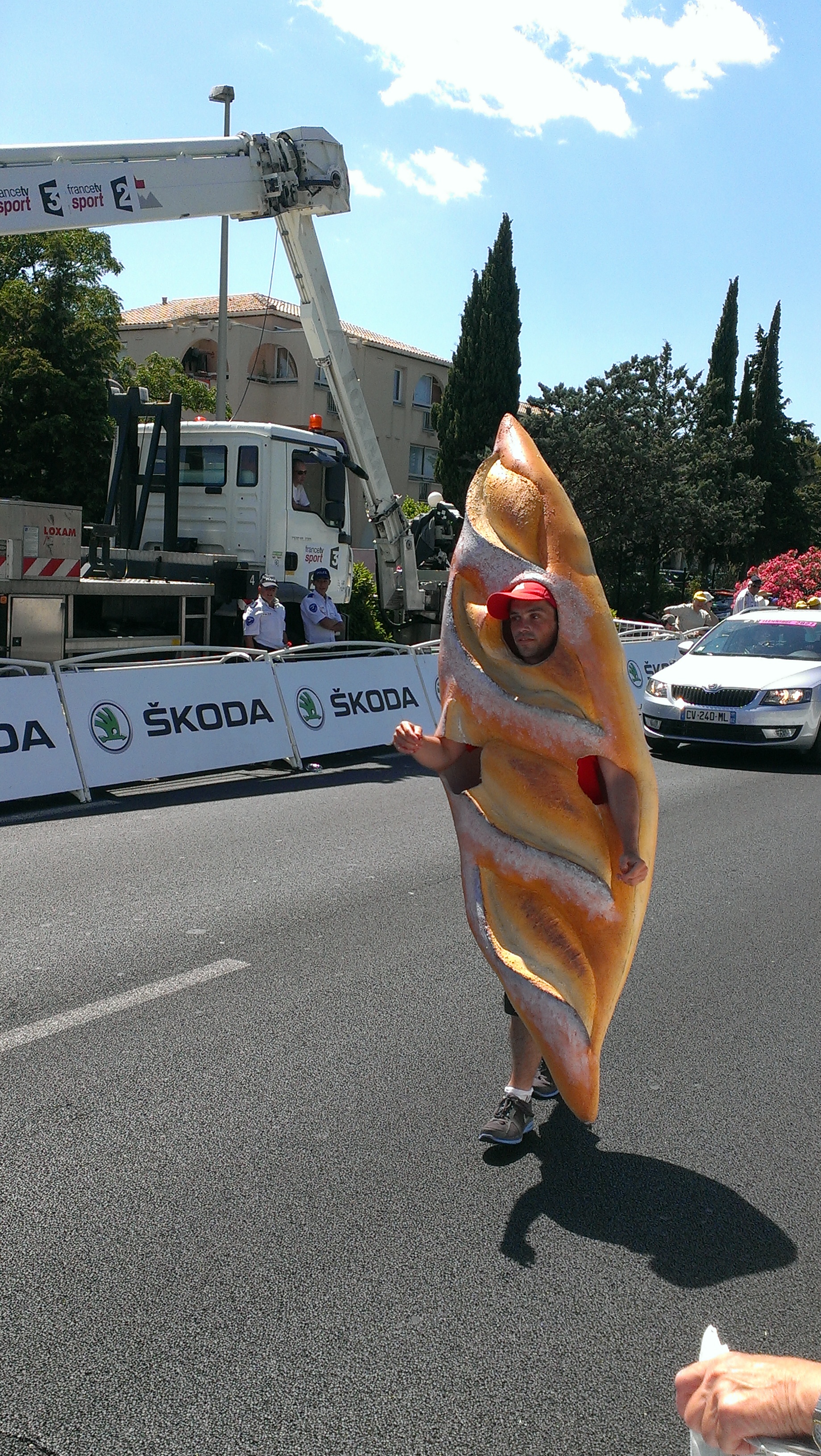
These freebies were being distributed by enthusiastic teens who careered up and down the last 500 metres in golf buggies, scooping handfuls of their respective temporary employers wares and flinging them outwards in a practiced arc that suggested at least a weeks experience of doing so. As we waited in the heat the other buggy likely to get a reaction from the crowd was the one with Vittel branding that carried a girl wielding a pressure washer that provided a brief respite from the sun. Even the Vittel water girl had to admit that she garnered less of a frenzied response than the pair from Banette who proudly announced that they had 3,000 artisan bakeries on the route of the Tour. One of the Banette’s pedaled up and down handing out gifts to his partner, who was dressed in a full length foam baguette outfit, to distribute to whichever section of the crowd he felt were screaming loud enough. With such wonders on offer as wristbands, t shirts and entire loaves on offer, of course we screamed along with the rest of our companions on the crowded central reservation.

All of this was an aperitif before the arrival of the publicity caravan. This is an event in itself at the Tour with its own outriders and official vehicles, including an official Skoda for the start, middle and finish of the procession. Accompanied by the flashing lights of its Garde Republicanne escort the caravan made its way towards us. The standard format for the brands that choose to apportion part of their annual marketing spend on participating in the Tour publicity caravan looks something like this:

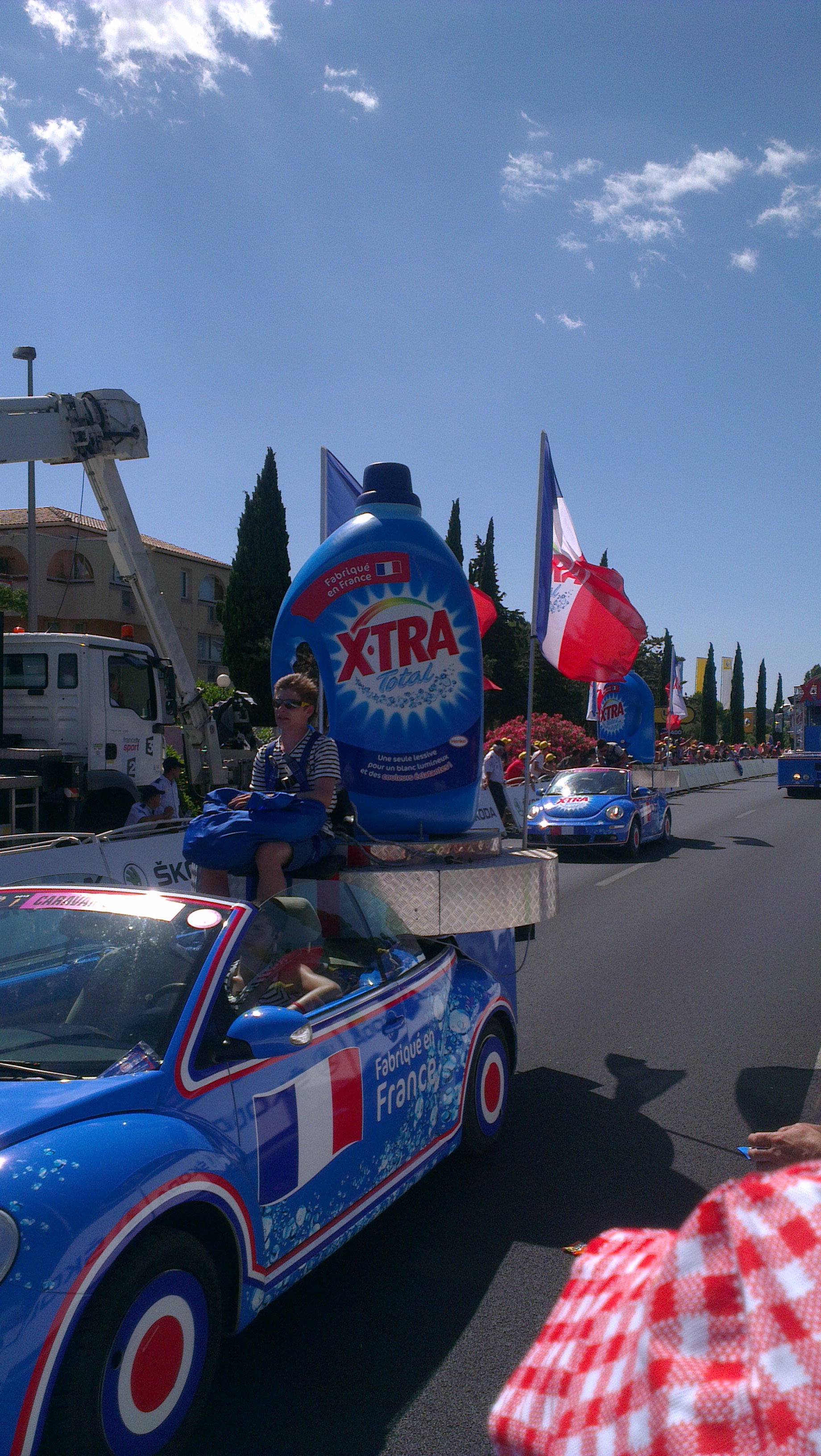
A central float (or floats) with a large model (or models) mounted on board that may or may not have some kind of cycling theme forms the centre piece. The float must be manned by a crew who will either fling freebies in the crowds direction of if the freebies have run out wave at the crowd while gyrating to whatever euro pop track the MC / DJ positioned on the front of the float is playing. The floats are escorted by small cars, a Fiat 500 or perhaps a Golf, either a convertible to allow for another freebie flinger to ride shotgun or a giant model of a flan or a wine bottle. In some cases you got a model and an open top providing the best of both worlds. Each crew member was held in place by a harness that gave them the appearance of a loadmaster on a military helicopter, although spreading Haribo’s and Saucission rather than machine gun rounds. A personal VCSE favourite was the Beetle convertibles with outsize representations of bottles of Fabric softener (sample free gift; a sample of fabric softener!). With the Tour visiting Corsica for the first time, the islands airline Air Corsica joined the caravan complete a pilot saluting from his perched atop a giant cartoon plane (think Thomas the Tank engine with wings). VCSE isn’t sure if he was a real pilot. It’s impossible to erase the image of a swoopy mid engined Renault two seater with a giant BBQ gas bottle bolted to its boot either. Green jersey sponsor PMU, took horsepower to it’s logical visual conclusion by managing to get three lifesize steeplechasers mounted onto the roof of a Peugeot. It was a shame that the Yorkshire Grand Depart 2014 section didn’t involve any giant black puddings or a 3 metre high statue of Geoff Boycott blocking a ball (not sure if most of the crowd would have understood cricket anyway) but at least the MC was representing the best local musical output by playing Pulp and Heaven 17 at full blast.

Free Fabric softener anyone? - The Tour publicity caravan
Free Fabric softener anyone? – The Tour publicity caravan

And then it was time for the race itself. Social media played its part and we were able to follow the race on Twitter thanks to the various feeds from Innrg, Sky and the official Tdf feed (note the publicity caravan has it’s own feed too, but it’s perhaps a bit of a niche follow). Race Radio on Twitter commented that “..for a transitional stage” the race was drawing big crowds and its an important point to make. The Tour doesn’t visit the same places each year and whether or not a particular stage is seen as worth watching on television means little to the fan at the roadside. For every negative story about professional road racing, being there at the event itself, it’s impossible not to get caught up in the atmosphere as the excitement builds.

At 350 metres Andre Griepel was already well placed in the sprint. The course had a slight incline to negotiate on the run in with a gentle curve that took the finish line from our view. Peter Sagan was ahead of Marcel Kittel with Mark Cavendish who had crashed on the route some way further back. Unlike the previous day where the Omega Pharma sprint train had looked so imperious it was clear from the number of his teammates that rolled in some way down on the bunch that things had gone wrong for the team in Montpellier. Later reports on Velonews suggested Cav was unhappy with his bike. He’s riding a matt black Specialized Venge with green pin-striping on this Tour, but from the VCSE vantage point the problem seemed to be a lack of lead out.

After fighting our way out of the crash barriers and hedge obstacles of the central reservation we wandered down to the finish line and caught the jersey presentations. We hadn’t been sure where the team buses were going to be parked and hoping to get a few autographs and photos we headed towards the section of ring road after the finish line that had been blocked off. It was pretty clear from the outset that none of the teams had warm downs planned for their riders. By the time we had fought our way past the media scrums around some of the teams, some buses were already leaving. There were plenty of English accents at the stage and unsurprisingly there was a pretty big crowd around the Team Sky Death Star. More surprising perhaps was that Edvald Boasson Hagen was stood outside quite happily posing for pictures while dealing with questions from the media. He’s had a return to form of late, after a dismal classics season and had freelanced some decent results in the bunch sprints*

Edvald Boasson Hagen after stage 6

With Mark Cavendish failing to win the sprint the media were camped outside the Omega Pharma bus, no doubt hoping to ask him what had gone wrong. VCSE spotted Cav’s major domo Rob Hayles, working as colour man for the BBC at the door of the bus, but of his friend / employer there was no sign. The management of Orica Green Edge were outside their bus and all smiles following Simon Gerrans day in yellow and the handover of the leadership to teammate Daryl Impey. The only other rider who was prepared to face the crowds was Astana’s Freddie Kessiakoff who had abandoned the Tour earlier on the stage. It was a shame that there weren’t that many photo ops as we meandered our way around buses and between team cars. It was easy enough to get up close and personal to the riders equipment and equipped with the knowledge of the number a rider was using we were able to snap some shots of some of the bikes used on the stage. It was interesting to see the amount of aero bikes used and not just by the sprinters.

Stage 7 catching the early part of the stage from the roadside in Roujan

Looking at the detailed route for the stage 7 we worked out that we wouldn’t need to journey back into Montpellier to catch the following days stage. The first categorised climb wasn’t until 80 kilometres into the stage, but there was a smaller climb around 60 km into the route at Faugeres that looked like it might make a good spot to watch the race from. Riding out to this point on Tuesday it quickly became clear that it was a bit of a non starter. Faugeres was a sleeply village in a small valley with the road climbing out of it. The approach involved an 8 mile uphill slog through scrubland alongside a railway and in the absence of anywhere obvious to grab some food or drink Faugeres felt like eight miles too far. The stage followed the course of the D13 from Pezanas and through Roujan and Gabian. Signs at the roadside indicated that the road would be closed from 10.00am and with the peloton not due to pass through Faugeres until 1.50pm at the earliest we decided to look for another spot.

We could get to the village of Roujan from our base without needing to use any of the stage and having decided that one exposure to the publicity caravan was enough headed out to find a decent viewpoint before the peloton rolled in. The atmosphere in Roujan was very relaxed with the Gendarmes happy to let everyone onto the road as we searched for the best spot to get a long view of the riders as they climbed up the gentle incline. There were quite a few English voices around here as well as a large Australian contingent who had taken over the roadside bar.

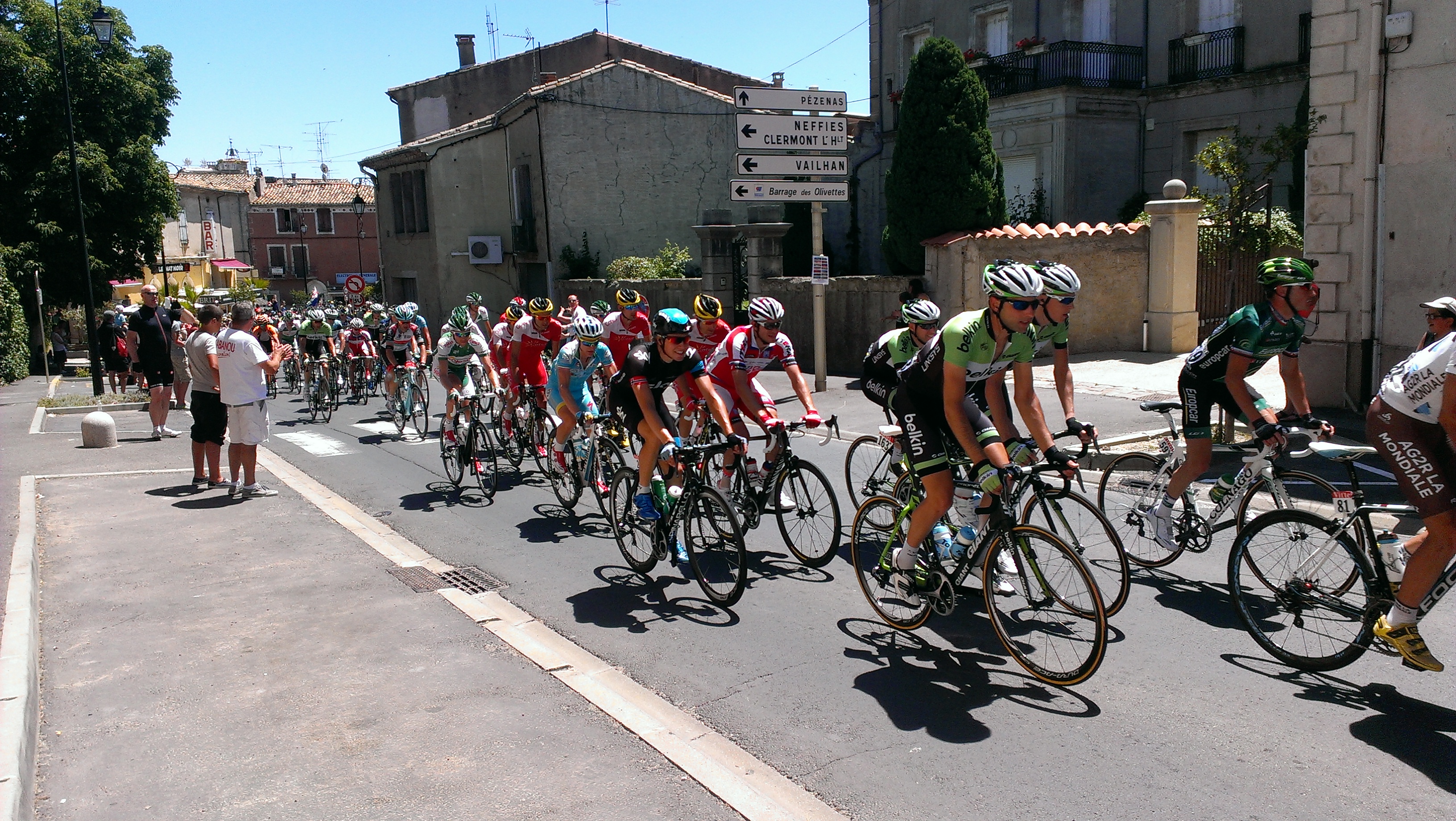
The peloton going through Roujan on stage 7

You know the Tour is coming as the helicopters begin to circle Apocalypse Now style over you, getting lower and lower, closer and closer. First through was the breakaway; the legendary Jens Voight of Radioshack and AG2R’s Blel Kadri who would take the King of the Mountains jersey at the end of the stage. The break had a five minute gap on the peloton who arrived pretty much in team groups. Anyone catching the stage on TV would have seen Cannondale on the front for most of the race and even at 60 km they were positioned on the front. From the head of the peloton to the last team car could be counted in minutes, but even though this part of the stage wasn’t seen as worthy of televising it has an appeal of it’s own. Being close to the worlds greatest bike race if only for a second is exciting and while we missed the freebies getting doled out on stage 7 we came away with something even better. As the Cannodale squad rolled through Roujan one of their riders (sadly not Sagan) tossed away a water bottle and delivered us the quintessential Tour souvenir.

VCSE will be picking up the Tour again for stages 12 & 13 with a finish and start the day after in the city of Tours in the Loire valley. These are transitional stages again and certainly stage 12 should end up with a bunch sprint. We will bring the fans eye view of the race with comment, pictures and video. There are more photos and video from Montpellier and Roujan on our Facebook page.

*Boasson Hagen was 3rd on GC going into Stage 8

The team from down under takes over – VCSE’s Racing Digest #11

English: Peter Sagan in green won the sprint a...
Peter Sagan – can he stay in green? (Photo credit: Wikipedia)

The riders of the 2013 Tour de France, having completed seven stages already would probably disagree, but this years race starts in earnest tomorrow as the Tour enters the Pyrenees for two days of climbing. Saturday sees the first summit finish at Ax 3 Domaines and will be followed by four first category climbs on Sunday. By Monday and the first rest day we will have our initial indications of who will end up in the Maillot Jaune in two weeks on the streets of Paris. Week one has pretty much centred on the points classification battle with all of the key figures, with the exception of Cannondale’s Peter Sagan, winning a stage ahead of Friday’s rolling stage to Albi.

Like many great plans the decision to forgo a prologue and open the 100th Tour with a sprint stage on the races first visit to Corsica didn’t quite pan out as expected. Tour Director Christian Prudhomme had made it pretty obvious that he favoured Mark Cavendish to take the first stage and with it the chance to wear yellow for the first time in his career. Argos Shimano with their sprint double team of Marcel Kittel and John Degenkolb ignored the script and it was Kittel who took the win and the honour of wearing the leaders jersey for stage 2. It later emerged that Cavendish had been suffering from a virus. He seemed philosophical about missing out on yellow, but such is the stature of the new British champion it’s entirely possible that parcours could be ‘tailored’  to allow him another crack at yellow in future Tours.

With the next two stages in Corsica taking in some significant climbs Kittel was never likely to retain the yellow jersey, such is his inability to climb much more than a gentle slope. Either stage offered the chance of a bunch sprint, but almost equally there were opportunities for a breakaway and it was once such move that prevailed by a single second at the line in stage 2. Jan Bakelants of Radioshack all but guaranteed his future employment with the new Trek team that will emerge from the Radioshack ashes in 2014 with the win that also catapulted him into the overall lead. One of riders a second back on Sunday was Sagan and he was pipped again on stage 3 by a rider with form at ‘stealing’ last minute (read: last second) victories; Orica Green Edge’s Simon Gerrans. The Australian rider had controversially snatched the win at Milan San Remo in 2012 by sneaking around Fabian Cancellara’s wheel at the line. His timing was spot on again and Sagan had to console himself with his haul of green jersey points.

The Tour was back on the mainland for Tuesday’s Team Time Trial in Nice. It’s fair to say that most eyes weren’t on Orica Green Edge ahead of the stage. Garmin, who had won the TTT when it last featured had David Millar one second from yellow and were shackled with the favourite’s label by the lazier commentators. Crucially Garmin have a different make up this year and look more likely to take stage wins, rather than feature high on the GC. It’s unlikely that the team would have expected Millar to be the leader in any case and the circumstances they found themselves in for the test were probably a happy coincidence rather than a grand plan. Omega Pharma, with Tony Martin and Sylvain Chavanel in the squad held the lead for considerable time on the day, with Sky the strongest of the GC teams. Orica were late off the ramp, but rode strongly to not only win the stage, but put Gerrans into yellow following his stage win the previous day.

Mark Cavendish’s (legal) pharmaceuticals had worked their magic by stage 5, although the difference was mostly his Omega Pharma sprint train who dominated the last few kilometres into Marseilles. All of the early season niggles about the lead out have now disappeared and with a further sprint stage due on Thursday in Montpellier a consecutive win could have been on the cards. Week one of the Tour de France will rarely follow such a conventional script and a late fall left Cavendish somewhat frayed of jersey and displaying a few cuts and bruises. He got himself back to the front for the bunch sprint, but it was Lotto Belisol who were firing on all cylinders after their previous day misfire. Andre Greipel took a relatively easy win. Gerran’s surrendered the yellow jersey, but Orica were able to celebrate all the same as it was passed to his team mate; Daryl Impey.

Cannondale ended the first week with a plan; deliver a stage win for Peter Sagan. Although the team in green had their man (comfortably) in the green jersey at the start of the day, at this point last year Sagan already had three wins to his credit. The team went full gas from the start, riding on the front for more than 100 kilometres. Sagan’s points classification rivals were gapped on the first serious climb of the day and with 40 km’s to go Cavendish, Greipel and co’ gave up on the chase back to the peloton. The only fly in the ointment was surprise of the week Bakelants who stayed away with a couple of others until the stage reached the outskirts of Albi. The fact that Cannodale, a man down since Ted King’s enforced withdrawl after the TTT, could still find riders to lead Sagan out summed up just how much his teammates buried themselves today. It would have been heartbreaking if Sagan had been pipped again, but as the first week came to an end he prevailed. It leaves him with an almost 100 point advantage of Greipel in the race to the green jersey, with Cavendish in third. There was always a possibility that the green jersey could get wrapped up early in the Tour and we could see Cavendish ceding the points contest and ‘putting it all on black’ for the final stage in Paris in two weeks.

Sky have three riders in the top 10 on GC as the race enters the Pyrenees tomorrow. Edvald Boasson Hagen has a slight advantage over Chris Froome and Richie Porte based on some well freelanced sprint efforts this week but he and the team will know that its Sky’s team leader who is expected to enjoy the limelight tomorrow. The way the week has panned out has been a bit of dream come true for Sky. The team, with one exception, have managed to avoid injury and have been able to quietly go about their business while teams like Radioshack and Orica have enjoyed their time in the sun. Froome’s GC rivals have been similarly unscathed and the question for the weekend is how the other teams will counter the Sky metronome on the climbs. In fairness to Sky, taking over the lead so soon last year was not part of their strategy, but this didn’t stop criticism of the tactic and claims that it led to a boring race (unless you were British). Their rivals have had twelve months to decide how to combat the Sky train and tomorrow will be the first look at what this counter insurgency entails. Froome will want to be in yellow by the time the race gets to the TT at Mont St Michel next week, where he would expect to consolidate any lead. It’s still too early to say who will launch a challenge, but lurking in the top ten is Garmin’s Dan Martin. If he’s not quite a rival for Froome over three weeks, he could upset the race with a stage win this weekend.

VCSE’s team of the week – Orica Green Edge

VCSE’s rider of the week – Jan Bakelants 

VCSE’s Tour de France 2013 Preview

2010 Tour De France
Tour De France (Photo credit: Wikipedia)

On Saturday the world’s greatest stage race begins its 100th edition in Corsica. The Tour de France visits Napoleon’s birthplace for the first time and in edition to the grand depart features two mores stages before returning to the mainland. The Pro Tour has already visited the island once this season in March for the Criterium International. While this years race starts without last years winner Bradley Wiggins there are some strong contenders returning in the shape of Alberto Contador, who was still serving a doping ban last July. VCSE will be in France for the first two weeks of the Tour and will be bringing some of the sights and sounds of the Grand Boucle from a fans perspective on four stages.

The parcours 

Following the Corsican stages (1 through 3) stage 4 is a 25km Team Time Trial in Nice, the first since 2011. It’s a flat course that will favour the teams with strong testers. Stages 5 and 6 will offer chances for a breakaway and the sprinters respectively, although there’s still a possibility for a Sagan or similar to ride strongly over stage five’s final climbs to snatch the win. Stage 6 is a genuine sprint stage with the Mistral likely to play a cameo role in further splitting the peloton once the initial bumps have been crossed.

Stage 7 will stretch the GC and climbers legs with four categorised climbs into the world heritage city of Albi before the race enters the Pyrenees. Stage 8 offers the first Hors Category climb of this years race, coming towards the end of the stage over the Col de Palihere’s before finishing with a Cat 1 ascent to Aix 3 Domaines. The following day the peloton will tackle four 1st and one 2nd category climbs including the Col de Peyresourde, finishing in Bagneres de Bigorre. With the first rest day and a long transfer to follow the stage could see whoever is in yellow trying to consolidate their lead or a rival team look to snatch the jersey away for their GC hope.

The peloton takes its rest day in Brittany and will complete stage 10 in the port of St Malo on a stage that suggests a sprint finish. In fact, the stage could see the points competition sewn up as the best opportunities for the sprinters will be behind them at this point. Stage 11 is the first of the races two Time Trials finishing at the spectacular Mont Saint Michel and one for the specialist testers within the peloton like Omega Pharma’s Tony Martin. If there is any life left in the Green Jersey points contest stage 12 guarantees a sprint finish following a route that passes many of the Loire valley’s most famous chateau’s. Stage 13 is the last of the truly flat stages before the final gallop down the Champs Elysees. As the race moves back into the hills and mountains after this it’s possible that some of the sprinters may abandon after this stage finishes.

Now the race continues its south western trajectory with a rolling stage (14) to Lyon followed by the test of a summit finish on the ‘Giant of Provence’ Mont Ventoux on Sunday’s stage 15. This stage falls on Bastille Day and promises huge crowds on the climb as well as the likely shoot out between the GC rivals.

The final rest day follows before the climbs continue into the foothills of the Alps. Stage 16 finishes in Gap with three 2nd cat climbs on the way and a downhill finish that could see a break away managing to stay away for victory. The final TT follows; 32km including two cat 2 climbs around a lake between the towns of Embrun and Chorges. Will riders opt to stay with the normal bikes equipped with tri bars or go for the full TT machine?

Probably the stage of this years race is Thursday’s stage 18 from Gap to Alpe d’Heuz. The route climbs the iconic mountain not once but twice. It’s a shorter stage and two climbs of the famous 21 hairpins aren’t as tricky as they sound (ordinarily the peloton could have climbed the Croix de Fer, Glandon or Galibier beforehand) but it should make for fantastic viewing. The Hors Category climbs continue on stage 19 with the Col du Glandon and Col de la Madeleine featuring in addition to the cat 1 Col de la Croix Fry. If the GC hasn’t been decided by that point there is Saturdays stage (20) that provides a cat 2, three 3rd category and the cat 1 Mont Revard before another summit finish at Annecy. Despite its location Annecy has little in the way of Tour history and the climb to Semnoz has none at all. Perhaps an odd choice for the last possible stage for a GC shake up.

Stage 21 from Versailles to Paris finishing on the Champs Elysees provides the finale to the Tour. The race has finished here since 1975 but this year the organisers have changed the route to allow the peloton to ride around the Arc de Triomphe rather than turning at this point and the stage moves to a nighttime floodlit finish.

VCSE’s “unmissable” stages

Stage 1 Porto Vecchio to Bastia – Cavendish in yellow?

Stage 9 Saint Girons to Bagneres de Bigorre – This years big Pyrenean climbs

Stage 15 Givors to Mont Ventoux – Summit finish on the Giant of Provence

Stage 18 Gap to Alpe d’Huez – Climbing the Alpe not once, but twice

Stage 20 Annecy to Annecy Semnoz – Last chance for a GC shake up

Stage 21 Versailles to Paris – Under the lights down the Champs Elysees

The contenders 

For the maillot jaune it’s been hard to see much further than Chris Froome and a second successive win for Team Sky. Like Bradley Wiggins in 2012 Froome has won pretty much everything he has entered including, crucially, emphatic victories against his main rivals. The exception? Tirreno Adriatico, where he was undone on the steepest climbs by eventual winner Vincenzo Nibali. Nibali is missing the Tour having focused on the Giro which leaves Froome facing challenges from three riders who out pointed him at last years Vuelta for starters.

Alberto Contador, winner of 2009 Tour de Franc...
Alberto Contador in the 2009 Tour (Photo credit: Wikipedia)

First and foremost is that races winner Alberto Contador. While his form this year to date hasn’t been spectacular Contador is talking a good game ahead of the Tour. Saxo Bank have chosen a strong team to support with ex Sky road captain Mick Rogers alongside top ten finisher Nico Roche and Amstel Gold winner Roman Kreuiziger.

Contador missed last years Tour as he was still serving his doping ban for Clenbuterol. Another rider missing from last years race and indeed the one before that is Jaoquim Rodriguez of Katusha. He chose to miss the Giro, after finishing second the previous year and should be in better form than his last appearance where he finished 7th.

The divisive figure of Alejandro Valverde rounds out the trio. Valverde has already suggested that he doesn’t have the firepower for the win, but Movistar have strength in depth with Tour de Suisse winner Rui Costa and another stage race winner from 2013 Nairo Quintana in support. Neither rider is in the first rank of GC contenders but assuming Valverde is struggling Movistar have leadership options and could switch to either of the younger riders. After their stage wins in the Giro another possibility is that the team approach the Tour with a similar strategy.

Another team with potential dual leadership is BMC with Cadel Evans and Tejay Van Garderen. Ahead of the Giro many commentators had written Evans off but a strong performance in Italy has seen some revisions of opinion about his form. Whether he has enough left in the tank after three weeks of snow and rain in the Dolomites remains to be seen. Waiting impatiently in the wings is Van Garderen. Still eligible for the young riders competition he looked fairly impressive taking the Tour of California. While he may end up taking the BMC leadership crown in July it’s hard to see him winning this year. It’s interesting that with Evans approaching the end of his career that BMC were rumoured to have approached Froome with a contract for 2014. Does the Swiss backed but US registered team have the confidence that Van Garderen can beat Froome or not? For the other teams it’s more likely that they will need to rely on the odd cameo performance via a breakaway win or victory in a specialism like the TT to snatch the headlines. There is a potential wild card in the peloton with Andy Schleck who has suffered a very public examination of his struggle to return to the form that saw him finish second to Contador in 2010 (elevated to 1st later). Schleck needs to ride for a contract as much as anything else as the team that was once built around him has been sold to bike supplier Trek for 2014.

Sky have selected a strong team to support Froome with Richie Porte likely to take the Froome role from last year to shepherd his team leader over the cols. The rest of the squad is made up of ‘engines’ like Vasil Kireyenka and David Lopez who will ride on the front all day following Sky’s now famous (or should that be infamous) tactic of controlling the race pace. Last year it was rumoured that Sky felt they had gone into the lead too early, but having survived in yellow for the majority of last years race this shouldn’t hold any fears for Froome and co this year. The route shouldn’t hold too many fears for Froome either, lacking many of the truly steep climbs that feature at the Giro or Vuelta. His rivals will probably be banking on more on Sky struggling to maintain their control of the peloton rather than Froome breaking down. There are plenty of contenders for attacks and break away wins and the all French wild card teams will see those as their best chance of showing the sponsors logos. Katusha, Movistar and Saxo all have riders that can cause an upset and if a Contador or Rodriguez can get away then Froome and Sky will be tested.

VCSE’s GC Top 5 prediction – Froome, Contador, Porte, Rodriguez, Evans

With the focus on Chris Froome it’s easy to forget the other British rider in search of a milestone win at this years Tour. Mark Cavendish comes into the race after an impressive points victory at the Giro, where the competition favours sprinters significantly less than the Tour. Cavendish was expected to thrive at Omega Pharma after leaving Sky last year and while the focus has been on the initially spluttering lead out train that came good in Italy, a notable improvement has taken place in his climbing. Unlike most of his rivals at the Giro, Cavendish didn’t abandon the race and rode over some of the most challenging climbs of the world tour in the worst kinds of weather. Clearly he has finished 3 week tours before, but as his win in last weekends British national championships showed, his all round racing has moved on. Cavendish will start the Tour in his national champs jersey and with the first stage likely to finish in a bunch sprint he could end the day in yellow. If he pulls this off, along with a fifth consecutive win on the Champs Elysees and the Green Jersey then Britain could have another cycling knighthood to look forward to.

Cavendish will face a strong set of sprint rivals however. Lotto Belisol’s Andre Greipel heads the list that includes a two pronged assault from Argos Shimano with Marcel Kittel and John Degenkolb. There’s also pure sprint capability at FDJ with Nacer Bouhanni, Lampre’s Roberto Ferrari, Orica Green Edge have Matty Goss and Sojasun Julien Simon. However the most likely battle for green will be had with Cannondale’s Peter Sagan. Sagan took green last year as Cavendish laboured in a Sky team focused on GC. Sagan is confident he has the edge over Cavendish on the intermediate stages if not in out right pace for a bunch sprint. Nevertheless with a team dedicated to him Cavendish should be adding another points jersey to his collection this year. 

King of the Mountains in recent years has been won by the rider who can race tactically, sweeping up the points on the smaller climbs to take a firm grip on the competition before the race reaches the highest peaks. Last years winner Thomas Voeckler has delivered some solid GC performances to go with breakaway stage wins and like Richard Virenque before him would be a popular native winner. This year might see a repeat of a wild card taking the Polkadot Jersey, but VCSE thinks the winner could come from one of the second rank of GC riders also, with Nairo Quintana a possibility of he isn’t in contention for the podium.

VCSE’s Points & KOM picks – Green Jersey Mark Cavendish, KOM Nairo Quintana 

VCSE at the Tour

In addition to our regular race coverage via our Racing Digest VCSE will be in France for the first two weeks of the Tour. We will be taking stages 6 and 7 around Montpellier before shifting our base to Tours for stages 12 and 13. Hopefully we will be able to provide a flavour of the world’s greatest stage race and a fans eye view. Follow our Twitter feed (@randompan) or Facebook pages for more details.

That’s the thoughts of VCSE. What do you think? Can anyone beat Froome? Will it be Contador’s year? Can Cav beat Sagan to the points jersey? Let us know what you think in the comment section below.

See what everyone else is saying. You can check out the Global Cycling Network TdF preview below or follow the links to these related articles at the foot of the page.

Related articles

VCSE wraps up the 2013 Giro

Giro stages 20 & 21 – Silandro to Tre Cime di Lavaredo & Riese Pio X to Brescia 

One of the recurring themes of this years Giro, if not the entire season so far, has been the (unseasonal) weather. Perhaps it shouldn’t have surprised anyone for it to have snowed in the Alps and the Dolomites, but heavy snowfall in the run up to and morning of Stage 19 saw its cancellation. With earlier stages effected by the route changing or being shortened, losing what had promised to be one of, if not the most iconic climbing stage was a massive blow. Probably the only rider in the peloton unhappy about getting an additional rest day was Vincenzo Nibali. Although he had dominated the second time trial, the chances to demonstrate his superiority via a stage win shrank by half with the loss of the Stelvio and Gavia from the race.

RCS wouldn’t have asked for the story that did come to dominate the day instead; Danilo Di Luca’s positive EPO test announced at almost the same time as stage getting cancelled. Di Luca was without a team at the start of the season and the was only 72 hours between the test being carried out and the announcement that he would be riding for Vini Fantini at the Giro. His attempts to animate the race, if not pick up a stage win had fizzled out pretty quickly so an immediate conclusion to draw was; doping to what advantage? Di Luca himself was pretty tight lipped. There was talk of ‘B’ samples to be checked. His team were more decisive, sacking him on the spot. The comments, from those members of the peloton that chose to, was (at least) unequivocal in condemming Di Luca as an example of once a doper always a doper. On a scientific note, the positive test was carried in a German lab where  rumour has it that micro dosing of EPO can be established. If this is fact rather than speculation it raises a couple of interesting points. One, in the doping ‘arms race’, are the testers edging ahead of the cheats finally? Two, was this a rider of a previous generation unable to race without taking performance enhancing drugs or not sophisticated enough to avoid detection?

After losing the previous days stage and the dread of a doping story the likelihood was that the organisers would have run any kind of stage the following day. To circumvent the worst of the weather the stage stayed in the valleys before taking in the climb to Tre Cime di Lavaredo. Although this resulted in 90% of the stage feeling pretty dull, the final kilometres more than made up for it. In fact, the route climbed steadily for most of the day, although the gradient was barely noticeable most of the time. As the km’s clicked up the temperature began to fall and the riders began to add the layers. The contrast between the conditions at the start of the stage and at the finish line gave the appearance of two separate races held on two separate days.

English: Vincenzo Nibali, winner of the 75th V...
Vincenzo Nibali in his first Grand Tour win – the 2010 Vuelta (Photo credit: Wikipedia)

For Vincenzo Nibali this was his last chance to cement, barring accidents, overall victory with a stage win. While the previous years winner, the now departed Ryder Hesjedal was recognised as a great champion, his win had been achieved without an individual stage success. For Nibali, the sense was a stage win would provide the required backdrop. His Astana teammates, who got stronger as the race went on got him into a great position for the final climb, emphasised by their own high placings at the finish. As the weather closed in, Nibali just seemed to get stronger with only one of his GC rivals, Rigoberto Uran who finished nearly 20 seconds down, in touch at the finish. Cadel Evans had looked broken on the stage, although he later cited a mechanical that caused him to give up his second place overall to Uran. It was a good day all round for Colombian riders with Carlos Betancur and Fabio Duarte finishing 1,2,3 (in fact 4, 3, 2 respectively) behind Nibali. He could smile through the cold as he took part in three separate presentations (he also took over the points jersey from Mark Cavendish) knowing that he had all but won the 2013 Giro.

The final stage of the Giro, unlike the Tour, is not run neutralised. With the destination of most of the jerseys resolved however, the peloton seemed happy enough to cruise into Brescia on the last day. No champagne or even prosecco was in evidence although there were some pizza deliveries being made from the team cars. Vincenzo Nibali was resplendent in pink, happy to up the quotient to socks and helmet if not to make any changes to his bike which stayed resolutely white and blue throughout the race. Carlos Betancur had ridden into the young riders jersey the previous day, which left just the Maglia Rosso points jersey up for grabs.

Mark Cavendish had been in and out of the points lead for the three weeks of the race. We had touched on the difficulties for a sprinter to win the points competition at the Giro in our Giro preview, going so far as to say that the challenge would probably see Cavendish abandon before the mountains. A look at his rivals for the jersey indicated the challenge; Nibali, Evan, Betancur etc. If he could take both intermediate sprints on the final stage,  Cavendish would be back in the lead and virtually assured of taking the Maglia Ross0. A flash of the legendary Cavendish temper ahead of the second sprint. As the peloton began their laps of the Brescia circuit a lone Andrioni rider made a break. Cavendish having reached a gentlemen’s agreement with Nibali that he (Nibali) wouldn’t race for the points, shot off in angry pursuit. Cue much gesticulation and no doubt profanity as attempts to marshal the recalcitrant wild card rider back to the group, Cavendish forced to sprint hard for the line.

On the second lap, another Cavendish sprint and general cussedness as the line was crossed; what was the cause of all of his frustration. The guilty culprit appeared to be the roadbook, certainly Omega Pharm at least didn’t appear to know at what distance the second intermediate fell. All of this was forgetten fortunately when it really mattered as Cavendish easily overhauled the much depleted from three weeks of hard racing sprint field. Elia Viviani probably the only recognised first line sprinter left to rival Cavendish at the death.

And so to the celebrations. Nibali emotional, yet dignified also. Hard to appear so in the hot pink throne that the organisers placed centre stage for him. Cavendish all smiles, 2012 avenged and one a select few riders to have won the points competition in all three grand tours. Betancur, winner of the young riders jersey a great prospect for the future, but here and now celebrating a relatively unsupported result; AG2R finishing the race with only four other riders.

Giro 2013 – postscript 

VCSE always tipped Vincenzo Nibali for the GC ahead of Bradley Wiggins. The spike in the popularity of cycling as a sport in the UK is largely fueled by Wiggins stellar 2012. It’s unfortunate, but somewhat inevitable also that this also polarises a lot of the coverage the sport gets in the UK mainstream media. It’s a good thing that, for example, the BBC covered the Giro the same way it would cover the Tour this year. It’s less positive that the lens through which everything got covered was Wiggins shaped. In fairness VCSE gave up on the daily BBC podcast for just this reason after about stage 4 or 5, so if the tone changed; mea culpa. The focus on Sir Bradley, as the BBC insisted on calling him, across the majority of the media in the UK meant that the reasons to celebrate British success (of which there were plenty) felt airbrushed from coverage more concerned with Wiggins descending difficulties.

The VCSE argument against a Wiggins victory in this years Giro was based on his relative to 2012 poor form coming into the race. Compared to the previous year where he had won pretty much everything he entered, in 2013 Wiggins didn’t have so much as a podium place to celebrate. Sure, things didn’t always go his way; the mechanical on the queen stage of the Trentino, his last race before the Giro a good example. The only crumb on offer was the line offered from Sky that his ‘numbers’ were “better than last year” or that he was climbing better than ever.

With the benefit of hindsight Wiggins climbing wasn’t the issue. There were some surface cracks in the Sky gameplan when their team leader seemed to lack protection that would have prevented him losing time in the early stages due to other riders accidents. Things fell apart on stage 7 with Wiggins inoccuous looking slide on the descent into Pescara. In the wet conditions that seemed to become the default for the rolling stages, Wiggins  remounted but proceeded at a snails pace. Nibali had suffered a slide of his own on the same descent, but the difference in the speed in which he remounted and then got on with things compared to his then joint GC favourite was palpable.

Sky would have expected to go into the first TT with Wiggins positioned to take the GC lead. Although the parcours was not particularly friendly to him, his testing abilities should have given Wiggins the platform to put time into his rivals. Instead, he suffered another mechanical and didn’t gel with his replacement bike, a completely different model. In spite of his bad luck and difficulties with his second bike this was perhaps Wiggins high point in the race. After the inevitable time loss at the first time check he recorded the fastest time over the second (longer) section. Although denied the stage win, Wiggins was back in contention. Unfortunately, the following day the rain was back and with it his descending woes. At one point Wiggins was out the back, but a massive turn from the Sky diesel domestiques got him back to Nibali’s group by the finish. Stage 10, the first summit finish was the big test to see Wiggins could hold onto Nibali who had gone into the lead after the TT. As things turned out Wiggins lost more time on the stage won by teammate Rigoberto Uran. With ramps of 20% in places VCSE’s view is that Wiggins performance on the stage was pretty strong for a rider who climbs at a steady rate, rather than with explosive accelerations. He lost time on the steepest sections, but was coming back at the finish, certainly fairing better on the climb than some his rivals.

Wiggins didn’t lose time the following day, but by the end of stage 12 he was gone. A difficult day where he lost time in heavy rain and the virus he had been suffering from getting worse led to Wiggins departure and Rigoberto Uran’s elevation to team leader. Uran had already leapfrogged his erstwhile team leader on GC at this point and he had unwittingly pointed to what would become the Wiggins narrative following his withdrawl when he (Uran) described himself as “..not like Froome”. There had been speculation before the Giro about what Wiggins would do at the Tour. Wiggins had fueled some of this himself when he declared in an interview that he wanted to lead Sky at the Tour and defend his title. In the week between the end of the Giro and the start of the Dauphine the story rolls on.

Vincenzo Nibali would probably be the first to admit his overall victory would have been enhanced by a fit Bradley Wiggins. Some may feel his achievement was also diminished by the enforced route changes and even cancellation of one stage. This would do him a disservice. Nibali looked the class of the GC field from the outset and while his team looked to have rode into some good form by the end of the race to support him during the final days, Nibali is the kind of rider who is well capable of looking after himself. His next target, supposedly is the Vuelta a race he has won before. Last years Vuelta top 3 were missing from the Giro, but if Nibali can maintain this form he should be a genuine contender for Spain’s grand tour.

The weather and viruses that swept through the peloton caused an attrition rate of nearly 20% including defending champion Ryder Hesjedal. This years Giro was a race to be endured rather than enjoyed. An ambitious and exciting parcours that included climbs of the Telegraphe and Galibier in France as well as the Stelvio and Gavia deserved to be raced and will hopefully feature again, although probably not next year. The doping story was an unfortunate reminder of the darker side of Italian racing, but the way it was handled by the organisers and the effected team gives confidence of the new attitude to drugs in the sport.

There was more British success with Alex Dowsett’s victory in the first TT. Dowsett moved to Movistar from Sky at the beginning of the year and his new team could justifiably claim to be the team of the Giro with stage wins for Giovanni Visconti and Benat Intxausti also.

Bradley Wiggins departure from the Giro spoiled the plans of much of the UK medias editorial which missed an arguably greater British achievement at the race. Mark Cavendish took 5 stage wins on the way to becoming only the fifth rider to win the points classification in all three grand tours. He had to overcome the equal weighting for points finishes on each stage in the Giro as well as getting himself over the climbs. Bradley Wiggins will always be the first British winner of the Tour de France but our greatest stage racer is Mark Cavendish.

Movistars – VCSE’s Racing Digest #10

Giro stages 16, 17 & 18 – Valloire to Ivrea, Carrvaggio to Vicenza & Mori to Polsa 

The curse of VCSE struck Mauro Santambrogio on stage 16 as our tip for a Giro podium place lost significant time on his GC rivals. While the Vini Fantini rider admitted he had a bad day, he was philosophical about his Giro so far saying, “I can’t complain how my Giro has gone.. it’s been great so far” His Vini Fantini DS Luca Scinto felt the loss of time was more a result of a tactics glitch where riders who had gone up the road to cover breaks weren’t available to support Santambrogio on the final climb of the day.

The possibility of bunch finish also fell away as the remaining sprinters in the peloton struggled over a category 3 climb that was harder than it looked in the road book. The GC protagonists had swallowed up the break on the ascent and the went into line astern on a technical descent that allowed Vincenzo Nibali and Cadel Evans to show off their lines.

Benat Intxausti-IMG 2021
Benat Intxausti (Photo credit: Wikipedia)

As the road flattened into the finish at Ivrea a game of cat and mouse ensued as riders attempted to break out, but in the main the group remained pretty much shackled. Robert Gesink, by this point well down on GC made an attack that did stick, only to suffer a heartbreaking mechanical with less than 2 km to go denying Blanco the consolation of a stage win at this years race. The eventual winner was Benat Intxausti giving him a stage to go with his day in the Maglia Rosa and Movistar their second win in 24 hours.

Stage 17 offered another crack at a win for the sprinters and decent weather again after the snow of the weekend. The weather forecast remained in the headlines ahead of the stage however. Snowfall in the Dolomites had put the mountain stages due later in the week at risk of course alteration and possibly even cancellation.

The parcours was similar to the previous day, with a ‘bump’ in the road to negotiated before the potential of sprint finish for Mark Cavendish to contest. As the GC group reeled in the break on the climb a sense of deja vu was palpable as Cavendish began to weave across the road and lost touch with the group. You have to feel for him in these situations, as with the previous day Cavendish had remained in contention with the peloton only to see his hard work unravel on supposedly gentle climb.

At one stage it looked like it would be Danilo Di Luca who would deliver the self styled ‘killer’ blow, but then a rapid acceleration out of the group came from Sunday’s stage winner Giovanni Visconti. He rode past Di Luca like he was standing still and crested the summit with a half minute advantage. How much of Visconti’s second and Movistar’s third victory in as many days was down to a lack of interest from the GC contenders might be seen as a diminution of the win. Movistar are rapidly becoming the team of this years Giro and the mood in the team must be fantastic at this point with four wins and Benat Intxausti’s day in the Maglia Rosa to celebrate.

Whether or not his rivals would rue their opportunity to put some time into Vincenzo Nibali come Sunday remains to be seen, but for the Astana team leader stage 17 was another step closer to winning this years Giro. With stage 18’s time trial to come, Nibali predicted he could be putting time into Cadel Evans and Rigoberto Uran ahead of the mountain stages on Friday and Saturday.

The TT with an uphill course was never going to favour specialist testers, instead promising the chance of the GC contenders to move up (and down) the leader board. Winners and losers on the day? The rider to emerge with the most ‘credit’ was Nibali, clear winner on the stage and increasing his overall lead to more than 4 mins. That advantage was held over Cadel Evans who lost so much time on the stage Nibali must have entertained thoughts of overtaking him. The difference in both riders body language as they crossed the line was clear to see, but Evans was classy in conceding the stage, if not the race later “Nibali in a class of his own.. Evans, if I may say so myself – abysmal”. He went on to say it was “good training”, a not so subtle note to Tejay Van Garderen about BMC leadership at the upcoming Tour perhaps?

One more bit of news as the day closed was the announcement that poor weather had forced the route for stage 19 to be altered. The prospect of the peloton taking on the Gavia and Stelvio will have to wait for another year.

The real heroes of cycling are the heroines

The surge in the popularity and reach of women’s cycling in the UK in recent years has been driven by the successes achieved in the velodrome by riders like Victoria Pendelton. A new generation of female track cyclists repaid the investment from lottery funding by taking home several golds at the London 2012 Olympics. Sixty years ago a pair of pioneering women were achieving greatness in very different circumstances.

A recent convert to the sport, perhaps inspired by the prominent results of a Cavendish or a Wiggins, could be forgiven for thinking that Britain has always  been a hotbed of road racing talent. The opposite is true, mainly as a result of the long standing ‘ban’ imposed on mass start racing by the predecessor of today’s British Cycling. Ever the improvisers, the early cyclists with sporting desires found new ways to vent their need for competition. In the absence of a stage race or criterium, the staple of the continental rider came the race against the clock. Time Trialing remains a staple of the club riders calender, although the long distance record attempts belong to a much earlier era.

In the age of lottery funding an athlete of potential might look forward to a lengthy sabbatical from the chosen profession without the anxiety of how to pay the bills. Many of the sportsmen and women competing in the events where Britain has become very successful (read Track Cycling) move seamlessly from education to competition without the need to consider a career elsewhere. This was not always the case. Outside of sports like football, becoming a professional in your chosen sporting pastime was an end to your chances of actually competing. This was certainly the case with cycle sport after the second world war and riders who were offered a professional contract needed to accept that they would earn their keep, at least within the UK outside of sanctioned competitions.

Eileen Sheridan
Eileen Sheridan

Eileen Sheridan was a successful time trialist or tester and track racer when, in 1951,  she was approached by the Hercules cycle company about becoming a professional. She won her first national title in 1945, aged 21 and had taken several titles and records in the years that followed both against the clock and for a set distance.

Hercules were something of a trendsetter, being the first British manufacturer to sponsor a professional men’s team as well as testers like Ken Joy. Unable to race in sanctioned events, Eileen Sheridan would target the long distance UK records in particular Lands End to John O’ Groats. She was not the first female professional to attempt this and not the first woman to ride professionally for Hercules. In fact Hercules had sponsored Marguerite Wilson  to do in 1939 what they wanted Eileen Sheridan to do now and it would be Wilson’s Lands End John O’ Groats record that Sheridan would attempt to beat. Wilson’s own professional career was short lived, with war intervening in the Autumn to curtail further record breaking. It’s tempting to think that the Hercules board were just waiting for the emergence of another talented woman to allow them to pick up where they had left off.

Certainly Eileen Sheridan had been thinking of the record. She preferred longer events and was a record holder for the ’12’, the amount of miles covered in a twelve hour period. Lands End to John O’Groats or LEJOG as it is shortened is the long distance place to place event that still resonates. It’s place within contemporary cycling is often as the epic route for a charitable cause. These rides generally allow a week to complete the distance and even this timescale represents a challenge for a seasoned rider. The record breakers look to achieve the distance in a little more than two days (women) and a little less than that (men).

The time that Eileen Sheridan was attempting to beat in 1953 was Marguerite Wilson’s; two days and nearly twenty three hours for the 871 miles distance (LEJOG covers less distance now since the Forth Road bridge was not built when both attempts took place). Sheridan had beaten the record by a matter of minutes in 1952, but this was not recognised due to an arcane ruling banning publicity for an attempt prior to the start. Her equipment for the race was a Hercules badged lightweight as even her sponsor recognised that riding a stock machine would have put the diminutive Sheridan at a disadvantage. Running three gears only, she would have been unable to keep up with the pedals on a descent whilst climbing remained more of a push than a spin. The ratios were the same as Wilson had used years previously.

With sports science in its infancy Sheridan,  who had already experienced the perils of sleep deprivation prepared as well as she could. This involved a regime of hardening her contact points with surgical spirit, while breaking in saddles and riding shoes. Her diet would consist of chicken breasts, bananas and Ribena.

The start was delayed as Sheridan and her support team waited for a favourable wind and weather forecast. As things turned out the forecast was wrong and she was battered by wind and rain within a few hours of leaving Lands End. By the end of the first day she was climbing the fearsome Shap Fell in Cumbria with over four hundred miles completed. Only now did she take a rest in the accompanying support caravan, for all of fifteen minutes. More than six hundred miles were down when she needed her lights for the second night of the attempt.

Now tiredness had Sheridan in its grip. She needed to stop twice more in the next hundred miles and had snatched only twenty five minutes sleep when she was woken at 7.30am to get back on the bike. She was going to complete the ride on another bike, with a slightly lower gear to help her over the hills to come. This was the slightest concession, fatigue was now forcing her to walk her bike over the steeper climbs.

Eileen Sheridan arrived at the John O’Groats hotel around 9pm. She had completed the ride in two days, eleven hours and seven minutes*. This wasn’t the end of her ride though. In addition to setting the LEJOG record in ’39 Marguerite Wilson had continued and set the benchmark for 1,000 miles also. With less than two hours sleep Sheridan was back on her bike. The lack of rest caused her to hallucinate; she saw people she knew and talked to them and polar bears. By the morning there were local supporters to keep her going, singing songs and running beside her. Completely exhausted she fell off her bike with 4o miles to go. Her support team cut up her breakfast and fed her like a baby and needed to lift her back on. She rode the last few miles weaving uncontrollably and lapsing from laughter to tears. She arrived back at the hotel an hour into the third day of riding.

It’s a testament to Eileen Sheridan’s achievement 60 years ago that the current record, set nearly 50 years later, is less than seven hours faster. Without seeking to diminish the mark set by L E A Taylor (also the mixed tandem record holder), what Sheridan achieved on a comparatively heavy steel bike (with three gears remember) was incredible.

Hercules made the most of it portraying her as an ordinary Coventry housewife and mother, when she was anything but ordinary. What was true was that she was a professional and the record she had beaten belonged to another professional rider. That record (Wilson’s) had already been beaten before Eileen Sheridan beat it again and further. Ironically, it was another Coventry housewife and mother of two who lowered the time by four hours in 1953, just ahead of Sheridan’s attempt. Edith (Edie) Atkins was an amateur however, starting her racing career a year later than Sheridan and still racing aged 76 in time trials. She was killed on her bike in 1999.

Britain’s next female cycling star arrived at the start of the sixties, although Beryl Burton won her first significant award a year after Sheridan retired as a professional in 1956. VCSE will cover Beryl’s story in the future.

There was article about Eileen Sheridan’s record breaking in issue 33 or Rouleur Magazine (details here) http://www.rouleur.cc/issue-33

Eileen Sheridan’s own biography is available as a reprint (details here) http://tinyurl.com/nvqo2j3

The writer who brought the story to life for VCSE in his own memoir ‘One more kilometre and we’re in the showers’ is Tim Hilton. The link to that book is available via our Facebook page (follow the link on the right hand side of the VCSE website).

And finally, there’s a very short clip of Eileen Sheridan on the VCSE YouTube channel (follow the links on the right hand side of the page).

* It seems appropriate to use (for example) twenty rather than 20 when listing Eileen Sheridan’s record breaking

Play it again Cav – VCSE’s Racing Digest #9

Giro stages 13, 14 & 15 – Busseto to Cherasco, Cervere to Bardonecchia (Jafferau) & Cesana Torinese to Col du Galibier

To paraphrase Casablanca; at least we will always have Cav. The deliberations on the Team Sky Death Star after stage 12 were over and the news before stage 13 was that Bradley Wiggins was going home. Cue frantic emails to the nicer hotels on the remaining route as sports editors and TV news reporters from the British media cancelled their travel plans. The conclusion that could be reached if the mainstream UK media was your only source was that the Giro was going to be a Wiggins benefit, so at least we are no spared the need for them to find ways of squirreling a Wiggins ‘angle’ into every report. The ‘failure’ of Wiggins attempt to win the Giro raises some interesting questions for the way the sport is covered in the UK however.

An increase in coverage, even at a superficial level is no bad thing and the Giro ‘story’ has held it’s own against some pretty seismic events in other sports. National radio has covered the race in a way that would normally only be seen for the Tour. The decision by Sky to show a daily highlights package, having previously shown the Tour de Romandie hinted that the satellite broadcaster could start making inroads into the TV rights for road racing assuming a similar level of success for ‘their’ team. Wiggins departure will not stop the rights discussion although a contrast will no doubt be made between the ratings that a Wiggins / Sky win would have achieved in the UK as opposed to the likely Nibali victory next Sunday.

There are some parallels in other sports. Sky purchased the rights to domestic Test Cricket around the time of the England teams resurgence in 2005. Could Sky be betting on the desire of Cycling fans (and Team Sky fans in particular) to watch racing live and therefore be prepared to pay for the privilege? ITV, who picked up the rights for the Tour from Channel 4 will continue to show the race free to air until 2015 at the earliest. Whether or not British riders build on the successes of 2012 (a Froome victory in 2013 at the Tour?) will have a massive influence on how we follow the sport in the future.

Which brings us to Mark Cavendish. While Wiggins decline and subsequent fall was being pored over Cav was busy winning his 100th stage as well as becoming the leading stage winner on the Giro 2013. At the time of writing (the second rest day) Cavendish remains in the race, having got himself up and over some fearsome climbs in the process. He has also seen off some of his key challengers for the sprint stages with John Degenkolb (Argos) and Nacer Bouhanni (FDJ) both abandoning, Bouhanni the day after finishing second to Cavendish at Treviso.

Cavendish has railed against the lack of coverage he received in the past and it would feel somewhat disrespectful if the mainstream media turned away from the Giro and what he is achieving because of Wiggins departure. He remains points leader going into the final week and assuming he can get over a ‘bump’ at the end of the stage has an opportunity to increase his win tally ahead of the pan flat final stage on Sunday. The Giro doesn’t favour sprinters for its points classification and Cavendish is up against some strong opposition among the climbers and GC contenders. With only a fleeting opportunity to wear the Maglia Rosa after his win on stage 1 Cavendish should have the motivation to go for the Maglia Rosso, particularly after just missing out last year.

Vincenzo Nibali’s grip on the GC looks pretty unshakable at the moment. He was able to put more time into his rivals on the shortened stage 14 and takes a lead of over a minute into the final week. After contending with mostly wet conditions the move into the alps coincided with snowfall to add to the riders misery. Organisers RCS had cut part of the stage 14 route, the climb to Sestriere due to the conditions but this provided minor comfort to the riders who made it to the finish. The stage was won by VCSE favourite Mauro Santambrogio from Vini Fantini who managed to out drag Nibali to the line on the Jaffrau. Nibali had turned the screw on this one though, putting time into Cadel Evans and yet more into Robert Gesink ending his hopes for the race. Consolation then for the race leader, although it’s unlikely that he would want to win the overall without taking a stage win himself. The two mountain stages in the week ahead should provide an opportunity.

Of course last years victor Ryder Hesjedal famously took the win without taking a stage. Hesjedal’s chances this year were long gone when he abandoned to rather less fanfare than Wiggins ahead of stage 13. Other notable withdrawals; stage 4 winner Enrico Battaglin following an accident and a rider who had seemed out of sorts right from the start, Garmin’s David Millar.

The weather intervened again for stage 15. A regular feature on the Tour, RCS had inserted one of the more interesting examples of cross border grand tour route planning by including the Col du Galibier on Sundays stage. Nibali seemed content to leave his powder dry for this one and the GC contenders crossed the line in a group about a minute down on Movistar’s Giovanni Visconti. Movistar are having a pretty good race so far with Benat Intxausti in the top ten and a spell in pink to go with two stage wins.

For the final week the GC looks like Nibali’s to lose. Cadel Evans remains the surprise package and finishing second would be no disgrace for a rider many (including VCSE) had written off beforehand. VCSE suspects that the limit of Rigoberto Uran’s ambitions is a podium place, although his win on the first summit finish on stage 10 suggest he can take it to Nibali. Sky would no doubt like to wrest the victory from Astana, but Uran has already had to take on a mind shift of epic proportions in becoming team leader. Can he step up? VCSE thinks not (this time). Uran will also be looking over his shoulder at VCSE podium pick Santambrogio.

Tour of California 

Great to see Tejay Van Garderen take the overall in the TOC. Van Garderen who took the lead from Janier Acevedo on stage 5 won from Saxo Banks Mick Rogers a previous winner at the tour. Van Garderen had finished in a group including the sprinters who had expected to contest stage 5, six seconds down on living legend 41 years young Jens Voight. Voight, who had been discussing the finer points of attacking the previous day (see the video below) struck as the stage entered its final kilometres. This was Voigt’s 99th win and afterwards he joked about signing on “..for another year”. He was also pretty vocal this week about the lack of an equivalent women’s TOC suggesting that any plans to extend the duration of the men’s race should include a women’s event on the undercard.

The penultimate and queen stage to Mount Diablo saw Net App Endura’s Leopold Konig take the win. It’s a great result for Net App for have secured a wild card entry to the Vuelta later this year after missing out on a place at the Tour. Acevedo came in second, but Van Garderen was close behind only five seconds down.

The final stage ended in another sprint and almost another win for Net App with Daniel Schorn just beaten by Peter Sagan. Sagan extended his lead for stage wins at the race, but might reflect on some opportunities missed during the week. He will continue to improve as a rider but has looked a bit jaded at times here which makes for a potentially intriguing match up between him and Mark Cavendish at this years Tour. Cavendish has been able to deliver on the sprint stages the day after finishing a debilitating climbing stage, whereas Sagan perhaps trying to race everything has not left enough in the tank for the stages where he is a genuine contender. In terms of outright speed Cavendish still has the legs, while Sagan is perhaps more of a sprinter in the mould of Thor Hushovd.

Tejay Van Garderen will also have much to think about ahead of the Tour. Prior to the Giro a Van Garderen win in California would have given him leverage to be chosen as BMC’s leader for the Tour ahead of Cadel Evans. Evans’ return to form at the Giro created a headache for the Swiss backed US team before Van Garderen’s victory on the west coast. Now all eyes will be on Evans to see if he can maintain the form shown in the first two weeks and cement his claim for the leadership at the Tour.